I Drank More Water for 90 Days to Fix My Crepey Skin. Honest Results.


I had been dealing with crepey skin on my upper arms and across my neck for about two years. The texture had crept in gradually — fine, papery, a little loose — until I couldn't look at a photo of myself in a sleeveless top without noticing it immediately. I was 51.
The advice I kept hearing from every corner of the wellness world was the same: drink more water. Hydration, they said, was the key. I was already drinking what most people would consider "enough" — maybe five or six cups a day. So I decided to take it seriously and run a real experiment. For three months I tracked my intake, hit at least three liters every single day, and photographed my arms and neck every three weeks in the same light, at the same time of morning.
Here is what happened, honestly.
The good news, and the limitation
By the end of the first month, things had genuinely improved — just not in the way I had hoped. My lips were less chapped. My skin felt less tight. My complexion looked more even-toned, and there was noticeably less flakiness around my elbows. Drinking more water made the outer surface of my skin feel better. I could see that clearly in the photos.
The crepey texture on my upper arms and neck? Unchanged. Not worse — I want to be fair about that — but not better either. The fine, papery quality was still there in week four, week eight, and week twelve. My hydration experiment had done a good job improving the surface of my skin. It had done nothing for the thing that was actually bothering me.
At that point, instead of assuming the advice was wrong or that I was doing something else incorrectly, I decided to actually understand the biology. What was causing the crepey texture? And why wasn't water touching it?
The answer starts with a layer you can't feel
Skin has layers. The one you can actually touch is the stratum corneum — a thin, brilliantly engineered barrier that keeps water in and keeps the world out. When this barrier is well-hydrated, skin looks plumper and more luminous. When it's depleted, skin looks dull and feels tight. Water genuinely helps this layer.
But crepey texture happens in a completely different layer: the dermis. The dermis is where the structural architecture of skin lives — a dense mesh of collagen fibers providing thickness and resistance, elastin fibers allowing skin to spring back, and hyaluronic acid holding water between them. When this mesh is full and intact, skin has the firmness and bounce we associate with youth. When it thins and loosens — as it does, starting in the mid-thirties — skin begins to crease and fold in places it never did before.
Here is the thing about the dermis: it has its own blood supply. It is a living tissue underneath the outer barrier. Topical products, including expensive serums and rich moisturizers, act on the outer barrier — they largely cannot penetrate the dermis in meaningful amounts. And drinking water supports that outer barrier. It hydrates what the stratum corneum does. It cannot reach the architectural layer underneath it and rebuild what's been lost there.
Water and crepey skin are a mismatch — not because water isn't important, but because they are acting on different layers. I had been trying to fix a structural problem with a surface solution.
Why the forties feel like a turning point
Collagen production slows from the mid-twenties onward — gradually, at roughly one percent a year, which is why nobody notices it happening. The forties feel like a threshold because a second change arrives at the same time: estrogen levels begin to fall during the perimenopausal years, and estrogen supports both collagen density and skin thickness. Researchers studying skin changes around menopause have found that a significant share of dermal collagen can be lost in a relatively short window. The slow slope and the steeper drop coincide. That's the "it happened overnight" feeling — it was actually building for years.
The thing that changed my thinking entirely
After my water experiment, I spent time reading research on what collagen synthesis actually depends on. What I found was both simple and something I had never thought about before.
Your body has not lost the ability to make collagen in your fifties. The cells that produce it — fibroblasts — are still active. The process is still running. But collagen synthesis is a chemical assembly line, and that assembly line needs specific tools to function — micronutrients called cofactors that drive the enzymes doing the actual work.
Two of these matter a great deal:
- Vitamin C is required by the enzymes that give each collagen molecule its stable, triple-helix structure. Without enough vitamin C, the collagen that gets made is weaker and less organized. This is not a supplement marketing claim — it is the established biochemistry behind scurvy, and it has been in textbooks for decades.
- Copper is needed by the enzyme lysyl oxidase, which cross-links new collagen and elastin fibers into the dense, organized network that gives skin its thickness and snap. Without copper, the fibers get made — but they never get woven into the tight mesh that matters.
Zinc plays a supporting role in skin integrity and the ongoing repair processes of the dermis. None of these are reliably supplied by drinking more water. Even mineral-rich water contributes far below the levels these enzymatic processes actually depend on.
What I understood for the first time was that my skin's collagen machinery wasn't broken — it might just be short on the tools it needs to run. That is a nutrition question, not a water question.
What I started using — and what I'd suggest looking into
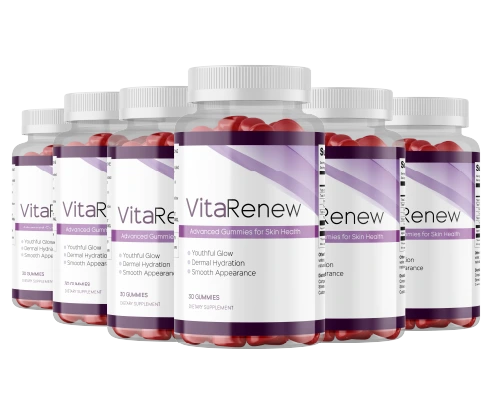
After this research, I tried several options. The one I kept returning to was VitaRenew, a daily collagen-support gummy made specifically for women in their 40s and 50s. It works from the inside, targeting the cofactor side of collagen synthesis — not the raw material side.
- Vitamin C & copper — the two most critical enzymatic cofactors for collagen production and cross-linking
- Zinc & antioxidants (vitamin E, selenium) — for skin integrity and protection from the oxidative stress that degrades existing collagen
- Daily gummy format — genuinely easy to maintain as a habit
It's a supplement, not a treatment or a cure for anything. I noticed a difference in my neck and upper arms at around the six-week mark — the texture felt less papery, more like skin that had some structure under it. I kept going and I'm still using it. I'd suggest giving it a full three months and photographing the same spots in the same light at the start.
What other women have found
"I'd been drinking tons of water and eating well for years. The crepey skin on my arms was still there. VitaRenew was the first thing that seemed to actually work underneath the surface — about eight weeks in, the texture had genuinely improved."
"My esthetician noticed the change before I mentioned anything. She asked if I'd changed something in my routine. I said I'd just started a new supplement. She asked which one so she could recommend it."
These statements reflect individual experiences. Results are not typical and will vary from person to person.
If you're where I was three months ago
If you've been drinking plenty of water and eating well and still dealing with crepey skin that won't improve, you are probably not failing any advice. You are most likely applying a surface solution to a structural problem — the same thing I was doing.
The water experiment taught me something useful: it showed me clearly what water can do, which made the gap visible. It helped the outer barrier. It didn't reach the dermis. Once I understood that distinction, the question changed from "am I drinking enough?" to "does my skin have the enzymatic cofactors it needs to maintain its own structure?" Those are very different questions with very different answers.
If you're looking for what actually supports skin firmness from the inside — at the layer where crepey texture originates — VitaRenew is where I'd start. I keep the 6-bottle supply on my bathroom counter now. For a payout that's the same regardless of which size you buy, the smaller pack is still a sensible first try if you want to see how your skin responds before committing to more.