Health & Wellness · Skin After 40
Will Crepey Skin Go Away? Why Exercise and Moisturizer Are Only Part of the Answer
If you have been moisturizing faithfully and staying active and the papery texture on your arms is still there, you are not doing anything wrong. You are just addressing the wrong layer of skin.

You have probably already tried the obvious things. A richer body lotion. More water. Some yoga or walking to improve circulation. Maybe a collagen powder stirred into your morning coffee. And the fine, papery texture on your forearms and hands is still exactly where it was three months ago.
It can be frustrating, because those are all genuinely healthy habits. None of them are wrong. The problem is that crepey skin originates in a layer of the skin that none of them actually reach.
Understanding that distinction — where crepey texture comes from, and what does and does not address it — is what this article is about.
Why exercise does not help with this particular thing
Exercise is one of the most well-supported health habits that exists. It improves cardiovascular health, supports muscle mass, helps with mood and sleep, and absolutely benefits skin in some indirect ways — particularly through circulation and by supporting hormone regulation.
But crepey skin is not a circulation problem. It is a structural problem in the dermis — the dense tissue layer underneath the outer surface of your skin. Exercise does not deliver building material to the dermis. It does not stimulate the cells there to produce more collagen. It cannot reach the layer where the change is happening.
This is not a knock on exercise. It is just an honest statement that exercise is not the tool for this job, any more than a hammer is the tool for tightening a screw. Different mechanisms, different jobs.
Why moisturizer doesn't go deep enough
Moisturizer works on the outer layer of skin — the epidermis. The epidermis is essentially a barrier: its job is to hold water in and keep the outside world out. When you apply a rich lotion, you are supplementing the barrier, keeping the outer layer hydrated and soft. When it works well, it genuinely can make skin look smoother and more supple.
But the barrier layer sits on top of the dermis. It does not affect what is happening underneath. Crepey texture is the surface appearance of a dermis that has thinned — the collagen and elastin fibres that provide firmness and rebound have decreased over time. The outer layer is still doing its job. It is the structural support underneath that has changed.
This is why a good moisturizer can make crepey skin look noticeably better in the morning and look essentially the same by the afternoon. The surface was addressed — but the source was not.
What is actually happening in that deeper layer
The dermis is a dense mesh of fibres — collagen for thickness and firmness, elastin for rebound — with water-binding molecules filling the space between them. When you were younger, this matrix was dense and well-maintained. As the decades pass, the net rate of new collagen being laid down falls, while the processes that break down old fibres continue. The matrix gradually thins. The surface appearance of that thinning is what you see as crepey texture.
The cells responsible for maintaining the dermis — fibroblasts — are still present. They are still active. The systems that build collagen are still running. What changes is not whether the systems exist, but whether they have what they need to run the process fully.
Collagen synthesis is a multi-step process, and like any multi-step process, it depends on specific inputs at each step. Those inputs are not moisturizer. They are not collagen peptides from a powder, at least not as the primary lever. They are a set of biochemical cofactors that the synthesis enzymes depend on to do their job.
Crepey skin is a dermal problem. Most things people try for it address the outer layer. The outer layer is not the problem.
Referenced in this article
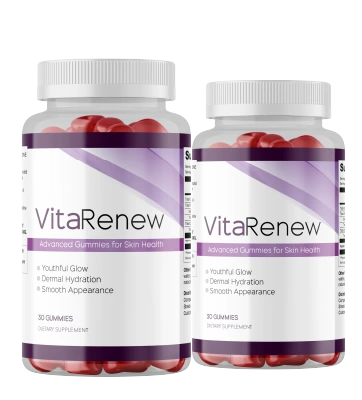
VitaRenew
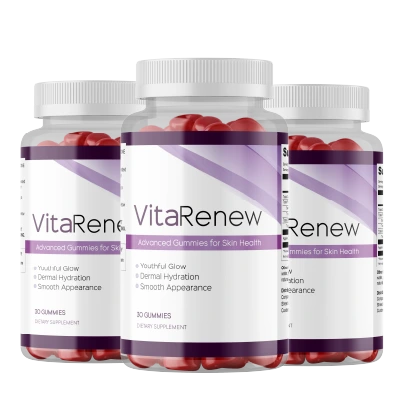
Vitamin C, zinc and copper — the cofactors the collagen synthesis pathway actually depends on — in a single daily gummy. Designed around what the dermis needs, not what markets well.
The piece most skin routines are missing.
60-day money-back guarantee · One-time purchase, no subscriptionWhat the dermis actually needs — and why most formulas miss it
The collagen synthesis pathway depends on specific enzymes at each step, and those enzymes depend on specific nutritional cofactors to function. Three of them matter most for the dermis.
Vitamin C is required by the enzymes that stabilize newly assembled collagen into its functional shape. Without enough vitamin C, the collagen that is made is structurally unstable — it forms, and then it breaks down before it can be incorporated into the dermis. This is not a wellness-industry claim. It is the same well-established biochemistry that explains scurvy.
Copper activates an enzyme called lysyl oxidase, which takes individual collagen and elastin fibres and assembles them into the cross-linked, load-bearing structure that gives the dermis its mechanical properties. Without adequate copper, the raw fibres are made but never assembled into functional structure. Most skin supplements do not include copper, partly because it does not photograph well on a label and partly because the amino acid angle has better marketing. But the cross-linking step is where the architecture of the dermis actually gets built.
Zinc supports fibroblast function and the ongoing maintenance processes the dermis runs continuously throughout our lives.
These are not exotic or expensive ingredients. They are the documented nutritional requirements of the synthesis pathway — the ones that tend to get skipped because collagen powder and hyaluronic acid have more consumer recognition. Supplying the cofactors may support the pathway the body is already trying to run.
What people who focused here have found
"I had spent two years trying different creams and serums and nothing made a dent. I finally understood that I was addressing the surface, not the structure. I started a supplement that had all three of the cofactors — the vitamin C, copper and zinc together — and after about four months the skin on my upper arms and hands looked genuinely different. It is hard to put a number on it but I went from dreading short sleeves to not thinking about it."
"I want to be honest with you: it took longer than I expected, and the change is subtle. But subtle and real is better than dramatic and imaginary, and after five months there is a visible difference in how my skin looks and how it bounces back. I also stopped spending money on every new cream that promised results, which was a bonus."
These are individual experiences. Results vary and are not typical. No supplement can diagnose, treat, cure or prevent any disease or condition.
Setting realistic expectations — and a sensible timeline
The outer layer of skin renews itself roughly every four to six weeks. This is why surface products can show results relatively quickly. If something improves surface hydration or barrier function, you can see it within a month.
The dermis works more slowly. Collagen remodeling is measured in months, not weeks. If you are going to evaluate anything targeting the dermis, three months is the minimum sensible window — and six months gives you a more complete picture. Individual response depends on your existing nutritional status, genetics, sun exposure history, and factors outside any supplement's reach.
The one practical suggestion: take a photograph in consistent light before you start. Gradual change is almost invisible without a reference point. The change, if it happens, will not be dramatic — but documented gradual change is far more useful than vague impressions either way.
Product referenced above
VitaRenew
Vitamin C, zinc and copper in a daily gummy. Made in an FDA-registered, GMP-certified facility. 60-day money-back guarantee.
Supporting the dermis from the inside — the layer moisturizer can't reach.
60-day money-back guarantee · Supports skin, hair and nails