Skin & Aging
Why Your Skin Gets Thinner After 40 (And What's Actually Behind It)
Most explanations focus on what you can see. The real reason goes a layer deeper — and it changes what can actually help.

Last spring, I reached across a table to grab something and brushed my forearm against the edge. A thin plastic edge. Barely anything. But it left a mark that took almost two weeks to disappear.
I hadn't thought of my skin as fragile before that moment. A little drier than it used to be, yes. A little less smooth. But fragile — that was new.
If something similar has happened to you, you already know the feeling. The skin on the back of your hand starting to look like a map of veins and tendons. A sleeve catching and leaving a red streak. A bruise from a contact you barely noticed making. The sense that your skin has less — less cushion, less resistance, less of whatever used to be underneath it.
You're not imagining it. Your skin is getting thinner. And the reason is not what most people think.
It's not a surface problem
When we talk about skin getting thinner, the instinct is to look at the surface — maybe it needs more moisture, maybe it's been too much sun, maybe it's just dryness catching up.
But the change is happening in a layer you can't reach with a cream.
Underneath the outer layer of skin you can touch sits the dermis — a dense, fibrous layer that gives skin its thickness, its bounce, and its ability to absorb small impacts without tearing or bruising. It's filled with a mesh of collagen and elastin fibres. Between those fibres, hyaluronic acid holds water in and keeps the whole structure plump and cushioned.
When skin "gets thinner," the dermis is getting less dense. The collagen fibres decrease in number. The cross-links that hold them together loosen. The cushion compresses. Everything that used to be underneath the surface — the structural layer — is gradually thinning.
Creams work on the epidermis — the top layer. They can hydrate it, smooth it, make it reflect light more evenly. That does something. But it doesn't touch the dermis, which is where the actual change is occurring.
Why it often accelerates in the forties
Collagen production doesn't stop suddenly. It declines gradually — a rough one percent of dermal collagen per year from the mid-twenties onward, so slow you wouldn't notice it happening if it were the only thing going on.
The forties bring a second change on top of the first. Estrogen — which actively supports collagen density and skin thickness — begins to fall during the perimenopausal transition. As it does, the rate of dermal thinning accelerates. Research on skin collagen during menopause has found measurable reductions in skin thickness in the years immediately surrounding it.
So the gradual long-term decline and the steeper hormonal shift happen at the same time. The "overnight" feeling isn't quite right — but two downward curves arriving together does feel sudden, even though neither one was.
What most people miss: the machinery, not the material
Here's the part that changes how you think about solutions.
Your body hasn't forgotten how to make collagen. The cells that produce it — fibroblasts — are still there and still working. Collagen synthesis is a chemical process that requires specific inputs to run properly, and the inputs that most people are missing are not the raw materials. They're the tools.
Three nutrients are particularly important to that process:
- Vitamin C. Every collagen molecule your body produces depends on vitamin C to achieve its stable, functional structure. Two enzymes central to the process — prolyl hydroxylase and lysyl hydroxylase — require vitamin C to work. Without it, the collagen your body makes is structurally weak. This is settled biochemistry, not a supplement claim.
- Copper. Newly made collagen fibres are, at first, loose threads. They need to be cross-linked into a proper network — bonded together into the resilient mesh that gives skin its cushion and recoil. The enzyme that does this, lysyl oxidase, is copper-dependent. Without copper, the fibres form but don't bind. The network stays loose.
- Zinc. Zinc is involved in the ongoing repair and maintenance of the dermis, supporting the normal function of skin cells and several enzymes involved in skin integrity.
Most collagen supplements focus on amino acids — the building blocks. That's reasonable. But if the limiting factor is not the building blocks but the enzymatic machinery — the vitamin C and copper that actually structure and bind the fibres — then adding more amino acids doesn't change the output.
What to look for if you decide to try something
The checklist is short. Whatever formula you consider, it should include: vitamin C in a meaningful amount (not a trace); copper specifically (it's left out of most formulas because it isn't glamorous); zinc alongside it; and antioxidant support like vitamin E and selenium to help protect existing collagen while the body tries to build more. A sixty-day minimum guarantee is the floor — anything less isn't a fair evaluation window for changes in the dermis.
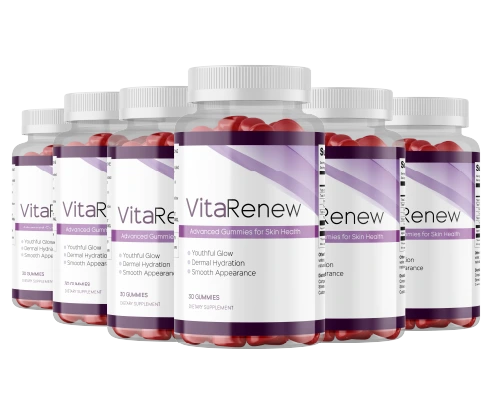
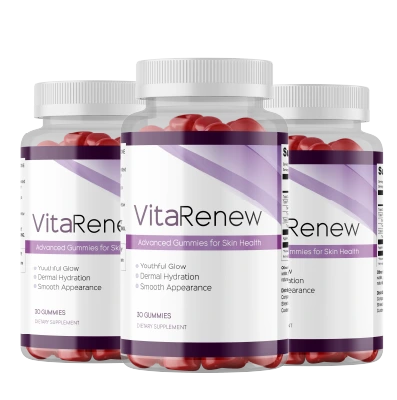
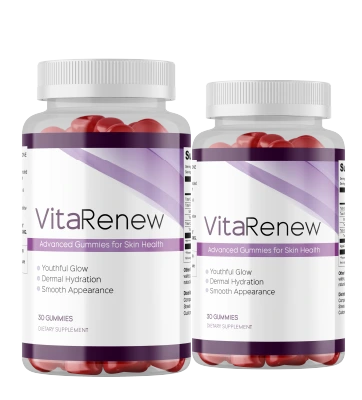
We've been following VitaRenew for a while now. It's a daily gummy that addresses the cofactor gap directly — vitamin C, zinc, and copper in one formula, with vitamin E, selenium, and beta-carotene for antioxidant coverage. Made in an FDA-registered, GMP-certified facility, sold with a sixty-day money-back guarantee. It supports skin, hair, and nails — it is a supplement, not a medical treatment, and won't diagnose or treat anything.
The manufacturer prices the smaller entry option at $79 per bottle — it's the lowest-commitment way to try it. Same sixty-day guarantee as the larger packs, same formula.
Referenced in this article
VitaRenew
Vitamin C, zinc and copper — the cofactors collagen synthesis actually needs — in one daily gummy.
For the skin that deserves to feel like yours again.
60-day money-back guarantee · One-time purchase, no subscriptionWhat people who have tried it say
"My arms were bruising so easily that I started being careful opening packages. About six weeks into VitaRenew, I noticed the bruises weren't showing up the same way. Three months in, I feel like I have my skin back a little. It's not dramatic, but it's real."
"I started taking it because the skin on my forearms looked almost see-through. Four months in, it looks a bit less thin to me — at least in the morning light. My sister noticed too, which surprised me. I'll keep going."
These reflect individual experiences. Results are not typical and will vary.
How long to give it
Surface skin turns over in four to six weeks. The dermis is slower — meaningful changes in the structural layer take at least three months, which is why most research on skin supplements measures outcomes at eight to twelve weeks. Give anything you try that full window, in consistent lighting, before you judge it.
Individual results depend on where you started, your diet, your hormonal status, your sun history, and a long list of factors a supplement doesn't control. The honest answer is that some people notice something, and some people don't notice much — and there's no reliable way to know in advance which group you're in without trying.
One distinction worth making: the gradual, symmetrical thinning this article describes is aging. If skin changes suddenly in a specific spot — changes colour, texture, shape, or thickness in a localized way — that is a dermatologist question, not a supplement question. Supplement or not, sudden localized changes should be looked at by someone qualified to assess them.
The short version
Your skin is getting thinner because the dermis — the structural layer beneath the surface — is losing collagen density. The change is normal. It's driven by a slow decline in collagen production and, around perimenopause, an accelerated loss tied to falling estrogen. Your body still makes collagen; what commonly limits the output is the enzymatic machinery that runs the process — specifically vitamin C and copper, which stabilize and cross-link every fibre produced.
That's not a glamorous answer. It doesn't involve exotic ingredients or breakthrough discoveries. But it points at something specific — something you can check on a label.
Product referenced above
VitaRenew
The cofactors most skin formulas leave out — vitamin C, zinc and copper — in one daily gummy. FDA-registered facility, 60-day guarantee.
For the morning your forearm doesn't surprise you anymore.
60-day money-back guarantee · Supports skin, hair and nails