Why Does Crepey Skin Happen? What No One Told Me Until I Finally Asked
I moisturized faithfully for years. The texture kept worsening. The answer, it turned out, had nothing to do with the surface.

I hadn't meant to run a science experiment at my kitchen table last spring. I was just doing that thing you do — the one you probably learned from your grandmother — where you pinch the skin on the back of your hand and see how fast it snaps back.
When I was younger it came back immediately. This time I watched it hold the shape of a small ridge for a moment, then slowly settle flat. I was forty-seven. I sat there with my hand on the table for probably longer than was reasonable, pinching it again to make sure I hadn't imagined it.
I hadn't. And suddenly I understood in a very immediate way why the back of my hands had that papery texture now, and why the skin above my elbows did the same thing in certain light, and why a photo from a family dinner two weeks earlier showed fine crinkled lines across my décolleté that I had not expected to see.
I'd been moisturizing every day for twenty years. I'd been drinking water, getting sleep, wearing sunscreen. The texture had been creeping in anyway. And I realized I had never once asked why it happens — only what I could put on it.
This isn't a surface problem
The first thing you learn when you start reading about crepey skin is that it's not about the outer layer of your skin at all. It's about what's happening in the layer underneath, the one called the dermis.
The dermis is where the structural work happens. It contains collagen fibres — dense protein cables that give skin its thickness and resistance — and elastin fibres that let skin spring back after it's stretched or folded. These two things together are what give young skin that plump, bouncy quality. They're what your pinch test is actually measuring.
Crepey skin happens when both of those things start to thin and loosen. And the biology of why it accelerates when it does — usually somewhere in the forties — is genuinely interesting once you understand it.
The reason the forties feel sudden
Here is something I didn't know until I started researching this: collagen production actually starts declining in the mid-twenties. By roughly one percent a year, quietly, invisibly, year after year.
For a long time you don't notice it because your dermis has so much to begin with. The losses are so gradual that they don't show up on your face or arms. You're just slowly spending down a reserve you built twenty years ago.
Then, in the forties, something else happens at the same time. Estrogen — which plays a direct role in maintaining collagen density and skin thickness — begins to fall. And when estrogen drops, collagen loss accelerates. Research on skin changes around menopause has found that a substantial portion of skin collagen can be lost in the years immediately surrounding that transition, above and beyond the baseline decline already running.
Two things that were happening slowly suddenly happen faster at the same time. Twenty years of gradual, invisible change becomes visible in two or three years. That's why it feels overnight. It wasn't overnight — it just finally tipped.
The fine crinkled texture specifically — as opposed to deeper wrinkles or general sagging — happens because the dermis has thinned enough that the surface layer above it no longer has solid support. When that surface layer is also a little dry, as it tends to be with lower estrogen, it doesn't lie flat. It crinkles. It looks like crepe paper. Which is exactly what it's been called.
Why moisturizer isn't the whole answer
I want to be fair to moisturizers here, because they're not useless. Apply a good one to a crepey forearm and it will genuinely look better for several hours. The outer barrier plumps with water and reflects light more evenly. It's a real effect.
But the dermis is roughly a millimeter thick, and most of what you apply topically doesn't reach it. By evening, the water has evaporated and you're back where you started. Nothing structural changed, because nothing structural was addressed.
It's not that you were doing anything wrong. You were just working on the wrong layer.
What collagen actually needs to rebuild
Here is where my research got genuinely useful. Your body hasn't forgotten how to make collagen. The cells that produce it — fibroblasts — are still in your dermis. The reason production has slowed is partly hormonal and partly because the biochemical process of making collagen has specific requirements that often go unmet.
Think of it as a factory that still has workers, but some of the tools are missing:
Vitamin C is essential for two enzymes that stabilize the collagen molecule into its functional shape. Without adequate vitamin C, collagen is made in a weaker, unstable form. This is the same mechanism behind the connective-tissue breakdown in scurvy — well-established biochemistry, not marketing copy.
Copper activates the enzyme that cross-links newly made collagen and elastin fibres into a strong network. Without it, fibres get made but don't get properly bonded. They're weaker from the start.
Zinc supports normal skin integrity and the repair processes running continuously in the dermis. It's also an antioxidant co-factor, which matters because oxidative stress breaks down existing fibres while your body tries to build new ones.
Vitamin E and selenium are worth adding to that list for the same antioxidant reason — they help protect what's already there while the slower work of building new structure happens.
I had been taking a collagen powder. It had never done much. Reading this, I finally understood why: I was adding raw material to a factory that was missing its tools. More bricks don't build a wall when the mortar crew isn't there.
What I found when I looked
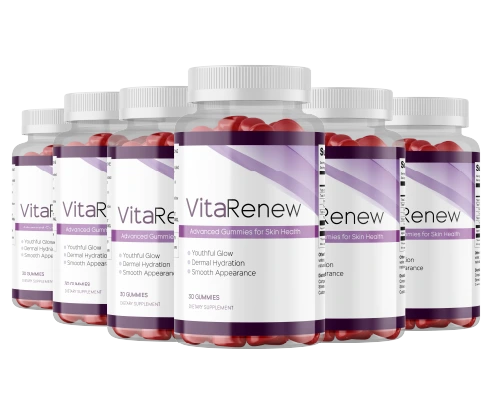
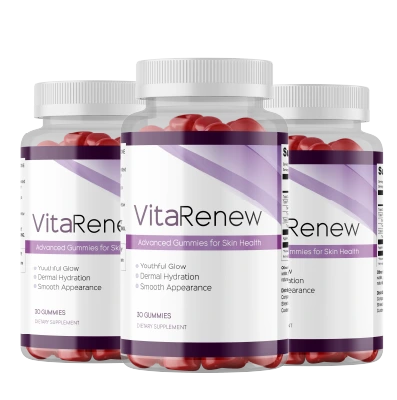
After going through quite a few labels looking for a formula that actually addressed the cofactor side of the equation — not just more collagen peptides — I landed on VitaRenew. It's a daily gummy built around the cofactors specifically: vitamin C, zinc and copper, with vitamin E, selenium and beta-carotene for antioxidant support.
It's made in an FDA-registered, GMP-certified facility, which matters to me. It comes with a sixty-day money-back guarantee, which is enough time to actually see whether something is working. And it's a one-time purchase — no subscription, no recurring charge, no pressure.
It's a supplement, not a miracle. It supports skin, hair and nails — it doesn't diagnose, treat, or cure anything. Any brand that tells you otherwise is one to skip.
What I recommend
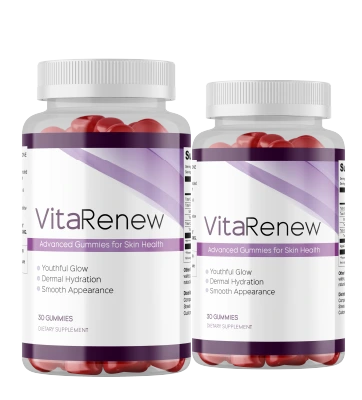
VitaRenew
The cofactors collagen synthesis actually runs on — vitamin C, zinc and copper — in a daily gummy. With vitamin E and selenium for antioxidant support.
For the photograph you take and actually like.
60-day money-back guarantee · One-time purchase, no subscriptionWhat others have noticed
"I'd tried everything for the skin on my arms. Three months into VitaRenew and the texture is noticeably smoother. Not perfect — but the kind of change I can actually see in photos."
"I started because of the crepey texture on my hands. Six weeks in I noticed my nails were stronger too, which I wasn't expecting. The skin on the back of my hands has definitely improved."
These statements reflect individual experiences. Results are not typical and vary based on genetics, lifestyle, sun history, and other factors.
How long to give it
The surface layer of your skin turns over every four to six weeks, so texture and tone changes tend to appear first. The deeper structural changes — more collagen being made and properly cross-linked — happen more slowly, over months rather than weeks.
Be realistic with yourself: take a photo on day one, give it sixty days before you judge, and look for gradual improvement rather than overnight transformation. Two months is enough time to know if something is working in the right direction.
And two months happens to be the smallest supply you can try — a reasonable way to start before committing to more.
Referenced above
VitaRenew
Vitamin C, zinc, copper, vitamin E and selenium in a daily gummy. Made in an FDA-registered, GMP-certified facility. Ships from the US.
For the version of you that feels like you again.
Start with a 60-day supply · No subscription