Nutrition · Personal Essay
What Vitamin Deficiency Causes Crepey Skin? More Than You’re Probably Taking.
I spent the better part of eighteen months cycling through vitamins trying to answer this question. Here's what I learned — and why the framing of the question itself was sending me to the wrong shelf.

The first time I noticed it was at the gym, under those particular fluorescent lights that are brutally honest. I lifted my arms to adjust my ponytail, glanced in the mirror, and saw the skin on my upper arms hanging in a way it hadn't the previous summer. Not wrinkled, exactly. More like — paper-thin and slightly loose. Like the packaging on something that had been opened and re-closed too many times.
I'm not a dermatologist. But I do write about nutrition, so my first instinct was to ask the question that would occur to most people who spend their days thinking about what the body needs: what vitamin deficiency causes this?
I assumed there would be a clean answer. Vitamin C, maybe. Or D. Something I could buy at the pharmacy and add to my morning routine.
There is an answer. It's just not the one I was expecting — and the reason it took me a while to find it was that the question itself was pointing me in a slightly wrong direction.
The question that led me wrong for a while
"What vitamin deficiency causes crepey skin" implies that somewhere, a single deficiency is the culprit. Fix that deficiency, fix the skin.
It's a reasonable model, and it works beautifully for some conditions. Vitamin C deficiency causes scurvy — gums bleed, skin bruises, connective tissue falls apart. Iron deficiency causes fatigue, brittle nails, pale skin. The deficiency-and-fix logic is elegant and real.
But crepey skin — the thin, papery, loose texture that tends to arrive on arms and chest and neck somewhere in the forties — isn't primarily a deficiency state. It's a structural change. The dermis, the layer of skin below the one you can touch, is built from a scaffolding of collagen and elastin fibres. That scaffolding thins as we age, and thins faster as estrogen drops during perimenopause.
Moisturizer helps temporarily — it plumps the surface layer — but it can't reach the scaffold. Neither can most of what I was buying.
The insight I kept missing: your body hasn’t forgotten how to build collagen. It’s an assembly line that still runs. The question isn’t which vitamin to replace — it’s whether the assembly line has all its tools.
Vitamin C — and why it still matters, just not the way I thought
I'd been taking a vitamin C supplement for two years before I understood what it was actually doing for my skin — which is to say, I hadn't understood it at all.
Here's the biochemistry in plain language. Collagen molecules only work because of their shape: three protein strands wound into a tight triple helix. That winding is performed by two enzymes — prolyl hydroxylase and lysyl hydroxylase — and both of them depend on vitamin C to function. Not as raw material; as an enzymatic cofactor. The switch that turns the machine on.
Without adequate vitamin C, the body still produces collagen. It produces a structurally weak version that doesn't hold its shape. This is why scurvy — severe vitamin C deficiency — causes connective tissue to fall apart from the inside. You don't need scurvy for this to matter; the enzymes work along a gradient.
So vitamin C isn't irrelevant. It's just that taking it alone is like having the machine operator show up without the rest of the crew.
Copper — the one I'd never heard of, and probably the most important gap
This is where my understanding of skin nutrition changed most significantly.
Even after vitamin C does its job and collagen fibres get synthesized with the right shape, those fibres start out as loose, unconnected threads. By themselves they're not much. What turns them into a resilient, springy network is cross-linking: chemical bonds that tie fibre to fibre, the difference between a heap of rope and a woven net.
Cross-linking is performed by an enzyme called lysyl oxidase. Lysyl oxidase requires copper to work.
No copper, no cross-linking. The fibres get made and never get bound. The machine builds the bricks but has no mortar.
I went back and looked at every skin supplement I'd taken in the previous eighteen months. Vitamin C was in all of them — it sells, it's familiar, it's on the front of the box. Copper was in exactly none of them. Not a trace. Which means the cross-linking step, the one that actually creates structural integrity in the dermis, wasn't being supported at all.
I wasn't taking the wrong thing. I was taking one part of a two-part process, and the missing part was the one that holds everything together.
And zinc, for the everyday work
Zinc supports normal skin integrity and the continuous repair that the dermis carries out on its own. It's not the headline in this story, but it belongs on any sensible list — because repair is ongoing, not one-time.
What I started looking for on labels
Once I understood the mechanism — vitamin C stabilizes the helix, copper enables cross-linking, zinc maintains the ongoing repair — the label criteria became pretty clear.
What I now check before buying anything for my skin
- Vitamin C at a real dose — not a token amount added so they can put it on the box.
- Copper — if it isn't on the label, cross-linking support is absent. This is the most common and most consequential omission I've found.
- Zinc — for the repair side of the equation.
- Antioxidant support — vitamin E, selenium, or both — because oxidative stress degrades the collagen you're trying to build.
- A named manufacturing standard — FDA-registered facility, GMP-certified. Not vague language about "quality."
- Honest timeline in the marketing — anything promising visible results in seven days is not worth trusting. The dermis takes months. Any company that says otherwise is optimizing for your credit card, not your skin.
What I found: VitaRenew
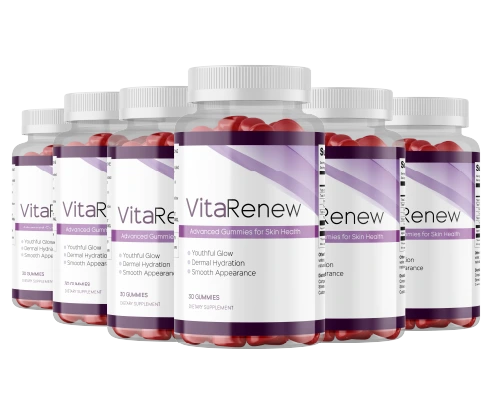
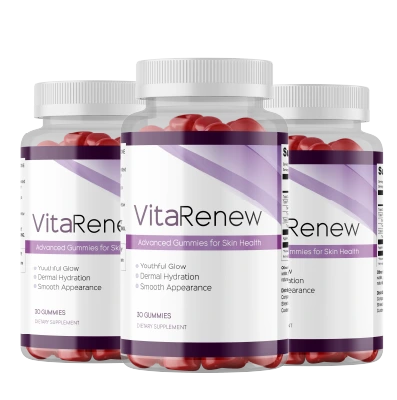
After doing this research and working through it in writing, VitaRenew was the formula that matched the list most cleanly. It's built around the cofactor side — vitamin C, zinc, and copper, with vitamin E, selenium, and beta-carotene for antioxidant support. One-time purchase, no subscription, sixty-day money-back guarantee. Made in an FDA-registered, GMP-certified facility.
It's a supplement that supports skin, hair, and nails. It is not a treatment for any condition, and any company that claims otherwise deserves your skepticism.
Referenced in this article
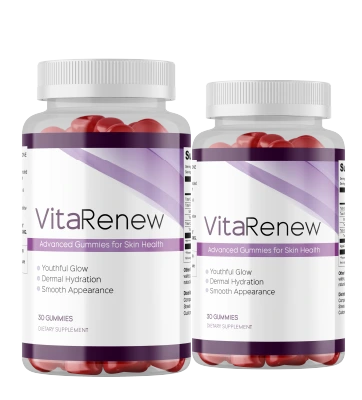
VitaRenew
Vitamin C, zinc and copper together — the three the collagen assembly line actually needs to do its job.
For the eighteen months I wasted cycling through supplements missing the one ingredient that mattered.
60-day money-back guarantee · One-time purchase, no subscriptionWhat others have reported
Individual results vary considerably — genetics, sun exposure, sleep, and what your diet already provides all make a difference. These are personal accounts, not clinical measurements.
"I'd tried four or five different collagen products with minimal results. When I read about the copper piece I felt genuinely annoyed at myself for missing it. Started VitaRenew in March. By May the skin on my upper arms and chest was noticeably smoother. Not a dramatic transformation — but real, and consistent."
"I appreciated that the formula didn't try to oversell itself. No 'revolutionary' claims, no before-and-after photos that looked digitally altered. Just a clear explanation of what it supports. Three months in, I stopped avoiding short sleeves. That's the honest version."
These statements reflect individual experiences. Results are not typical and may vary based on age, diet, lifestyle, and other factors.
The timeline question — and why getting it right matters
I'm going to say something here that I wish I had read at the beginning of my own search, because I burned through a lot of time making the wrong judgment calls.
The outer layer of skin — the stratum corneum — turns over roughly every four to six weeks. So surface texture and hydration can begin shifting fairly early. The dermis, where collagen remodelling happens, is structural tissue. It works on a months-long timeline. Most controlled studies of skin-directed supplements measure outcomes at eight to twelve weeks, and that's a reasonable floor for any honest evaluation.
Take a photo on day one. Same lighting, same position, no filter. Give it a full three months before you decide anything. Individual results vary with genetics, sun history, and dietary baseline. Expect gradual, not sudden.
One thing worth saying plainly. If a patch of skin changes suddenly, thickens in an unusual way, or a spot changes shape or colour — that's not a supplement question. That's a dermatologist's question. Crepey skin from aging is gradual and affects both sides of the body evenly. Anything that isn't should be looked at by someone with a medical licence. And if you're pregnant, nursing, on medication, or managing a health condition, run any new supplement past your healthcare provider first.
The short version of what I learned
Asking "what vitamin deficiency causes crepey skin" is reasonable. The more precise version of the question, though, is: does my collagen assembly line have all the tools it needs to run?
Vitamin C: yes — stabilizes the triple helix. Copper: probably not, because almost nothing on the supplement shelf puts it there. Zinc: the ongoing maintenance work. And antioxidant support to protect what's being built from what oxidative stress does to it.
That's the answer I wish I'd had in the beginning. It would have saved me a lot of bottles of things that were missing the most important ingredient.
Product referenced above
VitaRenew
Vitamin C, zinc and copper in a daily gummy. Made in an FDA-registered, GMP-certified facility.
The part that was missing from everything else I tried.
60-day money-back guarantee · Supports skin, hair and nailsBackground reading
- Pullar JM, Carr AC, Vissers MCM. "The Roles of Vitamin C in Skin Health." Nutrients, 2017.
- Rucker RB et al. "Copper, lysyl oxidase, and extracellular matrix protein cross-linking." American Journal of Clinical Nutrition, 1998.
- Ogawa Y et al. "Zinc and skin disorders." Nutrients, 2018.
- Thornton MJ. "Estrogens and aging skin." Dermato-Endocrinology, 2013.
- Choi FD et al. "Oral Collagen Supplementation: A Systematic Review of Dermatological Applications." Journal of Drugs in Dermatology, 2019.