I Treated My Crepey Skin Wrong for Three Years. Here's What Actually Causes It.
I tried every cream, every collagen powder, every tip I could find. None of it lasted. Then I finally understood what was happening — and why I'd been solving the wrong problem all along.

I was forty-four when I first noticed it.
Not wrinkles — I'd made a kind of peace with the idea of wrinkles years ago. This was something different. I was reaching for something on a high shelf and caught my reflection in the window opposite. The skin along the back of my arm, from elbow to wrist, had a texture I didn't recognize. Fine, papery, loose. Like tissue paper that had been crumpled and then smoothed back out, but not quite all the way.
I know what it's called. Crepey. I just didn't expect to see it on myself, not yet, not so clearly.
I spent the next three years trying to fix it — earnestly, consistently, with real money and genuine effort. And for three years, nothing I tried actually worked. It would improve for a few hours, look normal in good lighting, and then there it would be again the next morning.
What I eventually figured out — and I'm going to try to tell this as plainly as I can — is that I had been treating a surface problem when the problem wasn't on the surface at all.
The moisturizer years
The first thing I tried was the obvious thing: richer moisturizer. Heavier lotions. Oils. A dermatologist once told me that crepey skin is just skin that's lost moisture, and the solution is to put moisture back. This sounds reasonable. And it works, sort of, briefly.
Apply a heavy cream to crepey skin and it genuinely looks different for a few hours. The surface plumps slightly, the light catches it more evenly. You feel like you've done something. By evening it's back to how it was. By morning it's exactly the same.
After about eighteen months of this, I started wondering if I was solving the wrong problem.
I was putting moisture into a surface layer. But the change was happening in a completely different layer, one that moisturizer can't physically reach.
Here's the biology I eventually learned: your skin isn't one thing. The outer barrier — the part you can touch and treat with products — is a thin layer of already-dead cells and lipids whose main job is to hold water in and keep the world out. It responds to moisturizer. It looks better when it's hydrated.
Below it is the dermis, and that's where the actual architecture lives: a dense mesh of collagen fibres giving skin its thickness and resistance, elastin fibres letting it snap back, hyaluronic acid holding water between them. Crepey skin is what happens when that mesh starts to thin and loosen — when there are fewer fibres, and the fibres that remain are less tightly bound. When you press the skin and it settles instead of snapping back.
No cream reaches there. By definition. The dermis is not accessible to surface products. I had spent a year and a half treating something in the wrong place.
The collagen powder phase
The next thing I tried was collagen peptides. By this point I was genuinely curious and reading more carefully, and the logic here made more sense to me: if the dermis is losing collagen, give your body the building blocks to make more. It sounds like you're addressing the actual problem, not just the surface appearance.
I tried two different brands, both well-reviewed, both expensive. I was consistent for six months each. I didn't see a meaningful difference.
It took me longer to understand why, and when I finally did, it clicked in a way I hadn't expected.
Your body hasn't forgotten how to make collagen. The genes are still there. The fibroblast cells in your dermis that produce it are still alive and functional. Collagen synthesis is a biochemical process — an assembly line — and like any assembly line, it needs more than just raw material. It needs the equipment to run.
One piece of that equipment is vitamin C. Not optional, not "nice to have" — a hard biological requirement. Two specific enzymes that shape newly-made collagen into its stable, usable triple-helix structure are completely dependent on vitamin C to function. Without enough of it, collagen is produced in a weak, malformed version. (This is not a wellness claim — it's the mechanism that explains scurvy. Same proteins, same dependence.)
Another is copper. Once collagen and elastin fibres are made, an enzyme called lysyl oxidase weaves them into the cross-linked mesh that gives skin its actual resistance and recoil. This enzyme requires copper to work. Without copper, the fibres get made but never properly bound — like threads that were spun but never woven.
I realized I'd been delivering raw material to an assembly line that didn't have its tools. No wonder nothing changed at the output end.
The bottleneck wasn't collagen. It was the enzymatic machinery the whole process depends on — vitamin C for stabilization, copper for cross-linking, zinc for ongoing skin repair and integrity. I wasn't short of raw material. I was short of equipment.
Why the forties in particular
Once I understood the mechanism, the timing made more sense too.
Collagen production has been declining gradually since our mid-twenties. One percent a year or so — slow enough that nobody notices. Then, in the perimenopausal years, estrogen drops. Estrogen actively supports collagen density and skin thickness, and when it falls, the loss accelerates. Research on skin changes around menopause has documented that a meaningful share of dermal collagen can be lost in the years immediately surrounding this transition.
Two slopes meet in the same window of time. That's the "it happened overnight" feeling. It didn't happen overnight. Two things simply became visible at the same time.
What it meant for me: if my body was already running a slower collagen synthesis process, and if the enzymatic toolkit for that process was less than fully supported, I wasn't going to feel the difference by pouring collagen peptides in from the top. The rate-limiting step was deeper in the chain.
What I eventually tried
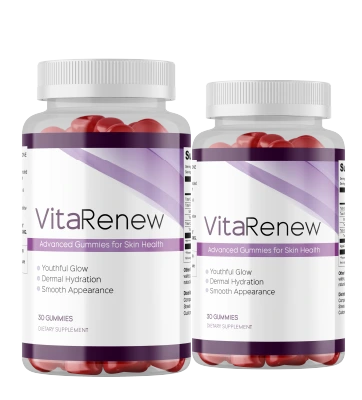
VitaRenew
A daily gummy built around the cofactor side of the equation — vitamin C, zinc and copper — with antioxidant support. Made in an FDA-registered, GMP-certified facility.
For the afternoon you're done wondering why the expensive stuff isn't working.
60-day money-back guarantee · One-time purchase, no subscriptionWhat I finally did differently
Once I understood what was actually limiting the process, I started looking for something that addressed the cofactor side — the enzymatic toolkit — rather than the raw material side.
That's a narrower filter than it sounds. Most skin supplements lead with collagen peptides. Most skin-care brands treat copper as an obscure ingredient. Vitamin C appears in nearly everything, but usually at trace amounts that do more for the label than for any biological process.
What I wanted: vitamin C in a meaningful amount. Copper, specifically and prominently. Zinc. Antioxidant support to reduce the oxidative load on the collagen that's already there, while whatever I was taking tried to support the repair process. A manufacturer willing to be transparent about their standards — FDA-registered facility, GMP-certified. A guarantee long enough to actually evaluate something that works at the speed of dermal remodelling, which is months, not days.
I found VitaRenew while researching that specific combination. It's a gummy — not a powder, not a capsule — built around the cofactors rather than the raw material. Vitamin C, zinc, copper, vitamin E, selenium, beta-carotene. Sixty-day guarantee. Made to a named standard. No claims it can't make.
I want to be honest about what I can and can't say here. I am not a doctor. This is not a treatment for any condition. What I noticed, around the ten-week mark, was that the skin on my forearms seemed to have slightly more resilience — not dramatically different, but measurably different in the way it behaved when I pressed and released. Firmer, maybe. Less papery. I took photographs and I can see a difference, though I'm aware I was looking for one and that individual results vary enormously.
What I can say more definitively is that I finally understood why what I was doing before wasn't working — and for me, that understanding was worth more than the result.
What other readers have found
"The thing that convinced me was actually the ingredient list, not the marketing. Vitamin C and copper together — I'd read about both of them separately and never found them in the same formula in useful amounts. About two and a half months in I noticed the skin on my chest and upper arms was holding its shape a bit differently. My husband noticed without being told what to look for."
"I'd tried two other collagen supplements before and felt nothing. This one actually makes sense to me mechanistically — I'm a retired nurse and the role of copper in connective tissue repair is well-established. I can't say it reversed anything, but my skin does feel like it has a bit more integrity than it did four months ago."
These statements reflect individual experiences. Results are not typical and may vary significantly based on age, genetics, diet, lifestyle and other factors.
A few honest caveats
Dermal collagen remodelling is slow. The outer layer of skin turns over in four to six weeks — that's as fast as surface changes can happen. The deeper structural work takes months. Any product promising visible change in a week is telling you something important about how much to trust it.
Give whatever you try a realistic timeline — at least three months, with consistent before photos in the same light. Individual variation is enormous: genetics, sun history, diet, sleep, stress all influence how quickly or slowly the process responds.
And if a patch of skin changes suddenly, thickens, changes colour, or a spot looks different than it did before — that is a question for a dermatologist, not a supplement. Crepey skin from ageing is gradual and symmetrical. Anything that doesn't match that pattern deserves a trained eye.
Referenced in this article
VitaRenew
Vitamin C, zinc and copper in a daily gummy. For the cofactor side of the collagen equation. Sixty-day money-back guarantee.
For the morning you stop treating the symptom and start asking what's causing it.
60-day money-back guarantee · Supports skin, hair and nails