Skin & Aging · Personal Essay
What Makes Skin Lose Its Elasticity After 40 — And Why the Answer Surprised Me
I blamed dehydration. I blamed bad lighting. I blamed not drinking enough water. The real answer turned out to be something entirely different — and it had nothing to do with the surface of my skin.

I was forty-three the first time I did the pinch test on purpose. I'd seen it referenced somewhere — press two fingers gently into your cheek, hold, let go. Watch how the skin returns.
Mine didn't spring back the way I remembered. It settled. Not dramatically — not in a way anyone else in the room would have clocked — but differently than it used to. The kind of different you notice when you're alone in a bathroom with good light.
I had been attributing this to dehydration for years. I needed to drink more water. I needed a better moisturizer. I needed to sleep more. Each of these things is probably true and none of them, it turns out, had much to do with what I was actually seeing.
What I eventually found, after a frustrating few months of reading things written for either medical professionals or people with no background in the subject at all, was that skin elasticity after forty is not really a skin-surface problem. It is a structural problem. And structure operates in a layer that water and cream cannot reach.
The piece I was missing
The skin you can touch — the layer you apply moisturizer to — is essentially a barrier. Its job is to keep water in and the outside world out. It is thinner than you'd imagine, and it is constantly renewing itself. It is also not where the properties we associate with "youthful skin" actually live.
Those properties — firmness, snap, that quality of feeling like there's something substantial underneath — come from the dermis. The dermis is the layer below, and it contains two structural proteins that determine almost everything about how skin behaves.
The first is collagen, which provides bulk and resistance. The second is elastin, which provides recoil — the actual snap-back. When I read that the elastin in adult skin is mostly the same elastin that was laid down in childhood and adolescence, and that the body barely produces new elastin after early adulthood, something shifted for me.
What changes after forty isn't primarily that your body "forgets" how to make structural proteins. The cells that make them are still there and still receiving signals. What changes is whether those cells have what they need to complete the job.
The thing nobody explained on any label I'd ever read
Here is the part that surprised me most, and the part I now think is the most useful to know.
Collagen and elastin are not produced in a simple, one-step process. They require enzymes — molecular machines — to complete the process of making them stable and functional. And those enzymes, it turns out, are entirely dependent on specific nutrients to work.
Two examples that I found stuck with me:
- Vitamin C. The enzymes that give a collagen molecule its stable, three-stranded shape — prolyl hydroxylase and lysyl hydroxylase — are strictly dependent on vitamin C. Without adequate vitamin C in the tissue, the collagen that gets produced is weak and unstable. This is why scurvy was so destructive to connective tissue: without vitamin C, you can't properly build collagen even if the instructions and raw materials are all there. I had always thought of vitamin C as an antioxidant you take when you feel a cold coming on. That is a narrow picture.
- Copper. New collagen and elastin fibres are, at first, loose individual threads. An enzyme called lysyl oxidase cross-links them into the dense, springy network that gives skin its mechanical properties — the spring and resistance you're actually sensing when you do the pinch test. Lysyl oxidase cannot function without copper. Without copper, the fibres are produced but never knitted together properly. I had never once seen copper listed on a skin-focused supplement.
Zinc is part of the same picture: it plays a role in normal skin integrity and in the ongoing repair processes that run in the dermis to address everyday micro-damage.
The analogy I kept coming back to: imagine a factory where the workers are present, the blueprints are intact, and there's plenty of raw material. But some of the tools are missing. Production doesn't stop entirely — but what gets made is incomplete, and it doesn't hold together the way it should.
Why this explained what I'd already tried
I had tried two different collagen powders over the years. One for about four months, one for six. I can honestly say I noticed very little from either of them. After reading about the enzymatic cofactors, I had a new way of thinking about why: the bottleneck was probably not the amino acid supply (collagen powders are essentially amino acids). The bottleneck was the machinery that was supposed to use them. I was adding material to a factory where the tools were still missing.
This is not a reason to feel bad about having tried those things. It's a reason to think about what was missing alongside them.
What I found
I started looking for a supplement that addressed the cofactor side rather than just the raw-material side. What I wanted was something with vitamin C in a real amount (not a trace on a label), zinc and copper together, and some antioxidant support — since oxidative damage degrades existing fibres in the dermis even as you're trying to support new ones.
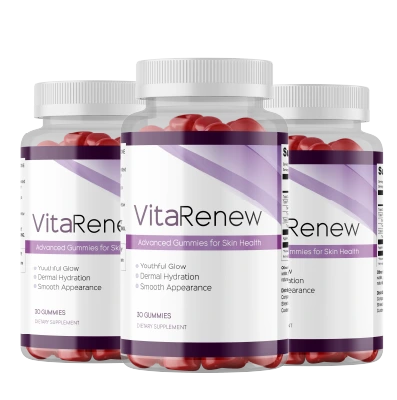
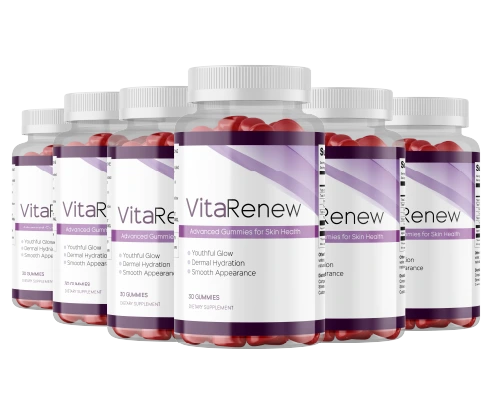
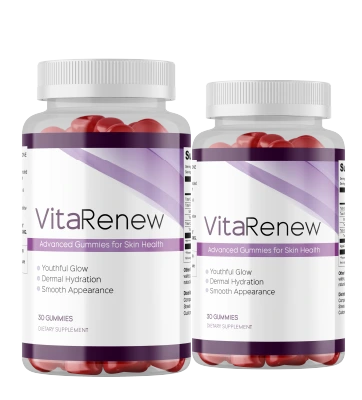
After going through a handful of options, I settled on VitaRenew — a daily gummy that's built specifically around vitamin C, zinc, and copper, with vitamin E, selenium, and beta-carotene for antioxidant coverage. It's made in an FDA-registered, GMP-certified facility and comes with a sixty-day money-back guarantee.
It is a supplement, not a treatment for any condition. It supports skin, hair, and nails. Any company telling you it will fix or reverse aging is telling you something about their marketing, not their product.
I started with the two-bottle supply — sixty days felt like the minimum honest test. The guarantee meant there was nothing to lose.
What I ended up using
VitaRenew
Vitamin C, zinc, and copper — the cofactors your skin’s repair process actually runs on — in a daily gummy.
Sixty days is the minimum honest test. The guarantee covers you either way.
60-day money-back guarantee · One-time purchase, no subscriptionWhat I actually noticed
I am going to be careful here, because I think overselling the experience is exactly what makes people distrust this category.
At around week five, I started to feel like my skin had a little more resilience when I pressed it. Not dramatically. Not in a way I could have pointed to in a photograph and convinced anyone. More like: the lag in the pinch test felt slightly shorter. My neck and chest felt less papery in the morning.
By the end of the two months, my husband mentioned, unprompted, that I looked well. He doesn't notice these things.
I have no way of separating the supplement from any other variable. I was also sleeping slightly better in that period. But I reordered.
What other women have said
"I'd been using collagen powder for almost a year with not much to show for it. Reading about the cofactor piece made me try a different angle. A couple of months in I noticed my skin felt different when I touched it — more there, somehow. My forearms especially. I'm on my fourth bottle."
"The sixty-day guarantee was the reason I tried it. I was committed to being skeptical. By week eight my daughter said I looked like I'd been on holiday. I hadn't. I've been recommending it to everyone in my book club who asks what I've been doing differently."
These statements reflect individual experiences. Results vary and are not typical. Individual factors including age, sun history, baseline nutrition, and consistency of use will influence outcomes.
The practical summary
What makes skin lose its elasticity after forty is not one thing failing. It's a combination: collagen volume declining (and accelerating around menopause), existing elastin degrading from decades of oxidative stress and sun exposure, and the enzymatic machinery that builds and cross-links both running short on the cofactors it depends on — particularly vitamin C and copper.
Addressing only the raw material (collagen powders) without the tools (the cofactors) is like restocking the lumber without fixing the nailgun. And applying things to the surface — which is what moisturizers do — doesn't touch the structural layer where any of this is happening.
That's the answer I was looking for when I typed the question. I hope it's useful.
Referenced above
VitaRenew
Vitamin C, zinc, and copper in a daily gummy. FDA-registered, GMP-certified facility.
Start with two bottles. See how your skin responds in sixty days.
60-day money-back guarantee · Supports skin, hair, and nails