Skin Health · Personal Essay
What Is Crepey Skin a Sign Of? The Dermal Signal Women Over 40 Often Miss
The question isn't about vanity — it's actually useful. That thin, papery texture is pointing to something happening one layer beneath the surface, and once you know what it is, what you do about it changes completely.

I was standing in my bathroom a few years ago, arm raised, looking at the skin above my elbow in unforgiving fluorescent light. The texture had changed. It wasn't a bruise. It wasn't dry patches. It was something subtler and harder to name — fine crinkles, a looseness, a quality like tissue paper that had been gently crumpled. I typed my question into a search bar that evening: what is crepey skin a sign of?
What I found, mostly, were articles about moisturizer.
It took a while longer to find the more useful answer — the one that explained why the texture was there in the first place, why it wasn't going away with better lotions, and what it was actually indicating. I want to save you the time.
It's a sign — not a failure
The word "sign" is the right word here. Crepey skin is your skin telling you something about what's happening in the layer you can't see or touch — the dermis, the deeper structural layer where collagen fibres give skin its thickness and firmness, and where elastin fibres let it snap back after being moved.
When that inner mesh thins and loses cross-linking, the outer layer has less scaffolding to rest on. It folds. It crinkles. In direct light, especially sunlight or fluorescents, it looks papery and loose in a way it didn't before.
What it is not a sign of: that you drank too little water, that you neglected sunscreen, that you used the wrong moisturizer for twenty years. Women who did everything right get crepey skin too. The causes are deeper and more fundamental than that.
Crepey texture is a message from the dermis. The useful question isn't how do I cover this up — it's what is my dermis telling me, and what does that mean for how I support it?
The two things actually driving it
Collagen and elastin production slow gradually from your mid-twenties onward. Most people don't notice because the slope is shallow — roughly one percent of collagen per year by some estimates. You can lose a meaningful amount before the surface shows it.
Then, somewhere in the forties, a second factor arrives: estrogen. Estrogen actively supports collagen density in the skin. As estrogen levels fall during perimenopause, the rate of dermal collagen loss steepens. Some studies on skin changes around menopause have found that a substantial share of skin collagen can be lost in the years immediately surrounding it.
So the "overnight" quality that many women describe — the sense that skin changed suddenly — isn't quite accurate. What happened is that two separate curves met. A slow, gradual slope collided with a steeper hormonal drop. That intersection feels abrupt because you were tracking the gradual part without noticing the steep part was coming.
Sun exposure and smoking can accelerate both processes. But they are accelerants, not the root cause. The fundamental driver is biological, and it happens to virtually everyone.
Why topicals have a ceiling
Here is where the moisturizer problem becomes clearer. The outer layer of skin — the stratum corneum — is roughly as thick as a layer of plastic wrap. Moisturizers work on this layer. They hold water in, they smooth the surface, they make skin look genuinely better for several hours. That's not nothing.
But crepey texture originates in the dermis, which sits beneath that barrier. The structural change — fewer collagen fibres, less cross-linking — is happening in a place that topical products cannot consistently reach in sufficient concentrations to change the architecture. The ceiling is real. Creams aren't failing you; they're reaching the layer they can reach, and the problem is one layer deeper.
What your body still knows how to do
This is the part of the story that most skin articles skip, and it's the most actionable piece.
Your body has not lost the ability to make collagen. The genes are intact. The fibroblast cells responsible for producing it are still in the dermis. Collagen synthesis is a biochemical assembly process — and like any assembly process, it needs the right components to run properly.
Two of those components are worth knowing by name:
- Vitamin C is a required cofactor for the enzymes that stabilize a collagen molecule into its functional shape. Without adequate vitamin C, collagen is produced in a weakened, structurally compromised form. This isn't a supplement claim — it's why scurvy destroys connective tissue. The biochemistry is well-established.
- Copper activates the enzyme that cross-links freshly made collagen and elastin fibres into the dense, springy network that gives skin its firmness. Without copper, fibres are produced but never properly woven together into structure.
Zinc is part of the same picture: it's involved in maintaining normal skin integrity and in the continuous repair processes the dermis runs throughout life.
The analogy I find useful: you have plenty of bricks, but the crew is short on the tools to lay them and the mortar to bind them. Adding more bricks doesn't fix that.
Referenced in this article
VitaRenew
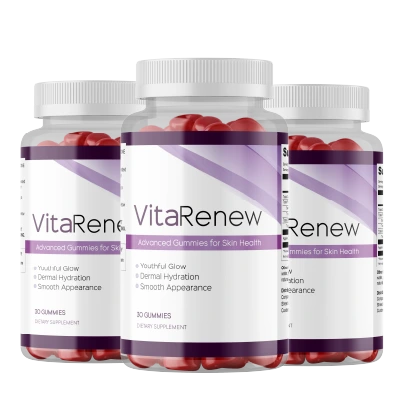
Vitamin C, zinc and copper — the cofactors collagen synthesis runs on — in a single daily gummy. Made in an FDA-registered, GMP-certified facility.
For when you want to support the layer the mirror is reading.
60-day money-back guarantee · One-time purchase, no subscriptionReading the label on whatever you try
If you decide to try a supplement aimed at skin support, here is what the label should show:
- Vitamin C in a real amount — not a trace for the ingredient panel.
- Both zinc and copper. They work on different steps of the same process. Most skin formulas include zinc. Copper is frequently omitted. Its absence is a meaningful gap.
- Antioxidant support (vitamin E, selenium, or both) to protect existing fibres while new ones are being built.
- A guarantee long enough to actually give it a fair trial. The outer skin layer turns over every four to six weeks; the dermis changes on a timescale of months. Sixty days is the floor for a serious evaluation.
- No promises that match drug claims. "Supports healthy skin" is honest. "Reverses aging" or "cures sagging" is a regulatory violation and a sign to keep walking.
One note worth adding: collagen powders are not the same as cofactor supplements. Collagen powder supplies raw amino acids; cofactor supplements supply the enzymatic machinery. If the rate-limiting step in your skin's repair process is the machinery (which, in a normally-fed adult, is often more likely), adding more raw material won't change the output. Both approaches have their logic. They're addressing different parts of the same process.
What people notice
"I had tried collagen protein shakes for eight months and honestly didn't notice much. A friend mentioned the cofactor angle and I looked into it. About ten weeks after switching I noticed the texture on my upper arms was different — not dramatic, but real. I've now finished four bottles and I'll keep going."
"I was skeptical of anything in a gummy format. But the ingredient list is clean and the 60-day guarantee made trying it feel low-risk. The change in my chest and décolletage area has been gradual and real. I photographed it at the start — that was the right call."
Individual accounts. Results are not typical and vary based on many factors. No supplement diagnoses, treats, cures, or prevents any disease or condition.
Product referenced above
VitaRenew
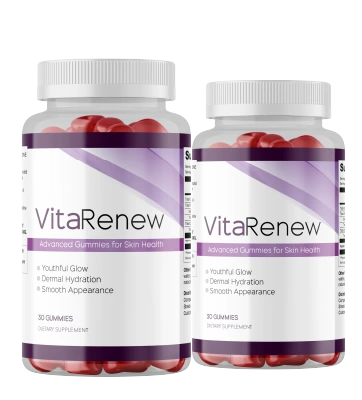
The cofactor approach to skin support — vitamin C, zinc and copper in one daily gummy. 60-day money-back guarantee on every option.
Give it the full three months before you judge it.
60-day money-back guarantee · Supports skin, hair and nailsBackground reading
- Pullar JM, Carr AC, Vissers MCM. "The Roles of Vitamin C in Skin Health." Nutrients, 2017.
- Thornton MJ. "Estrogens and aging skin." Dermato-Endocrinology, 2013.
- Rucker RB et al. "Copper, lysyl oxidase, and extracellular matrix protein cross-linking." American Journal of Clinical Nutrition, 1998.
- Proksch E et al. "Oral supplementation of specific collagen peptides has beneficial effects on human skin physiology." Skin Pharmacology and Physiology, 2014.
- Ogawa Y et al. "Zinc and skin disorders." Nutrients, 2018.