What Causes Suddenly Dry, Crepey Skin After 40 — And Why Your Moisturizer Isn't Solving It


I was 46 when I first typed "why is my skin so dry and crepey all of a sudden" into a search bar. It was early morning. I had been standing in my bathroom staring at the skin on my forearm, which had somehow started to look like the inside of a paper bag — thin, folded, slightly papery. I didn't recognize it. I hadn't seen it a year ago.
What I found over the next few weeks changed how I think about my skin entirely. Not because of a product — but because the explanation I'd been missing made everything else make sense. Including why four different moisturizers had done nothing lasting.
So: what actually causes suddenly dry, crepey skin? And more importantly — why are these two things, the dryness and the crepe texture, so often happening at the same time?
It didn't happen suddenly. But here's why it looked like it did.
The first thing my research turned up was that this change is almost never actually sudden — even when it looks like it is. What we're seeing is the visible crossing of a threshold that's been building for years.
Starting in our mid-twenties, the body makes progressively less collagen — the structural protein that gives skin its thickness and resistance. The loss is slow enough that nothing is visibly different from one year to the next. But around the mid-forties, something accelerates it: estrogen levels begin to fall as perimenopause approaches, and estrogen actively supports collagen density. When estrogen declines, collagen loss speeds up noticeably.
So what you're looking at — the skin that seems to have gone papery and thin "out of nowhere" — is two gradual processes arriving at the same threshold at the same time. The change didn't happen last year. Your skin's been on that path for twenty years. You just hit the place where it became visible.
That's worth knowing, not because it's comforting, but because it tells you something practical: this isn't about what you did or didn't do. Skincare-conscious women get crepey skin. Women who've moisturized every day for decades get crepey skin. It isn't neglect.
Why dry AND crepey? Why always both?
I kept coming back to this question because the combination felt significant — like the two things were connected somehow. They are.
Skin has layers that serve different functions. The outermost layer — the stratum corneum — is essentially a seal made of flattened cells held together by lipids called ceramides. Its job is to hold water inside your body and keep irritants out. When ceramide production declines (which happens with both age and the drop in estrogen), this seal gets leaky. Water escapes more easily. Skin feels persistently dry.
Deeper than that is the dermis — where the real structure lives. Collagen fibres give skin its thickness and resistance. Elastin fibres give it the ability to snap back. Hyaluronic acid holds water between them. Crepey skin is what a thinning, less-organized dermis looks like from the outside: the skin doesn't resist or recoil the way it used to. It settles and folds into fine papery lines that weren't there before.
Both the barrier layer and the structural layer are influenced by the same hormonal and nutritional shifts. That's why they tend to arrive together — and that's why treating one doesn't fix the other.
This is the reason creams and serums hit a ceiling. Apply a rich moisturizer to crepey skin and you genuinely help the surface for a few hours — you're feeding the barrier layer. But the crepey texture lives in the dermis, which creams don't reach. By evening the surface is back, because nothing structural was addressed.
I had to stop and sit with that for a moment, because I'd spent a year doing exactly this — layering on products that were helping one thing while the thing I actually noticed (the texture, the thinness) stayed unchanged.
What the dermis actually needs to repair itself
This is the part that finally made sense of everything for me, and the part I hadn't read anywhere in the beauty space.
Your skin hasn't lost the ability to make collagen. The cells that produce it — fibroblasts — are still active. But collagen synthesis is a chemical process that depends on specific cofactors: nutrients that run the enzymes doing the work. Without those cofactors, the machinery slows down or makes structurally weaker collagen even when it's running.
The ones that matter most for skin:
- Vitamin C — required by the enzymes that give each collagen molecule its stable shape. Without it, collagen is assembled incorrectly. This isn't marketing; it's the biochemical reason scurvy destroys connective tissue, and it's been understood for decades.
- Copper — needed to cross-link collagen and elastin fibres into the organized, load-bearing network that gives young skin its springiness. Without enough copper, fibres are produced but never properly bound together. This cross-linking is a big part of the difference between skin that bounces back and skin that doesn't.
- Zinc — involved in skin integrity and in the continuous low-level repair processes happening in the dermis even in the absence of injury.
What hit me when I read this: I'd been taking collagen peptide powder for months and seeing nothing. Not because oral collagen is useless — some studies do show modest benefits — but because amino acid supply wasn't the bottleneck. The limiting step was the enzymes that process them. I was adding raw material to a line that didn't have the tools to use it properly.
What I tried, and what actually helped
The formula I've been using — and why it matches what I found
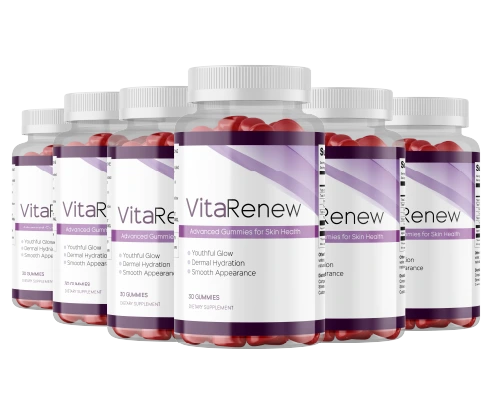
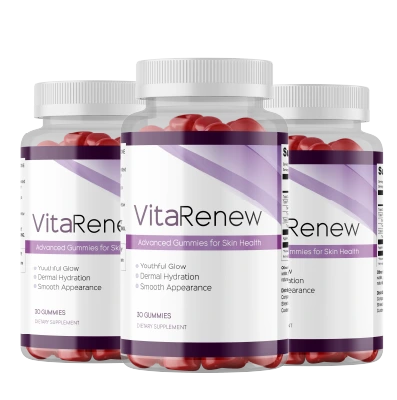
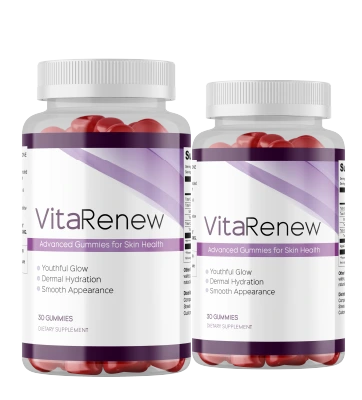
After about a month of research I started looking for a supplement that addressed the cofactor side of the equation rather than the raw-material side. I found VitaRenew, a daily gummy formulated for women in their 40s and 50s that focuses on vitamin C, zinc, and copper — the three things I'd now identified as the most likely gaps. It also includes vitamin E, selenium, and beta-carotene for antioxidant support, which matters because oxidative stress degrades existing collagen while you're trying to support new production.
- Vitamin C & copper — the essential cofactors for collagen assembly and cross-linking
- Zinc & antioxidant support — for skin integrity and slowing oxidative degradation
- GMP-certified facility, FDA-registered — I checked before I ordered
- 60-day money-back guarantee — long enough to actually evaluate it
I want to be honest about what it is: it's a supplement that supports skin, hair, and nails. It doesn't treat or cure anything, and any product making those claims would be one I'd walk away from. What it does is address what I'd found to be the actual gap in my routine.
After about six weeks I started noticing the texture on my neck and upper arms looked smoother in morning light. By month three I was getting questions from friends about what I was doing differently. I hadn't changed my skincare. I'd changed what I was giving my skin to work with from the inside.
A realistic timeline
This matters, so I'll be direct: dermal collagen remodelling is slow. The outer layer of skin turns over every four to six weeks, and surface texture can shift a little in that window. But the structural changes in the dermis take months. Most well-designed studies on skin-support supplements run for at least eight to twelve weeks.
Give anything you try a full three months. Take a photograph in honest light on day one. Expect gradual, not dramatic. Individual results vary based on genetics, sun history, diet, and a dozen other things I can't predict for you. A supplement that genuinely supports the process doesn't override all of those — it adds one more factor pointing in the right direction.
Worth saying clearly: crepey skin from ageing is gradual and symmetrical. If a patch of skin changes suddenly, thickens, discolours, or a spot changes shape, that is a question for a dermatologist, not a supplement. Please see someone with a licence for anything that doesn't fit the even, gradual pattern of age-related change.
What other women found
"I'd been chasing the perfect serum for three years with nothing to show for it. Understanding that the problem was in a layer creams don't reach changed everything. My chest skin looks noticeably less papery. I'm genuinely a convert."
"I almost didn't order because I was so skeptical of supplements. The science behind the cofactor explanation is what got me. After two and a half months the crepey skin on my arms is softer and the texture is smoother. My daughter noticed before I said anything."
These statements reflect individual experiences. Results are not typical and will vary from person to person. Results depend on many factors including age, diet, and individual health status.
If you've been where I was
If your skin has turned dry and crepey and nothing you're applying is making a lasting difference, you may be solving at the wrong layer. The texture change is structural — it's in the dermis — and the dermis needs different inputs than the surface does. Vitamin C, copper, and zinc are the most consistently underrepresented pieces of that puzzle, and they're where I'd start looking.
VitaRenew is where I started, and where I've stayed. That's my honest answer to the question I was Googling at six in the morning.