Health & Wellness
What Causes Skin to Sag — And Why I Finally Got My Answer at 46
It wasn't the mirror. It was a photo someone took without warning. And once I understood what was actually happening beneath the surface, the question I'd been asking for years completely changed.

A friend texted me a photo from my cousin's birthday dinner last spring. She was in the foreground, laughing, and I was standing a few feet behind her. A completely unstaged moment — nobody had told me a camera was pointing in that direction.
I looked at the photo for a long time. Not because anything was wrong with it. But there was a looseness around my jaw and the side of my face that I didn't quite recognize as mine. In my head — and in the mirror on a good morning — I look younger than that. The photograph was not interested in my good mornings.
I am not the type to spiral over something like this. I am the type to get curious. What was actually happening? And was there anything I could realistically do about it?
I spent the following weeks reading — not the magazine summaries, but the actual research. What I found was more specific, and more actionable, than "collagen loss." It changed what I was looking for entirely.
Why cameras show what mirrors hide
Mirrors, I've since read, are somewhat forgiving by habit. We look at them in consistent light, from angles we've learned work for us, usually awake enough to unconsciously hold ourselves the way we know looks best. We have been looking at ourselves in mirrors our whole lives — there is a kind of optimization that develops without our noticing it.
A phone camera pointed from a lower angle, in ambient light, at a moment you weren't composing — that is reality without the optimization. It captures the parts of your face you have never consciously presented to your reflection. The side of your neck. The lateral jaw. The area below the chin.
The looseness I saw in that photo was real. The mirror just hadn't happened to show it to me quite that plainly before.
What's actually happening beneath the surface
Skin has layers. The one you see is a thin barrier — it keeps water in and the outside out. Below it sits the dermis: a dense, springy network of collagen fibres, elastin fibres, and a water-binding gel that together give skin its thickness, its bounce, and its ability to hold its shape.
What I found was that skin sagging isn't one change — it's several happening simultaneously. Collagen production has been declining since our mid-twenties, but when estrogen levels begin to fall in the forties, that decline accelerates sharply. Elastic fibres, which the body can barely produce in adulthood, slowly fragment over decades of oxidative stress. And the water-binding substances in the dermis — hyaluronic acid chief among them — lose both volume and molecular weight, leaving the tissue less full from within.
What looks like sagging from the outside is what all three of those changes look like together from the inside. The skin hasn't fallen — it's lost the internal structure that held its shape.
The part that surprised me most: the body doesn't stop being able to build collagen after 40. What changes is whether it has the specific nutrients each step of that process actually requires.
Why the obvious answers only go so far
I had tried things. Most people my age have. Some of it genuinely helped — certain retinoids do have real evidence, and the right moisturizer makes a difference in texture and surface quality. I was not under the impression that any jar of cream was going to rebuild my dermis. But once I read the biology, I understood more precisely why.
The outermost layer of skin is a barrier. Its entire job is to keep things out. Most molecules applied to it — even the effective ones — don't penetrate to the structural layer in any meaningful concentration. This isn't a criticism; it's a physical fact. The surface and the structure are different problems, and they need different approaches.
This is what pointed me toward nutritional inputs as a parallel strategy — not instead of topical care, but addressing the structural layer from the inside while the skincare handles the surface.
Referenced in this article
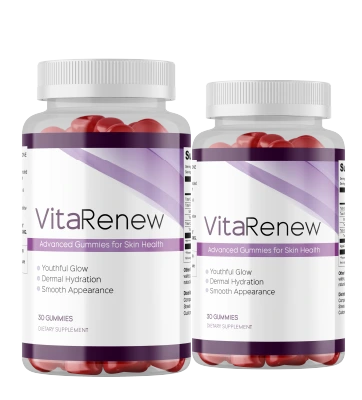
VitaRenew
Vitamin C, zinc, copper and antioxidants — the cofactors that support collagen synthesis and help protect elastin — in one daily gummy.
The 2-bottle supply is where most readers start. Sixty days is a fair window to decide.
60-day money-back guarantee · One-time purchase, no subscriptionWhat the research actually pointed me toward
Once I understood the mechanism — the enzymatic steps involved in building and maintaining collagen — my checklist for any supplement became much more specific.
Collagen synthesis is a chain of steps, each requiring its own cofactors. The two most documented:
- Vitamin C is required by the enzymes that stabilize the collagen triple helix. Without it, the collagen produced is structurally weak. This is not a fringe finding — it is why scurvy destroys connective tissue.
- Copper activates the enzyme that cross-links collagen fibres into the load-bearing mesh. Most skin supplements include zinc but not copper, which means they support only the first half of the process.
For elastin: since the body can't produce meaningful new elastic fibres in adulthood, the question becomes preservation. Antioxidants — vitamin E, selenium — help neutralize the free radicals that cause oxidative fragmentation of the elastic fibres you still have.
Zinc, meanwhile, supports the regulated turnover of collagen — the breakdown of old, damaged fibres to make way for new synthesis. It matters for the balance of the whole process.
What I was now looking for on a label
- Vitamin C at a real dose. Not a trace for marketing purposes.
- Both copper and zinc. They work at different steps. Very few formulas include copper.
- Antioxidant coverage. Vitamin E and selenium to support elastin preservation.
- Verified manufacturing. FDA-registered, GMP-certified — checkable, not just stated.
- Honest timeline expectations. Dermal remodelling takes months. Anyone promising results in days is not someone I trust with my health decisions.
- A guarantee long enough to actually evaluate. Sixty days minimum.
What I found
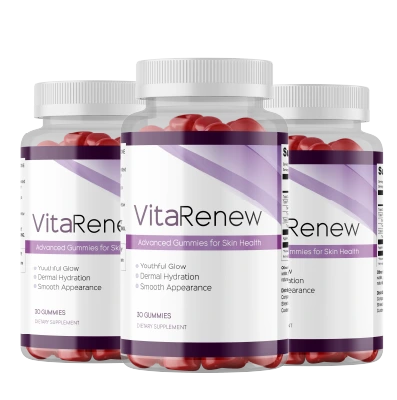
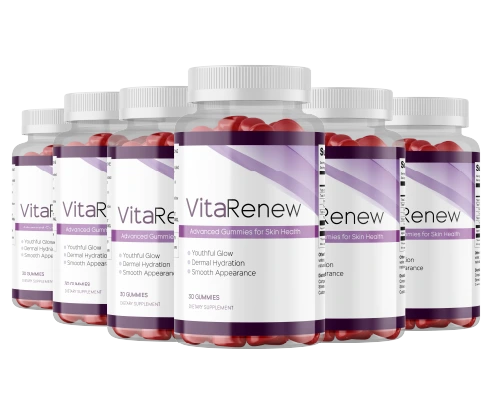
After going through a number of options against this list, the one that fit was VitaRenew. It has vitamin C, zinc, copper, vitamin E, selenium, and beta-carotene — in a daily gummy, which meant I actually took it, which matters more than I expected after years of capsules that ended up at the back of a drawer.
It is manufactured in an FDA-registered, GMP-certified facility and comes with a 60-day money-back guarantee. No subscription. I started with the 2-bottle supply at $79 per bottle — two months felt like a fair window to see if anything was actually changing before deciding whether to continue.
I want to be honest about this: it is a supplement, not a treatment. It supports skin, hair and nails. It does not diagnose, treat or reverse any condition — these statements have not been evaluated by the FDA. What I noticed after about ten weeks was that the looseness I had seen in that birthday photo looked slightly less pronounced in photos taken under similar conditions. My skin felt less papery in texture. Those are personal observations, not clinical findings.
How long it actually takes
The outer layer of skin turns over every four to six weeks, so you might notice something in texture within that window. The deeper structural layer is slower — dermal collagen remodelling is measured in months. Research studies measuring skin changes typically run for eight to twelve weeks before drawing conclusions. Sixty days is the right window for a first evaluation, and the 2-bottle supply is exactly that.
What other readers have said
"I had the same photo-revelation experience. I started with the 2-bottle supply and after about twelve weeks noticed the side of my face looked a bit firmer in candid photos — not dramatically, but clearly enough that I noticed. I am now on my third order."
"The ingredient list was what convinced me — copper was in there alongside the vitamin C and zinc. I had never seen that. After nine or ten weeks my skin felt more substantial and less tissue-paper-thin. I will keep going."
These statements reflect individual experiences. Results are not typical and will vary from person to person. VitaRenew is a supplement, not a medical treatment. Consult your healthcare professional before adding any supplement to your routine.
Referenced in this article
VitaRenew
The cofactors that support skin from the inside — vitamin C, copper, zinc, vitamin E and selenium — in one daily gummy.
Support firmer, smoother-looking skin — starting with the smallest pack.
60-day money-back guarantee · One-time purchase, no subscription