I Finally Understood Why My Tummy Skin Went Crepey — And It Had Nothing to Do With Weight
I hadn't gained weight. I hadn't been pregnant recently. But the skin on my belly had gone soft and papery in a way it never used to be. Here's what was actually happening underneath, and what the science says about what supports it.

I noticed it on a Tuesday morning, getting dressed before the gym.
I ran my hand across my stomach — the way you do without thinking — and something felt off. The skin was soft in a way that was new. Not flabby in the sense I associated with weight. It was more like the texture had changed. Fine, almost papery. Loose in a quiet way that hadn't been there the year before.
My first thought was weight. I checked: the same. My second thought was that I must have missed something — not enough water, not enough sleep, some vitamin I hadn't been paying attention to. My third thought, which took longer, was that maybe I just needed a better body lotion.
None of those explanations were right. It took reading about skin biology to understand what was actually happening, and the explanation was at once more complicated than I expected and, in a strange way, a relief.
The word for it, and why it appears on the belly
The technical term is crepey skin — a texture that resembles crinkled paper, fine lines across the surface of skin that has become thinner and less resilient from the inside. It tends to appear on the upper arms, the chest, the inner thighs, and the abdomen — areas where skin is naturally softer and less supported by dense underlying muscle.
For many women, it arrives somewhere in their early-to-mid forties, and it almost always feels like it appeared without warning. That's because the changes responsible for it are gradual and internal — happening in a layer you can't see or feel until the surface gives it away.
And critically: it has nothing to do with weight. Women of every body type get crepey abdominal skin with age. It is a biological change, not a consequence of anything you did or failed to do.
The change is happening inside the skin — in the dermis — not on the surface. That's why surface products have a limited ceiling, and why understanding the mechanism is the most practical thing you can do.
What's happening inside the skin — the dermis story
Skin has layers. The one most people think of — the outermost barrier — is actually a surface of already-dead cells. Its job is to keep moisture in and the environment out. When you apply a cream, this is where it lands.
Deeper down is the dermis — the structural layer. This is where collagen fibres give skin its thickness and resistance, where elastin fibres make it spring back after being stretched, and where hyaluronic acid holds water in the tissue. When the dermis is dense and well-organized, skin has what people describe as a firm, youthful quality. When the dermis thins, the surface loses its internal support — and that's when the crepey appearance arrives.
No topical product changes the dermis. The reason creams produce a temporary improvement — which they genuinely do — is that they soften and hydrate the barrier layer, which makes the surface reflect light more evenly for a few hours. The structure underneath is unchanged. That's not a criticism of moisturizers; it's just a description of what they reach and what they don't.
Why the forties trigger this
Two processes, running on parallel timelines, happen to converge in most women's fourth decade.
The first is a slow, decades-long decline in collagen production that starts in the mid-twenties. The rate is modest — often cited as roughly one percent a year — which is why nobody notices it until it accumulates.
The second is hormonal. As estrogen levels fall through the perimenopausal transition, the dermis loses an important source of structural support. Estrogen plays a role in maintaining collagen density and hyaluronic acid production, and its decline accelerates dermal thinning in ways that can feel sudden even though they aren't.
The slow decline and the hormonal shift land at roughly the same time. That's the "it happened overnight" moment — it didn't, but it isn't surprising that it feels that way.
The part that changed how I was thinking about it
Here's what I hadn't understood before, and what ended up being the most useful thing I learned.
The body hasn't stopped knowing how to make collagen. The fibroblast cells that produce it are still in the dermis. The genetic instructions haven't changed. What collagen synthesis needs — beyond the raw amino acids — is a set of enzymatic tools that run the production process. And those tools depend on specific nutrients that are easy to be short on without realizing it:
- Vitamin C is required by the enzymes that give the collagen molecule its stable triple-helix shape. Without adequate vitamin C, the collagen produced is structurally weak. This is established biochemistry, not supplement marketing — it's the mechanism behind scurvy's destruction of connective tissue.
- Copper activates lysyl oxidase, the enzyme that cross-links individual collagen and elastin fibres into a strong, springy mesh. Without copper, fibres are made but never properly bound. Most people don't think about copper, and most skin supplements don't include it.
- Zinc supports normal skin renewal and the ongoing repair cycle in the dermis.
I kept returning to the same analogy: it's like trying to build something when you have all the lumber but none of the nails or tools. You can keep adding wood to the pile, but if the joining mechanism isn't there, the structure doesn't come together.
That's why taking collagen powder and noticing little was a confusing experience for so many people — and why what you take alongside it may be the more important question.
What I started looking for on a label
After enough reading, the checklist became short and specific:
- Vitamin C in a meaningful dose — not a trace amount added for the label
- Copper — the cross-linking cofactor that most formulas skip
- Zinc — for the repair cycle that runs continuously in the dermis
- Antioxidant support (vitamin E, selenium) — because oxidative stress degrades existing fibres while new ones are being formed
- A guarantee long enough to reflect the actual biology — the dermis moves on a timeline of months, not days. A 60-day guarantee is the minimum that makes honest sense.
What we looked at
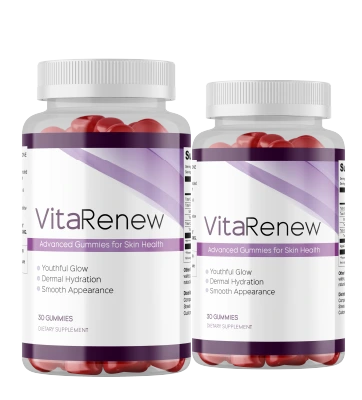
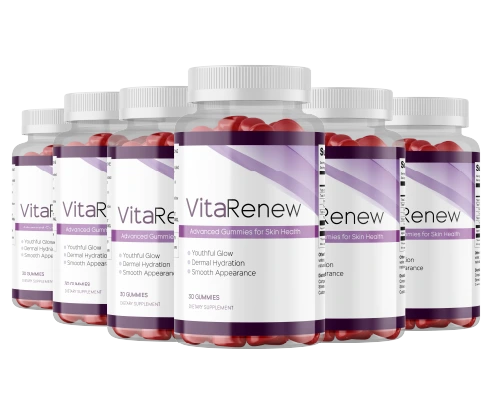
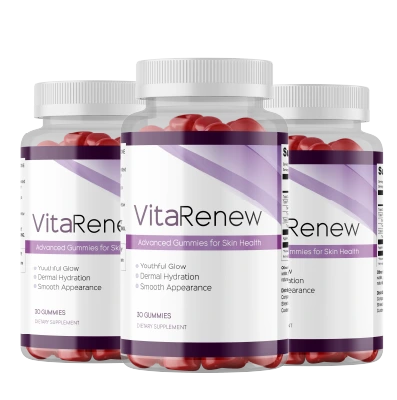
VitaRenew
Vitamin C, zinc and copper — the cofactors the dermis actually depends on — plus vitamin E, selenium and beta-carotene for antioxidant support. Daily gummy, made in an FDA-registered, GMP-certified facility. Supports skin, hair and nails.
What other women have said
"The texture on my stomach was the first thing I noticed, and I kept thinking it was from a fluctuation in weight. It wasn't. When I started paying attention to what was happening on the inside — the collagen side of things — the experience was genuinely different. I won't overclaim. But I understand my skin better than I did, and that matters."
"I spent a year on collagen powder and didn't see much. Turns out I was missing the cofactors — the vitamin C and copper pieces. Adding those in was the shift. I don't have twenty-five-year-old skin. But the texture is noticeably different and I'm not hiding my stomach at the pool anymore."
These are individual experiences. Results are not typical and will vary based on age, genetics, diet, lifestyle, and other factors.
How long this actually takes
The surface layer of skin turns over in four to six weeks. Changes in texture and hydration at that level can happen relatively quickly. Dermal remodelling — actual changes to the collagen and elastin structure — takes longer. Most research studies that measure collagen-related outcomes run for eight to twelve weeks, which is a more realistic minimum for noticing structural change.
A photograph in the same lighting on day one is worth more than any memory. The dermis works on geological time relative to our expectations, but it does move.
A note worth saying clearly: if a patch of skin changes in a way that doesn't look like gradual, symmetrical aging — sudden changes in color, texture, or shape — that's a conversation to have with a dermatologist. Crepey skin from natural aging is slow and even. Anything that isn't should be looked at.
Referenced throughout this article
VitaRenew
Built around the cofactor side of the equation — not just raw material. The formula most of the options I looked at were missing copper entirely. This one has it.