What I Found Out After Looking at My Mother's Hands

My mother turned 79 last spring. We were sitting outside at her birthday dinner — late afternoon light, sleeves rolled up — when I noticed it more clearly than I ever had before. The skin on her forearms was thin. Creased. It had a soft, papery texture, like tissue paper that had been balled up and smoothed flat. When she reached across the table, it shifted and folded in a way it never used to.
I've seen her arms thousands of times. But this time I looked at my own hands afterward — I'm 52 — and I thought: this is where I'm going. And I wanted to understand the road.
So I started asking around. I talked to a friend who's a dermatologist. I read the research. What I found wasn't depressing — it was clarifying. Once you understand what's happening, you understand what can sensibly support it.
It starts in a layer you can't see
Crepey skin — that fine-crinkled, tissue-paper texture — is not a surface problem. It begins in the dermis, the middle layer of skin that sits directly beneath what you can touch. The dermis is a dense mesh of collagen fibres (which give skin its thickness and resistance), elastin fibres (which let skin snap back), and hyaluronic acid (which holds moisture between them). When this mesh thins and loosens, the surface above it starts to look crinkled.
That thinning is slow and cumulative. Collagen production begins declining in the mid-twenties — roughly one percent per year. For decades, the loss is invisible. But by the time someone reaches their seventies or eighties, that gradual decline has compounded. The dermis that once held everything firm has lost much of its original density. The skin above it no longer has the internal support it once did.
Why elderly skin is different from "just aging in your 40s"
There's a real difference between the changes that show up in the forties and what you're looking at in the seventies and beyond. In the forties, the main driver is hormonal: as estrogen falls through perimenopause, it accelerates dermal loss — that's why the change can feel sudden, like two gradual slopes converging at once.
In older adults, you're looking at the cumulative result of all of that, plus things that add up over decades:
The fat cushion underneath thins. Below the dermis is a layer of subcutaneous fat that rounds and pads the skin from below. In elderly adults — especially on the hands, forearms, and upper arms — this cushion thins considerably. Without it, the skin can look loose and papery even independently of the dermis changes.
Decades of sun exposure arrive all at once. UVA radiation — which penetrates clouds and glass — reaches the dermis and breaks down collagen over time. My mother spent most of her life outdoors, decades before anyone wore sunscreen seriously. That accumulated UV exposure doesn't show up gradually while it's happening. Then one afternoon, in the right light, you see it all.
The skin's own renewal slows. Healthy skin continuously repairs itself. In elderly adults, cell turnover slows significantly and the dermis renews itself at a lower cadence. The whole system runs quieter.
The part about what the process actually needs
This is the part my dermatologist friend said that I keep thinking about. Elderly skin hasn't lost the ability to make collagen. The fibroblasts — the cells that manufacture it — are still there, still working. What changes is the efficiency of the process, and specifically the availability of the cofactors it depends on.
Vitamin C is essential to two enzymes that give each collagen molecule its structural stability. Without adequate vitamin C, the body produces collagen in a weaker form. Older adults tend to have lower circulating vitamin C than younger people, partly because the gut absorbs it less efficiently with age.
Copper is required by lysyl oxidase, the enzyme that cross-links loose collagen and elastin threads into the resilient mesh that gives skin its structure. Without copper, those threads are produced but not properly assembled.
Zinc plays a supporting role in skin cell renewal and repair. Mild zinc insufficiency is common in older adults — often undetected — because absorption from food decreases with age.
What she was describing, I realized, is a factory that still has workers but is running low on tools. If that's the actual bottleneck, then adding more raw material — collagen powder, for instance — addresses the supply side but not the process. The limiting factor may be elsewhere.
What I've been looking into
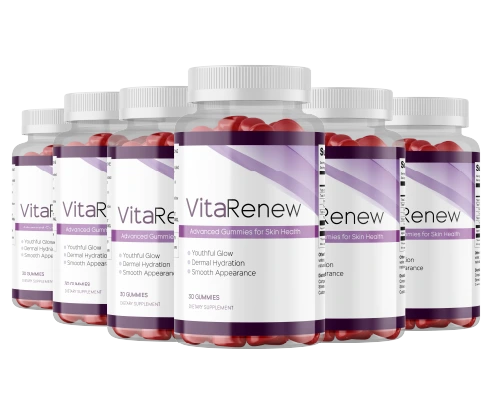
I started reading about supplements built around the cofactor side rather than raw collagen, and VitaRenew kept coming up — a daily gummy with vitamin C, copper, zinc, vitamin E, and selenium. Not a medication; a supplement formulated around the micronutrients the synthesis process actually depends on.
- Cofactor-focused — addresses the tools, not just the raw material.
- Daily gummy — simple routine, nothing to measure or mix.
- 60-day guarantee — enough time to assess honestly.
I'm realistic about what it can do. Decades of accumulated change don't reverse in two months. But as a daily habit aimed at supporting what's still possible — giving the process what it needs — it felt like the sensible place to start. Both for my mother, and for the hands I looked at afterward.
What readers have shared
"My hands were the giveaway — the skin had been papery for years. Around the two-month mark on VitaRenew, the texture on the backs of my hands felt slightly less crinkly. My husband noticed before I said anything."
"I'm 66 and I started it for my nails, but the texture change on my forearms has been the thing I keep noticing. Subtle, but it's real."
These statements reflect individual experiences. Results are not typical and will vary from person to person.
What I'd tell anyone thinking about this
Be patient with the timeline. The dermis changes slowly, and collagen remodelling is measured in months, not weeks. Photograph the same spot — your hands, your forearm — in the same light on day one, then at eight weeks and twelve weeks. Evaluate the direction, not a single snapshot.
And remember that what's happening to elderly skin isn't a failure — it's the accumulation of a life. Understanding the mechanism doesn't mean expecting reversal. It means knowing what you can sensibly support from where you are.