Skin Health · Personal Research
What’s Actually Causing Turkey Neck After 50 — And What I Found Out
It was a candid photo from a family lunch that made me stop pretending I hadn’t noticed. What I researched next changed what I was looking for.

I turned 53 in March. I have spent most of my adult life relatively unbothered by the mirror — I knew I was getting older, I accepted it, and most of the visible signs felt proportional and gradual. The neck blindsided me.
The moment that pushed me to actually research it was a photo a friend took at a backyard lunch. My face looked fine — recognizably me, a little more lived-in than ten years ago, nothing I hadn’t made peace with. But my neck looked like it belonged to someone older. The skin below my jawline had loosened, the smooth vertical line from chin to collarbone was gone, and there were horizontal folds I had not noticed standing in front of my own mirror in the morning.
I started Googling “turkey neck causes.” What I found over the next few weeks was more specific, and more useful, than I expected.
The first thing I misunderstood
My initial assumption was that what was happening to my neck was a version of what happened to skin everywhere else as it aged — just faster, because I’d been less diligent about sunscreen there. Gravity. Sun damage. The passage of time. All the usual suspects.
The dermatology research I read told a more specific story. Neck skin is not just older-looking facial skin. It is anatomically different in ways that make it particularly vulnerable to the exact changes that happen in the forties and fifties.
First: the skin on the neck is thinner than the skin on most of the face. The dermis — the structural layer beneath the surface you can touch — is typically one to two millimetres deep on the neck, compared to three to five millimetres in areas like the forehead and cheeks. A thinner starting scaffold means age-related changes that affect all skin at similar rates produce proportionally more visible effects in a thinner material.
Second: the neck has far fewer oil glands than the face. Sebaceous secretion maintains the lipid barrier that keeps skin supple and resistant to the kind of surface dryness that amplifies the appearance of crepiness and fine horizontal lines. Without it, the neck’s surface is more vulnerable to looking papery and crepey — independently of what’s happening in the structural layer beneath.
Third — and this one surprised me — the neck experiences a mechanical stress pattern the face does not. Decades of looking down at books, phones, and screens fold the neck repeatedly at the same horizontal zones. Research has documented that this kind of repetitive mechanical loading accelerates local degradation of the structural fibres in those crease areas. The “tech neck” conversation is usually about posture and pain. It also has a skin dimension.
I had been looking at the surface. The research was pointing somewhere else entirely — at what was happening to the structural layer I couldn’t see or feel.
What I learned about what’s underneath
The part of the skin I had been ignoring is called the dermis. It is not the part you can touch or treat with a cream. It is the structural layer: a dense mesh of collagen fibres running in multiple directions, elastin fibres woven through them, and a water-attracting matrix between the threads that gives skin its volume, its spring, and its ability to return to shape.
Collagen production declines from the mid-twenties onward — slowly at first, roughly one percent per year, cumulative over decades. That is the background curve. In the forties, a second curve lands on top of it: estrogen falls during the perimenopausal transition, and estrogen plays a direct role in fibroblast activity (fibroblasts are the cells that produce collagen and elastin) and in regulating hyaluronic acid. When estrogen declines, dermal collagen loss accelerates. The published literature suggests that a significant proportion of total dermal collagen can be lost during the years immediately surrounding menopause — a rate that then settles to a slower trajectory.
The “it happened overnight” quality so many women in their early fifties describe reflects these two independent curves overlapping at the same time. Nothing happened overnight. Two gradual processes coincided, and the combined effect became visible — first, and most dramatically, on the neck, because the neck started with a thinner scaffold.
What I tried first — and where it stopped working
I had been using a retinol serum on my face for years. I extended it to my neck and increased the concentration. I tried a firming cream specifically marketed for the décolleté. I was more consistent about SPF below the jaw.
Some of that was probably sensible. But none of it addressed what I had read was actually happening. The research on topical products for skin sagging consistently points to a structural ceiling. The outermost layer of skin — the stratum corneum — limits the penetration of larger molecules. Collagen itself is far too large to cross this barrier from the outside, and applied forms remain at or near the surface. Retinoids are the exception: they are small enough to penetrate and do have documented effects on fibroblast signalling and surface texture.
But even retinoids work primarily at the dermal-epidermal junction — the boundary between the two skin layers — rather than deep in the dermis where the structural scaffold lives. And dermal rebuilding is not primarily a surface process. The fibroblasts that produce collagen and elastin work from within.
The question I hadn’t been asking
What changed the direction of my research was a fairly simple fact I had not encountered before: the body does not lose the ability to make collagen at 50. Fibroblasts remain present. The enzymatic machinery for collagen synthesis is still there. What the research describes is a system that slows partly because it is lacking the cofactors — the specific molecules those enzymes need in order to complete their work.
The two that came up consistently in the clinical nutrition literature were:
- Vitamin C, which is required by the enzymes that stabilise and cross-link the collagen triple helix. Without adequate vitamin C, newly synthesised collagen is structurally incomplete — the fibres are there but do not hold together properly. This is the mechanism behind scurvy, documented for centuries, and it operates at subclinical levels as well as clinical deficiency.
- Copper, which is the cofactor for lysyl oxidase — the enzyme that cross-links collagen and elastin fibres into the load-bearing scaffold. Without copper, the final bonding step cannot be completed. Copper was missing from every supplement I had previously considered for skin.
Zinc came up repeatedly as well, for its role in dermal integrity, wound repair signalling, and the regulation of enzymes involved in collagen turnover. And vitamin E and selenium appeared together in the literature on oxidative stress — the mechanism by which existing collagen fibres are degraded by metabolic byproducts, at the same time the body is trying to produce new ones.
What I was looking for, I realised, was not a cream. It was a supplement with the specific cofactor combination that the dermal repair process depends on — and it needed to include copper, which almost nothing I found actually had.
Referenced in this article
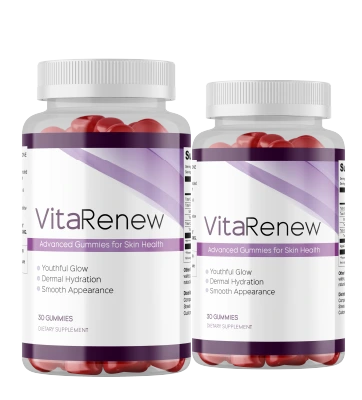
VitaRenew
Vitamin C, copper, zinc, vitamin E and selenium — the cofactor combination the collagen synthesis process depends on, in one daily gummy. 60-day money-back guarantee.
The 2-bottle supply is where most readers start. Sixty days is the minimum honest window to evaluate any internal skin support.
60-day money-back guarantee · One-time purchase, no subscriptionWhat I looked for in a supplement
Once I knew what the research said to look for, the checklist became fairly specific:
What I was checking
- Vitamin C at a dose that actually matters — not a token milligram included for label purposes.
- Copper, not just zinc. They work at different enzymatic steps. A formula with zinc and no copper addresses one part of the system and skips the cross-linking stage where the scaffold actually forms.
- Vitamin E and selenium together. The pair that appeared most consistently in the literature on oxidative stress in the dermis — not a single antioxidant source.
- An FDA-registered, GMP-certified manufacturing facility. Not marketing language about “quality standards” — a certifiable fact the manufacturer can document.
- No subscription model. I have enough monthly charges. A one-time purchase or nothing.
- A guarantee of at least 60 days. Dermal remodelling takes months. Any product with a 30-day return window is telling you it does not expect to be evaluated on dermal outcomes.
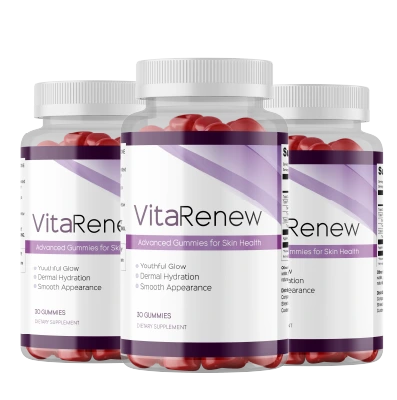
VitaRenew
VitaRenew was the formula that checked everything on the list. It is a daily gummy supplying vitamin C, zinc, copper, vitamin E, selenium, and beta-carotene — the full cofactor combination rather than a partial version. It is manufactured in an FDA-registered, GMP-certified facility, sold with no subscription, and backed by a 60-day money-back guarantee.
The entry option is two bottles at $79 each, which is exactly 60 days — the minimum time horizon for any honest evaluation of an internal skin supplement. That is where I started.
It is a supplement, not a treatment. It supports healthy skin, hair and nails. It does not diagnose, treat or cure any condition, and these statements have not been evaluated by the Food and Drug Administration.
What I can tell you after several months
I am not going to tell you my neck looks like it did at 35. That is not what the research predicts, and it is not what happened.
What I can tell you is that the horizontal folds that alarmed me in that photograph are less pronounced than they were. The skin on my neck feels less papery to the touch. The change has been gradual and consistent — which is exactly what the biology says should happen, if it happens at all. My sister noticed before I said anything. That meant something to me.
More than the specific change, I feel settled in a way I did not before. I am doing the thing that the research says addresses the actual mechanism, rather than investing more in what I had already established was working above the structural layer.
“The loose skin under my chin is what finally pushed me to research properly. After about three months on VitaRenew I noticed the contour under my jaw looked a bit more defined. Not dramatic — gradual. I’ve kept going because the direction is right.”
— Deborah H., 55, verified purchaser
“I read about the copper cofactor and specifically looked for a supplement that had it. VitaRenew was one of very few that did. About four months in, the horizontal lines on my neck are noticeably softer and the skin feels more resilient. I’m recommending it to my two older sisters.”
— Teresa F., 61, verified purchaser
Individual results vary. These testimonials represent personal experiences and may not reflect typical outcomes.
A note on when to see a professional: what I am describing — gradual, symmetrical loosening of neck skin after 50 — is a normal aging process. If you notice a change on your neck that is rapid, asymmetric, thickening, or accompanied by any other symptom, that is a question for a dermatologist, not a supplement. Always consult a qualified healthcare professional before starting any new supplement, especially if you are pregnant, nursing, managing a health condition, or taking medication.
Product referenced above
VitaRenew
The cofactor-first formula for skin, hair and nails. Vitamin C, copper, zinc, vitamin E, selenium. FDA-registered facility. No subscription.
Start with the 2-bottle supply — the 60-day window the biology says you need for a fair evaluation.
60-day money-back guarantee · No subscription · Ships from the US