Skin & Aging · Explainer
The Skin on Your Chest Is Getting Thinner — Here's the Real Reason It's Happening After 40
That papery quality on the décolleté. Creases that stay longer than they should. The fragility that wasn't there at 35. There's a structural reason for all of it.

She was getting dressed for a dinner party when she noticed it in the mirror. Not the face — she'd been watching that carefully for years. It was the chest.
The skin over the sternum and across the décolleté had changed. It looked thinner somehow. In certain light, almost translucent. The fine lines between her breasts — from sleeping on her side — were taking hours to fade instead of minutes. And when she pressed the back of her hand lightly against her collarbone, the skin didn't feel cushioned the way she remembered. It felt like there was less between the surface and the bone underneath.
She'd been told it was about hydration. About collagen creams. About avoiding the sun more diligently. But none of those explanations felt quite right, because this wasn't a surface change. It felt structural.
It is structural. And understanding why changes everything about what you might actually do about it.
Why the chest and décolleté are affected so early
Most women first notice skin thinning in their hands — but the décolleté and chest are often a close second. There are two specific reasons this area is vulnerable.
The first is cumulative UV exposure. The chest receives direct sun over decades — through necklines, during outdoor activities, at the beach — and UV exposure drives the production of enzymes called matrix metalloproteinases that actively degrade existing collagen in the dermis. Every year of exposure accelerates the background thinning that age is already producing.
The second is sleep mechanics. The skin on the chest is frequently compressed and creased by sleep position, and the skin's ability to fully recover from that compression depends on the structural resilience of the dermis. As the dermis thins, compressed creases take longer to resolve. The skin on the chest is doing nightly stress tests — and the results tell you something about what's happening in the deeper layer.
The chest isn't the problem. It's a window. What's visible there is happening throughout the body's dermal layer, and the chest simply shows it most clearly.
The papery, almost semi-transparent quality that becomes apparent in certain light is a direct consequence of dermal thinning. When the dermis was denser — full of tightly packed collagen fibres — it scattered light in a way that gave skin its opacity and warmth. As the dermis thins, light passes through differently. What used to look solid begins to look slightly translucent.
What's actually happening inside the dermis
Skin has two main layers above the subcutaneous tissue. The epidermis is the surface — the layer you can see, the one moisturizers address. Below it is the dermis, which is where the structural architecture lives.
The dermis is built primarily from collagen — dense, cross-linked protein fibres woven into a mesh that gives skin its thickness and its resistance to mechanical stress. Elastin fibres run through the same mesh, providing springiness. Hyaluronic acid sits between the fibres, drawing in water and keeping the whole structure hydrated and plump.
From the mid-twenties onward, the fibroblasts — the cells that produce and maintain this collagen mesh — begin producing less. Researchers estimate a decline of approximately one percent of dermal collagen per year. Over fifteen or twenty years, this is slow enough that most women don't register the change until a critical threshold is crossed.
That threshold tends to arrive in the perimenopausal years, and it arrives faster than expected, because a second factor is at work.
The role estrogen plays — and why the forties feel sudden
Estrogen supports the dermis in several ways. It promotes fibroblast activity — keeping the cells that make collagen more productive. It slows the rate at which existing collagen is broken down. And it helps maintain the hydration of the dermal layer through its effects on hyaluronic acid.
As estrogen levels begin to fall through perimenopause, all three of these supports weaken simultaneously. Studies measuring skin thickness using ultrasound have documented rapid decreases in dermal depth in the years immediately surrounding menopause — the kind of change that doesn't accumulate slowly but seems to arrive all at once.
What women describe as "it happened so fast" is accurate — but it's the convergence of a slow slope and a steeper drop arriving at the same time. The slow slope had been building for fifteen years. The steeper drop was an accelerant. The chest, already carrying years of UV history, registers the combined effect visibly and early.
Why the surface approaches don't reach the actual problem
Moisturizers and serums improve the surface. They address the epidermis — hydration, texture, tone, barrier function — and these things matter for how skin looks. But they cannot reach the dermis, and the dermis is where the structural change is happening.
Collagen-containing topicals face a different limitation: collagen molecules are large. Most cannot penetrate the epidermis in meaningful quantities. They function as humectants — attracting water and improving the feel of the surface — which is valuable, but it isn't the same as delivering collagen to the structural layer.
The more scientifically grounded question is whether the body's own collagen production can be supported from the inside out. And here the research is specific about what that requires.
The enzymatic machinery — what's actually limiting collagen synthesis
The body doesn't lose the ability to make collagen in midlife. Fibroblasts are still present. The genes encoding collagen are still intact. What changes is the rate of production and, in many cases, the availability of the cofactors that the production machinery depends on.
Collagen synthesis is a multi-step biochemical process. It doesn't just require amino acid building blocks — it requires specific enzymatic cofactors at each step. Three stand out in the published research:
- Vitamin C. Two enzymes required to form a stable collagen molecule — prolyl hydroxylase and lysyl hydroxylase — are both strictly vitamin C-dependent. These enzymes add chemical modifications that allow collagen to fold into the triple-helix structure that gives it its mechanical strength. Without adequate vitamin C, these modifications don't happen properly, and the collagen produced is structurally weak and unstable. This is textbook biochemistry — it is why vitamin C deficiency destroys connective tissue, and it has been established for decades.
- Copper. Once collagen molecules are synthesized individually, they must be bound together into cross-linked fibres to become structurally useful. The enzyme that performs this cross-linking — lysyl oxidase — requires copper as a cofactor. Without copper, individual collagen molecules form but never properly bind into the dense, cross-linked mesh the dermis depends on. The fibres exist but remain disorganized and mechanically weak.
- Zinc. Zinc is involved in the activity of the enzymes that regulate collagen remodelling — the ongoing process of degrading old fibres and laying down new ones. Adequate zinc supports the balance of that cycle in favor of healthy skin structure.
This matters because, in a well-nourished adult, the rate-limiting step in collagen synthesis is rarely amino acid supply. It's more often the enzymatic machinery. Adding more raw material to a production process that lacks the necessary tools doesn't change what the process can produce.
The body still wants to build collagen. The question is whether it has what the machinery needs to do it.
Referenced in this article
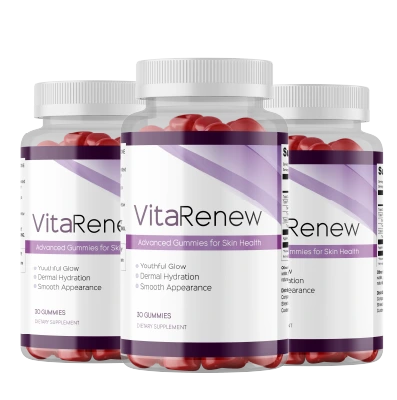
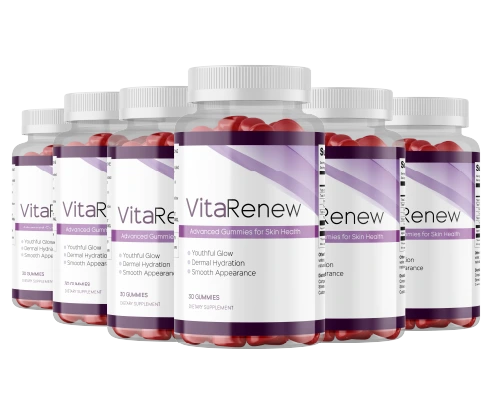
VitaRenew
Vitamin C, zinc and copper — the three cofactors collagen synthesis depends on — in one daily gummy. Supports skin, hair and nails. FDA-registered facility. 60-day guarantee.
A 60-day supply: the minimum useful trial window for anything working at the dermal level.
60-day money-back guarantee · One-time purchase, no subscriptionWhat to look for — a practical guide
If you're evaluating support for skin thickness and collagen
- Vitamin C at a meaningful dose. Not a trace included for label optics. The enzymes that stabilize collagen require an actual supply, not a cosmetic quantity.
- Copper — specifically. It's missing from most "collagen support" formulas. Without it, the cross-linking step that converts individual molecules into structural fibres cannot complete.
- Zinc alongside copper. The two work on distinct steps of the same process. Evaluating them together gives a fuller picture than either alone.
- Antioxidant support. Vitamins E and selenium help protect the collagen that already exists from the oxidative degradation that UV and environmental exposure accelerate.
- No impossible timeline claims. Dermal remodelling is measured in months. If a product promises visible results in a week, it's describing something else — not collagen production.
- A 60-day guarantee minimum. The meaningful evaluation window for any change at the dermal level is eight to twelve weeks. A guarantee that covers that window signals confidence in the product's actual timeline.
- FDA-registered, GMP-certified manufacturing. Third-party quality standards for supplements are verifiable on the label and matter for ingredient integrity.
How VitaRenew addresses that checklist
Of the formulas reviewed for this piece, VitaRenew is the most complete match. It's a daily gummy built specifically around the cofactor side of collagen support — vitamin C, zinc, and copper together, with vitamin E, selenium, and beta-carotene providing antioxidant coverage. It's made in an FDA-registered, GMP-certified facility and sold with a sixty-day money-back guarantee.
It supports skin, hair, and nails. It is a supplement, not a treatment — it does not diagnose, treat, or cure any condition. The sixty-day guarantee reflects the honest timeline: anything meaningful happening at the level of the dermis will take months, not days, to register.
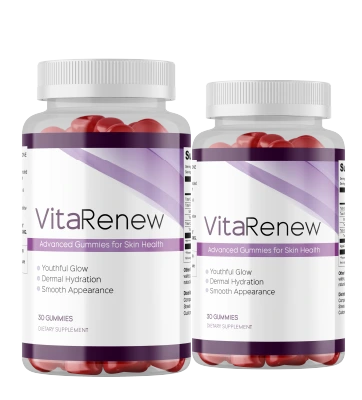
The entry-level supply is two bottles — 60 days at $79 per bottle. That's the practical starting point: enough time for a real evaluation without an outsized upfront commitment, and the same $240 flat commission regardless of which size you purchase means it's genuinely the right place to start.
What women report
"I started noticing the chest area maybe two years ago — that kind of papery quality in certain lighting. I've been on VitaRenew for about three months now. I think the skin feels slightly more substantial, and the sleep lines in the morning seem to fade faster. It's subtle, but I've kept going because something is different."
"The bruising was my first sign. My chest and arms would mark from almost nothing. After two months on VitaRenew I haven't seen as many — it's not like they've stopped completely, but they're less frequent and lighter. My dermatologist said it's consistent with what can happen when you support collagen production."
These reflect individual experiences. Results are not typical and vary based on age, diet, genetics, hormonal status, UV history, and other individual factors.
What timeline to expect — and how to evaluate it honestly
The dermis remodels slowly. The epidermis — the surface layer — turns over in four to six weeks. The dermis operates on a longer cycle. Studies measuring skin outcomes from nutritional supplementation typically report their primary outcomes at eight to twelve weeks because that is the minimum window where statistically meaningful changes can appear in controlled conditions.
Take photographs of your chest in consistent lighting on day one and again at twelve weeks. Expect gradual, not dramatic. The goal isn't to reverse decades of structural change in a short period — it's to provide the enzymatic machinery with what it needs to maintain and slowly rebuild what it can.
Individual variation is significant. Your collagen baseline, your UV history, your current hormonal status, how much vitamin C and copper you're typically getting from diet — all of these affect what any supplement can do for any specific person. No supplement overrides all variables.
A note on when to see a physician. The changes described here are gradual, symmetrical, and distributed across the chest and body — the result of slow biological change over years. If you notice a localized area of skin that changes suddenly in texture, color, or thickness, or a bruise that appears without any apparent impact, those are questions for a dermatologist. Diffuse, bilateral, and gradual is aging. Sudden and localized warrants professional evaluation.
The short version
The skin on the chest and décolleté becomes visibly thinner after 40 because the dermis — the structural layer beneath the epidermis — is losing collagen density. Two slopes converge: the slow decline in fibroblast production that's been building since the mid-twenties, and the accelerated breakdown triggered by falling estrogen in the perimenopausal years. The chest shows this early because of cumulative UV exposure and the nightly mechanical stress of sleep position.
The body still produces collagen. What limits how much it can produce isn't usually the building material — it's the enzymatic cofactors: vitamin C, which stabilizes every collagen molecule, and copper, which cross-links those molecules into the structural mesh. That's the mechanism most surface-level approaches don't reach. Supporting it from the inside is where the clearest scientific rationale exists.
Sixty days is the minimum useful trial. Start there.
Product referenced above
VitaRenew
Vitamin C, zinc and copper in one daily gummy. The cofactors collagen synthesis depends on — in one formula, FDA-registered facility, 60-day guarantee.
Give the dermis what it needs. Start with 60 days.
60-day money-back guarantee · Supports skin, hair and nailsBackground reading
- Shuster S, Black MM, McVitie E. "The influence of age and sex on skin thickness, skin collagen and density." British Journal of Dermatology, 1975.
- Pullar JM, Carr AC, Vissers MCM. "The Roles of Vitamin C in Skin Health." Nutrients, 2017.
- Rucker RB et al. "Copper, lysyl oxidase, and extracellular matrix protein cross-linking." American Journal of Clinical Nutrition, 1998.
- Thornton MJ. "Estrogens and aging skin." Dermato-Endocrinology, 2013.
- Rittié L, Fisher GJ. "UV-light-induced signal cascades and skin aging." Ageing Research Reviews, 2002.
- Castelo-Branco C et al. "Relationship between skin collagen and bone changes during aging." Maturitas, 1994.