Nutrition · Explainer
You've Been Taking Collagen and Seeing Nothing. Here's the Likely Reason.
You weren't wrong to try it. But collagen is the raw material, and raw material isn't usually what's missing.

There's a particular kind of quiet disappointment that comes about four months into a collagen habit.
You bought the tub. You stirred it into your coffee every morning, including the mornings you didn't feel like it. You took the honest before photo. And when you finally compared it to the after, you had to squint and want it a little too much to see a difference.
Most women conclude one of two things at that point: that collagen is a scam, or that their own skin is somehow past helping.
Neither is likely to be true. There's a third explanation, it's less demoralizing than both, and it lives in a part of the process almost nobody talks about.
Your body doesn't have a collagen supply problem. It has, in most cases, a collagen assembly problem.
What actually happens to collagen powder
Start with the mechanical facts, because they're rarely stated plainly.
Collagen powder is protein. When you swallow it, your digestive system does what it does to all protein: breaks it into amino acids and short peptides. Those enter the bloodstream as building blocks — not as collagen, and certainly not as collagen with an address label reading "deliver to the skin on my upper arms."
The body then decides what to build with them, based on what it needs and what it's able to do.
To be fair to the research: several controlled trials of oral collagen peptides have reported modest improvements in skin elasticity and hydration, and there's an interesting hypothesis that certain peptide fragments act as signals to skin cells rather than mere raw material. So this isn't a case of "collagen does nothing." It's a case of a modest effect that many people don't notice.
And here's the question that follows, which almost nobody asks: if you're a reasonably well-fed adult eating protein most days, was raw material ever the thing you were short of?
For most women, no. Which means adding more of it to the pile changes very little.
The step that actually limits the process
Making collagen is an assembly line, and the interesting failures on an assembly line are almost never shortages of material. They're broken machines.
Two machines matter more than the rest here.
1. Vitamin C — the machine that makes collagen stable
A collagen molecule only works because of its shape: three protein strands wound into a tight triple helix. That shape is what gives it tensile strength.
The winding is done by two enzymes, prolyl hydroxylase and lysyl hydroxylase, and both are strictly dependent on vitamin C to function. This is not a wellness-industry talking point. It is the reason scurvy — a vitamin C deficiency — causes connective tissue to fall apart, wounds to reopen and gums to bleed. Without vitamin C, the body still produces collagen; it just produces an unstable version that doesn't hold.
You don't need scurvy for this to matter. The enzymes work along a gradient, not a switch.
2. Copper — the machine that ties it all together
This is the one that gets left out, and it may be the more interesting of the two.
Freshly made collagen and elastin fibres start out as loose, unconnected threads. On their own they give skin very little. What turns them into a resilient network is cross-linking — chemical bonds tying fibre to fibre, the difference between a heap of rope and a woven net.
Cross-linking is performed by an enzyme called lysyl oxidase, and lysyl oxidase requires copper to work. No copper, no cross-linking. The fibres get made and never get bound.
Now look at the ingredient panel of the last skin supplement you bought. Vitamin C is probably there — it's a familiar name and it sells. Copper very often isn't.
Which means the most common version of this story isn't "I took the wrong thing." It's "I took one part of a two-part process, and the missing part was the one that binds everything together."
And zinc, briefly
Zinc supports normal skin integrity and the everyday repair that goes on continuously in the dermis. It isn't the headline, but it belongs on the list.
So what should you actually look for
Whatever you decide to do next — including deciding to do nothing, which is a legitimate answer — this is the short list worth holding a product to:
Six things worth checking on the label
- Vitamin C in a meaningful amount, not a token sprinkle for the front of the box.
- Copper. If it isn't there, cross-linking isn't being supported — and this is the single most common omission.
- Zinc, for ordinary skin repair.
- Antioxidant support — vitamin E and selenium are the usual pair — because oxidative stress degrades existing fibres while you're trying to build new ones.
- Third-party testing and a named manufacturing standard.
- Marketing that behaves itself. No cures, no diseases, no celebrity endorsements, no "results in seven days," no countdown timers. How a company talks tells you how it thinks.
No. 1: VitaRenew
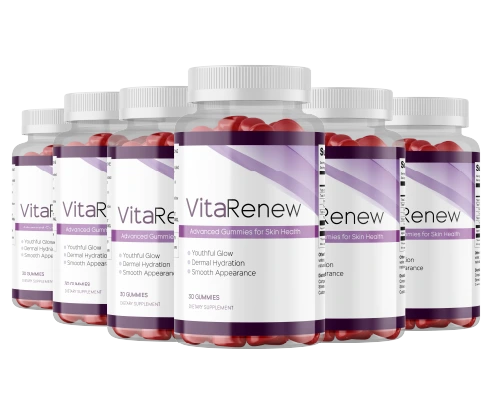
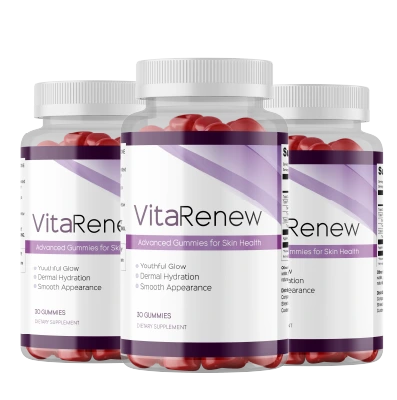
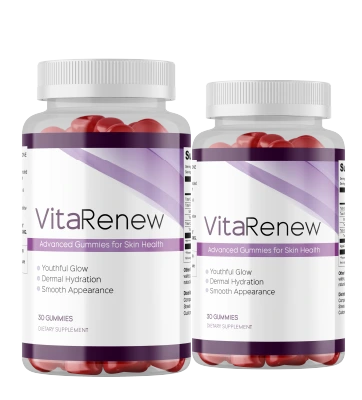
Of the formulas we looked at while researching this, VitaRenew is the one that lines up most closely with that list — largely because it's built around the cofactor side rather than the raw-material side. It's a daily gummy with vitamin C, zinc and copper, plus vitamin E, selenium and beta-carotene for antioxidant support. Made in an FDA-registered, GMP-certified facility, with a sixty-day money-back guarantee.
It supports skin, hair and nails. It is not a treatment for any condition, and nobody should sell it to you as one.
Referenced in this article
VitaRenew
Vitamin C, zinc and copper in one daily gummy — the three the assembly line actually runs on.
This time with the part that was missing.
60-day money-back guarantee · One-time purchase, no subscriptionIf you already own a tub of collagen
Don't throw it out. There's a reasonable case for taking it alongside adequate vitamin C rather than instead of it — you're supplying material and supporting the machinery at the same time, which is a more sensible experiment than either alone.
What's worth dropping is the expectation that the powder by itself was ever going to be the deciding factor.
How long before you can judge it
Longer than the internet suggests, and that's the honest part.
The outer layer of skin turns over roughly every four to six weeks, so surface texture and tone move first. The deeper structural layer is slower — collagen remodelling runs on months. Most controlled studies of skin-directed supplements measure their results at eight to twelve weeks, which is a reasonable benchmark to borrow.
Give anything a full three months. Take the photo on day one, in the same light, without a filter. Expect gradual. Individual results vary with genetics, sun history, sleep and what your diet already provides.
One caution. Copper and zinc compete for absorption, and very high doses of one over long periods can affect the status of the other — which is why sensible formulas keep them in balance rather than loading up on either. If you're already taking a separate high-dose zinc supplement, or you're pregnant, nursing, on medication or managing a health condition, run it past a pharmacist or doctor first. That's a two-minute conversation and it's worth having.
The short version
Collagen powder gives your body bricks. Vitamin C is what lets it lay them straight, and copper is what mortars them together. If you've been supplying bricks to a site with no mortar for four months, nothing about that is your failure — and it explains the result far better than "my skin is past helping."
Product referenced above
VitaRenew
Vitamin C, zinc and copper in a daily gummy. Made in an FDA-registered, GMP-certified facility.
For the next four months to end differently than the last four.
60-day money-back guarantee · Supports skin, hair and nailsBackground reading
- Pullar JM, Carr AC, Vissers MCM. "The Roles of Vitamin C in Skin Health." Nutrients, 2017.
- Rucker RB et al. "Copper, lysyl oxidase, and extracellular matrix protein cross-linking." American Journal of Clinical Nutrition, 1998.
- Choi FD et al. "Oral Collagen Supplementation: A Systematic Review of Dermatological Applications." Journal of Drugs in Dermatology, 2019.
- Ogawa Y et al. "Zinc and skin disorders." Nutrients, 2018.
- Institute of Medicine. Dietary Reference Intakes for Vitamin A, Vitamin K, Arsenic, Boron, Chromium, Copper, Iodine, Iron… National Academies Press, 2001.