Photoaging · Personal Story
I Finally Understood Why My Chest Looks Older Than My Face
I'd worn sunscreen on my face for twenty years. The skin I never thought to protect is what I'm most self-conscious about now — and the reason has nothing to do with age alone.


Two summers ago, my daughter wanted a family photo at the beach. Someone hired an actual photographer, and when the prints arrived, I sat with them for a long time.
My face, in those photos, looked the way I expected for fifty-three. I'd been religious about SPF 50 since my early forties. But my chest — the décolletage above my bathing suit neckline — and my forearms, and my hands: these looked like they belonged to someone a decade older. Thin, slightly crumpled, with a texture I'd been hearing described as "crepey" without ever really associating it with myself.
I'd bought firming body lotion. I'd tried a vitamin C serum stretched from my neck down to my chest. Three different brands over five years, and none had made a visible difference — because, as I eventually learned, I was trying to treat a structural problem with surface products.
The conversation that changed how I understood this
I'm lucky to have a close friend who's a dermatologist. Not in a "call her at midnight about a mole" way — but she'll tell me things straight at dinner without me having to make an appointment. I described what I'd noticed in the photos. Her response surprised me.
"What you're describing isn't just aging," she said. "It's photoaging. They're different things with different timelines, and the reason your face looks better than your chest is almost certainly that you've been protecting one and not the other."
I'd heard the word photoaging before, but I'd assumed it meant wrinkles from squinting. It doesn't. Photoaging is a specific, cumulative process driven by UV radiation that targets the structural layer of skin — the dermis — in a way that has nothing to do with how many birthdays you've had. The visible effects can take fifteen to twenty years to fully appear, which is why someone who spent their thirties and early forties in the sun without protection often sees the results most clearly in their fifties.
What ultraviolet light actually does to the dermis
The dermis is the layer beneath the visible skin surface. It's where structural integrity lives: collagen fibers that provide thickness and support, elastin fibers that allow the skin to snap back after movement, and hyaluronic acid that keeps everything hydrated and plump.
When UV light — particularly UV-A, which penetrates deeply — hits the dermis, it generates reactive oxygen species. These molecules trigger an active response: they activate a family of enzymes called matrix metalloproteinases, or MMPs. Under normal circumstances, MMPs are useful — they break down old, disorganized collagen so new collagen can replace it. Under chronic UV exposure, they become overactive. They continuously degrade collagen and elastin without adequate replacement.
Over years, the cumulative result is a dermis that has lost density. The collagen network becomes thinner and more disorganized. Elastin fibers fragment and lose their elastic properties. Without that internal scaffold, the surface layer of skin — far thinner than most people realize — has nothing firm to rest against. It settles on itself, compresses when you move, and catches light in ways that make every crinkle visible.
My face looked ten years younger than my chest in those beach photos. The reason was twenty years of SPF on one and nothing on the other.
UV-A also depletes vitamin C in the dermis — and vitamin C is essential to the body's ability to synthesize new collagen. It's required by two enzymes, prolyl hydroxylase and lysyl hydroxylase, responsible for giving each collagen molecule its stable helical structure. Without adequate vitamin C at the tissue level, the collagen the body tries to produce is structurally incomplete. You get raw material arriving at a factory that's also running low on the tools it needs to do anything with it.
Why the arms and chest show it first
The facial skin receives intense UV exposure, but it's also the zone most people consistently protect — and where thicker underlying tissue provides some structural buffer. The forearms, the décolletage, the backs of the hands: these are often unprotected for decades. They receive significant UV exposure from driving, outdoor activities, and daily life, with comparatively little underlying muscle or tissue to compensate for dermal thinning.
There's also a thickness factor. The skin on the chest and inner forearm is naturally thinner than skin on the back or thighs. With a thinner starting point, the same degree of dermal degradation produces more visible effects at the surface. The math catches up faster in those areas.
My friend's observation — that my chest looked older because I'd been protecting my face and ignoring everything else — landed with particular clarity once I understood the biology. The years of UV exposure I couldn't see while they were accumulating had been doing structural work in my dermis the whole time.
Why most of what I tried wasn't aimed at the right layer
The firming creams I'd been using work on the epidermis. They hydrate, they may temporarily plump the surface, and some help with surface-level hydration. What they don't do is deliver the cofactors needed for collagen synthesis in the dermis. That layer has its own supply chain, and topical products have limited penetration to it.
Collagen powders — which I'd also tried — provide amino acids that are the raw materials for collagen. But producing structurally sound collagen requires more than raw material. It requires the enzymes that organize those amino acids into a stable helix, and those enzymes need specific cofactors. Adding building material to a factory that's low on tools doesn't solve the problem.
My friend pointed me toward the research on three specific cofactors: vitamin C, copper, and zinc. Vitamin C for the hydroxylation enzymes that stabilize collagen structure. Copper, required by lysyl oxidase — the enzyme that cross-links newly formed collagen and elastin fibers into an organized, resilient network. Zinc for supporting the ongoing repair and turnover of skin cells in the dermis.
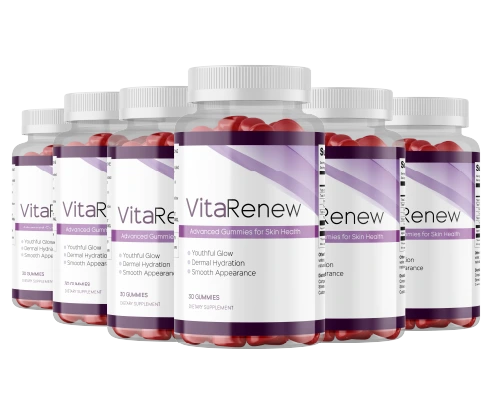
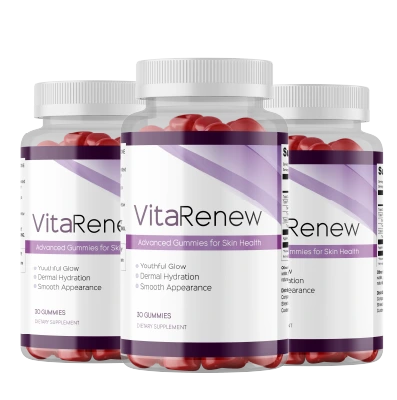
I spent a few weeks looking for a supplement that combined these three specifically. What I found was a daily gummy called VitaRenew, formulated around this cofactor combination for dermal support. I started with the 2-bottle kit — about $79 per bottle, with a 60-day money-back guarantee. Two months is the minimum time to form any real opinion about a supplement working at the tissue level, and starting there kept the financial risk low.
What I use
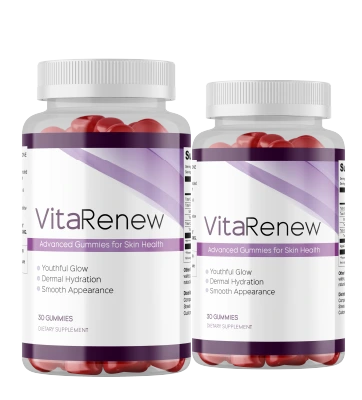
VitaRenew
Vitamin C, copper, and zinc — the cofactors the dermis depends on for collagen assembly and cross-linking. Daily gummy, FDA-registered GMP-certified facility.
For the photos where you stop choosing the angle based on what your arms look like.
60-day money-back guarantee · One-time purchase, no subscriptionWhat actually happened over three months
I want to be specific, because I came in expecting something and what I got was different — not worse, but not what I'd imagined.
The first six weeks: nothing I could point to. I kept going because of the guarantee. Month two: the skin on my chest started feeling different when I touched it — slightly more resistance, like there was something more solid underneath, though I couldn't see it clearly in a mirror. Month three: I noticed one morning that the texture across my décolletage was less pronounced than I remembered. The crinkles when I looked down were there, but shallower.
It didn't disappear. I want to be honest about that. The dermal damage accumulated over twenty years doesn't resolve in ninety days. But there was a real and measurable improvement in how the skin on my chest moved and looked under different light conditions. I'm now coming up on eleven months. I don't think about my chest skin the same way I thought about it after those beach photos.
The timeline matters enormously to set correctly: the dermis is slow. Surface skin turns over in weeks. The deeper structural layer that determines crepey texture takes months to respond to internal support — if it responds at all, and there are no guarantees. What I know is that the 2-bottle entry was the right place to start: low financial risk, long enough to see something if something was going to happen.
"The skin on my forearms was bothering me most — not my face, my forearms. I've been taking this for five months and the difference isn't dramatic, but it's real. The texture is smoother, less folded-looking. My husband noticed without me saying anything."
"I kept thinking creams would be the answer, because that's what gets marketed. It wasn't until I understood that the issue was happening underneath that I switched to an internal approach. Four months in, I'm glad I did. Results took time, but they came."
These statements reflect individual experiences. Results are not typical and will vary from person to person.
What I'd have done differently
I would have understood the distinction between photoaging and chronological aging earlier. I would have stopped directing products at the surface of a structural problem. And I would have started protecting the skin on my arms, chest, and hands with the same attention I gave my face — though that part is in the past now.
The internal cofactor approach isn't a cure. Nothing is. But if the question is whether the sun actually caused the crepey skin on my arms and chest — the answer is yes, through a specific mechanism that responds, at least partially, to specific internal support. The 2-bottle kit costs less than a month of premium body serums and carries a guarantee. It's where I started, and it's where I'd tell someone like me to start.
Where to start
VitaRenew
The cofactor approach to dermal support — vitamin C, copper, zinc. No autoship, no subscription. 60-day guarantee.
Two months. No risk. See what happens.
60-day money-back guarantee · One-time purchase, no subscription