Why your skin suddenly stopped bouncing back — what's actually happening, and what to do about it


It happened to a reader who emailed us last spring. She was 46, she said, and had been using the same skincare routine for three years — one that worked. Then, in what she described as "maybe a four-month window," the skin on her arms started behaving differently. The pinch test she'd done absently for years now took a moment. The skin on her jawline sat differently. "I kept thinking I was just tired," she wrote, "but it wasn't that."
She wasn't imagining it. What she was describing has a specific cause — one that's well-documented in skin research and tied to a hormonal transition, not to aging in general, and not to anything she'd done wrong.
Why skin bounces back — and why it stops
The bounce-back quality of skin depends on two proteins deep in the dermis, the living layer beneath the surface. The first is collagen, which forms the dense scaffolding that gives skin its thickness and substance. The second is elastin, which acts like a molecular spring — it's what allows skin to deform when you press it, then return to its original position.
Both start declining in our 20s. Collagen production drops at roughly 1% per year from the mid-20s onward. Elastin, uniquely, stops being produced after adolescence — the elastin fibers you have at 18 are largely the ones you carry through your adult life, slowly losing flexibility as they age in place.
At this pace, the changes are barely perceptible year to year. What can change the pace dramatically — and quickly — is a shift in estrogen.
The hormonal connection most people don't know about
Estrogen isn't just a reproductive hormone. It also plays a regulatory role in the cells that make collagen. The fibroblasts in your dermis — the cells responsible for producing and maintaining the collagen scaffolding — have estrogen receptors. When estrogen levels are healthy, those receptors receive a signal that supports collagen synthesis. When estrogen starts declining, as it does in perimenopause, that signal weakens. Fibroblasts slow down. Collagen production drops.
Research published in the British Journal of Dermatology — and replicated in multiple subsequent studies — found that women can lose up to 30% of their skin's collagen in the first five years after menopause, with the steepest drop in the first one to two years of that window. The annual 1% baseline decline can accelerate to something closer to 5–6% during this transition.
This is the mechanism behind the "it happened in a season" experience. It's not imagined, and it's not random. It's a well-documented consequence of what estrogen withdrawal does to the cells that hold skin's structure together.
What the pinch test is actually telling you
When you press your thumb into the soft skin on the back of your hand or your forearm and let go, what you're observing is the elastin spring doing its job — or not doing it as quickly as it used to. Young, collagen-dense skin returns almost instantly. Skin that's been structurally thinned by collagen loss takes a beat longer. It's not a dramatic pause — it's a fraction of a second — but once you notice it, it's hard to un-notice.
The same change shows up elsewhere: a jaw line that feels less defined, the neck and décolletage with a slightly different texture, the backs of the hands looking more papery than they used to. These aren't separate problems. They're all expressions of the same thing happening in the dermis.
Why your skincare routine hasn't fixed it
This is the part that confuses a lot of women: they have a good routine. They use SPF every day. They've tried retinoids. Nothing seems to be getting at the actual firmness change.
The reason is anatomical. Topical products — even excellent ones — work on the surface layers of skin. The collagen and elastin that determine structural firmness live deeper, in the dermis, below where most topical ingredients meaningfully penetrate. Moisturizers keep the surface hydrated and reduce water loss. Retinoids have real evidence for stimulating some surface-level collagen — particularly at prescription concentrations, used consistently. SPF remains the most effective anti-aging intervention in dermatology, full stop.
But the deeper structural scaffolding — the layer that perimenopause is depleting — doesn't respond to topical application. Supporting it requires a route that goes below the surface.
What some women are doing differently
A growing body of research has looked at whether supplementing with hydrolyzed collagen peptides can support the dermis from within. These are collagen molecules that have been broken down into small fragments — small enough to be absorbed through the digestive system and reach the bloodstream. Once absorbed, they may work in two ways: providing raw material (amino acids) that fibroblasts use to produce collagen, and possibly signaling fibroblasts to increase their own production.
Multiple randomized controlled trials have found measurable improvements in skin elasticity, hydration, and texture with daily collagen supplementation over 8–12 weeks. A 2019 meta-analysis reviewing 19 randomized trials found statistically significant improvements across all four of those markers. Results vary by person and the effects are modest, not dramatic — but the direction of the research is consistent.
One consistent research finding: vitamin C must be part of the picture. It's a required cofactor for the enzyme that gives collagen its structural stability. Without it, the synthesis is incomplete. The two belong together.
What we suggest looking into
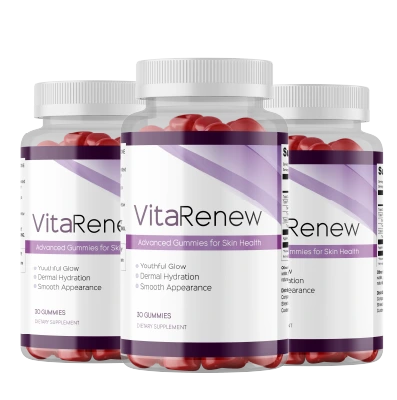
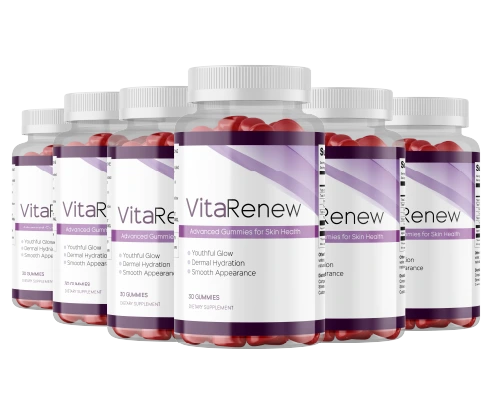
VitaRenew is a daily collagen gummy built around what this research points to — the specific nutritional support your skin's structural layer needs from within, not the surface:
- Type I & III collagen peptides — the two types most researched for skin elasticity and firmness (not Type II, which is joint collagen and a common substitution in cheaper products).
- Vitamin C included — the required cofactor for collagen synthesis, already in the formula.
- Hyaluronic acid and silica — to support hydration and connective tissue alongside the collagen.
- One gummy per day — easy to remember and maintain; compliance is typically much better with gummies than with powders.
- Third-party tested — no gluten, soy, dairy, or GMOs.
The honest version: VitaRenew is a supplement. It won't recover what's been lost over years, and it's not a substitute for talking to your dermatologist or your doctor if something feels medically off. But if you're in that perimenopausal window where the elasticity change is new, recent, and noticeable — and you want to do something that targets the underlying cause rather than just layer on more topicals — this is a well-reasoned, low-risk starting point. The 2-jar starter is a 60-day window with a money-back guarantee if your skin doesn't respond.
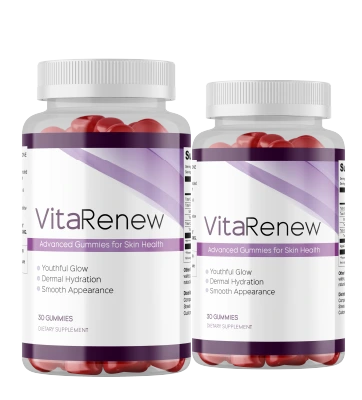
VitaRenew
Collagen peptides and cofactors, in one daily gummy — designed to support skin's structure from within.
The 2-jar starter is a 60-day way to find out if your skin responds. 60-day money-back guarantee · One-time purchase, no subscriptionWhat women say
"I'd been doing the pinch test on the back of my hand while watching TV for years — and one night I noticed it genuinely wasn't snapping back the way it always had. I started VitaRenew mostly because I wanted to try something that actually worked on the inside, not just the surface. By week eight the spring-back was noticeably faster."
"My dermatologist explained the estrogen-collagen connection when I brought up the firmness change. She didn't push back on collagen supplementation — she said the research is mixed but real enough. I tried VitaRenew for three months. The skin on my forearms and my jaw area just feels more substantial now."
These statements reflect individual experiences. Results are not typical and will vary from person to person.
The bottom line
If your skin's elasticity dropped suddenly — not over years, but in a span of months — there's a real biological explanation: the hormonal shift of perimenopause changes the rate at which the dermis loses collagen, turning a slow process into a faster one. Topical products address the surface. The deeper structural layer responds to what you give it from within. Daily collagen supplementation with vitamin C is the most research-backed nutritional approach to supporting that layer — which is what VitaRenew delivers.
The 2-bottle supply is the lowest-commitment way to find out whether your skin responds. A 60-day money-back guarantee means the risk is low. And if the answer turns out to be yes — the pinch test tells you soon enough.