Health & Wellness
Why Skin Starts to Sag After 40 — And What Actually Supports It
One morning the face in the mirror looks different. Not wrinkled — just softer, looser. Here's what's happening, and what actually helps from the inside out.

There's a particular morning most women can describe in detail.
You're in the bathroom, probably early, not fully awake. You lift your face toward the mirror and something looks — off. Not wrong, exactly. Not sick. Just different from six months ago. The skin at your jaw is softer. The side of your neck has a quality you'd call loose if you were being honest. You press your cheek gently and it doesn't spring back the way it used to.
You're 42, or 47, or 51. And you find yourself wondering: when did that happen?
I had that morning at 44. I've spent a lot of time since then trying to understand what was actually going on — not because I expected to find a miracle, but because I find it easier to make decisions when I understand the mechanism. And what I found changed which questions I was even asking.
It isn't what most people think
The easy explanation is gravity, or the sun, or not drinking enough water. Those aren't wrong. But they're not the main story either.
Skin has layers. The one you touch is a thin barrier — it keeps water in and the world out. Below it sits the dermis: a dense, springy mesh of collagen fibres, elastin fibres, and water-holding molecules. Together they give skin its thickness, its bounce, and its ability to hold its shape after being pressed or creased.
What changes after 40 is that mesh. Collagen production has been declining slowly since our mid-twenties — roughly one percent a year — slow enough that we don't notice it for a long time. Then, in the early-to-mid forties, estrogen levels begin to fall. Estrogen supports collagen and skin thickness; as it drops, the decline accelerates. The dermis becomes thinner, the fibres less tightly bound. The scaffold that held everything in place is thinner than it used to be.
Sagging skin is what a thinning scaffold looks like from the outside. It isn't falling — it's lost some of the internal structure that was holding its shape.
The part that surprised me: the body doesn't lose the ability to build collagen. The machinery is still there. What it sometimes lacks are the tools the machinery needs to run.
Why creams can only do so much
I tried everything. I wasn't naive — I knew the expensive jar wasn't going to rebuild my dermis. But when something is bothering you in the mirror, you try things.
Some topicals genuinely help. Retinoids have decent evidence. Certain peptides do something. But there's a physical ceiling: the outermost layer of skin is a barrier, and most molecules applied to it stay near the surface. The dermis — the structural layer — is harder to reach from the outside in.
This isn't a reason to throw away your skincare routine. It's a reason to think about what else might be possible, working from the inside out.
The tools the body needs
When I started reading about how collagen actually gets built — not at the marketing level, but at the biochemistry level — I found something I hadn't expected: the bottleneck isn't usually the building material.
Collagen synthesis is a chain of enzymatic steps. Each step requires specific cofactors — helper molecules without which the enzyme simply can't complete its job. Two of them matter most for the structural collagen in skin:
- Vitamin C. Two enzymes — prolyl hydroxylase and lysyl hydroxylase — give the collagen molecule its stable, helical shape. Both require vitamin C to function. Without it, collagen is produced in a weak, unstable form. This is textbook biochemistry; it's the reason scurvy destroys connective tissue.
- Copper. Once collagen fibres are formed, they need to be cross-linked into the load-bearing network that gives skin its mechanical properties. The enzyme that does this — lysyl oxidase — is copper-dependent. Without copper, the fibres are made but never bonded properly.
Zinc works at a different point: it supports skin repair processes and helps regulate the enzymes that break down old collagen, keeping turnover balanced.
What I found unexpected was how often these are missing from skin-focused supplements. Many formulas lead with collagen peptides — the raw material — without including the cofactors that determine whether the building process can actually complete. It's like sending bricks to a construction site without the mortar or the crew.
What I started looking for
Once I understood the mechanism, my checklist got simpler:
What to look for on a label
- Vitamin C in a real amount. Not a trace for marketing purposes.
- Both zinc and copper. They work at different steps of the same process. Most formulas include zinc; very few include copper.
- Antioxidant support. Vitamin E and selenium help protect existing collagen from oxidative breakdown while you're rebuilding.
- Verified manufacturing. FDA-registered facility. GMP-certified. Not a claim — a checkable fact.
- A realistic timeline. Dermal collagen takes months to remodel. Anyone promising noticeable results in a week is telling you something important about how honest they are.
- A money-back guarantee long enough to actually evaluate it. Sixty days minimum.
What I found
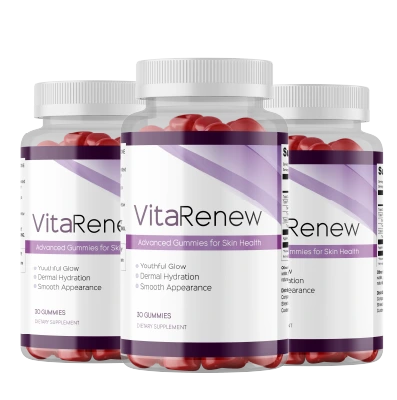
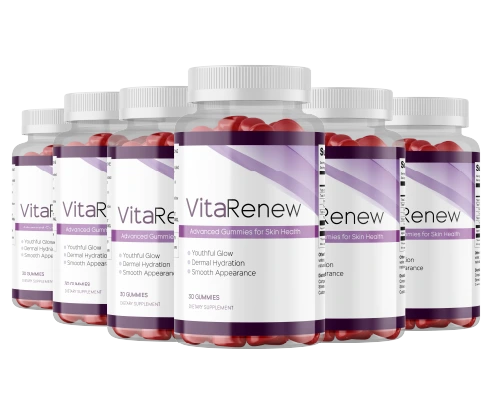
After going through a number of options against this list, the one that fit best was VitaRenew. It's a daily gummy — which meant I actually took it consistently, unlike capsules that ended up at the back of a drawer — with vitamin C, zinc, copper, vitamin E, selenium, and beta-carotene. It's made in an FDA-registered, GMP-certified facility and comes with a 60-day money-back guarantee.
The entry point is the 2-bottle supply at $79 per bottle. That's where I started — two months felt like a fair window to see if anything was actually changing before committing to more. The guarantee meant I wasn't risking much either way.
I want to be honest about this: it's a supplement, not a treatment. It supports skin, hair and nails. It does not diagnose, treat or reverse any condition — and these statements haven't been evaluated by the FDA. What I noticed after about ten weeks was that my skin felt less papery in texture and the looseness under my jaw looked slightly less pronounced in photographs taken in consistent light. That's a personal observation, not a controlled trial.
Referenced in this article
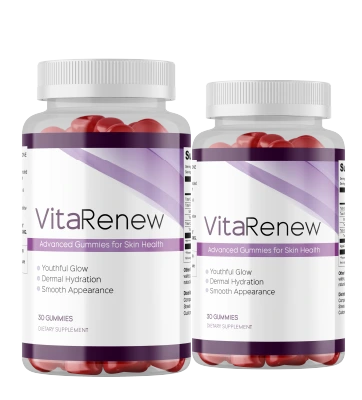
VitaRenew
Vitamin C, zinc, copper and antioxidants — the cofactors skin's structural repair actually needs — in one daily gummy.
The 2-bottle supply is where most people start. Sixty days is a fair window to decide.
60-day money-back guarantee · One-time purchase, no subscriptionWhat a realistic timeline looks like
The outer layer of skin turns over every four to six weeks, so you might notice something in texture and hydration within that window. The deeper structural layer is slower — dermal collagen remodelling takes months, which is why the research trials measuring skin changes usually run for 8 to 12 weeks before drawing conclusions.
Individual variation is real. Genetics, how much sun you've had over your lifetime, sleep, diet, and — particularly for women in the perimenopausal years — hormonal context all affect where you're starting from and how quickly things can shift. There's no honest way to promise a specific outcome to a specific person.
What I'd suggest: take a photograph on day one, in consistent light, at a consistent angle. Forget about it for eight weeks. Then compare. That's the only honest evaluation method, and it's the one the people running clinical trials use too.
"I've been skeptical of supplements my whole life, but my sister talked me into trying this after she had results she couldn't stop mentioning. At around eight weeks I noticed my neck skin looked less 'drapey' in photos. I'm on my third bottle now."
— Deborah H., 49, verified purchaser
"The thing nobody tells you about sagging skin is that it's not about dryness — I was using three different moisturizers and it wasn't changing anything. Switched focus to this and noticed my forearms felt different in texture within a couple of months. My husband asked what I was doing differently."
— Rosemary T., 57, verified purchaser
Individual results vary. These testimonials reflect personal experiences and may not be typical.
Worth saying: if you notice a skin change that is sudden, asymmetric, rapidly changing, or unusual in colour or texture, please see a dermatologist. Age-related sagging is gradual and symmetrical. Anything that doesn't fit that pattern deserves a professional look.
The short version
Skin sags after 40 because the dermal scaffold — collagen and elastin — thins over time, with the process accelerating as estrogen falls. Topical products have a real but limited ceiling; they work above the structural layer, not within it.
The body still has the capacity to build collagen. What the process often lacks are the cofactors — vitamin C, copper, zinc — that the enzymatic assembly line depends on. Those are the ingredients worth checking on a label.
I can't promise VitaRenew will do for you what it seemed to do for me. I can say the formula matches the mechanism I understand, and the risk of trying the 2-bottle option with a 60-day guarantee is minimal. That's the math I did, and it's the one I'd invite you to do too.
Product referenced in this article
VitaRenew
Supports skin, hair and nails with the cofactors most formulas leave out. FDA-registered facility. GMP-certified.
For the version of yourself that shows up in photos without apology.
60-day money-back guarantee · No subscription · Ships from the US