Skin losing elasticity after 40? Here's what's really going on


There's a moment a lot of women describe the same way. Not a dramatic change. Just a morning — sometime in their early forties — when they look in the mirror and something is slightly different. The skin along the jaw looks a little looser. A line that used to appear only when they smiled is now there without one. They press a finger into their cheek to test it, and it takes just a moment longer to settle back into place.
It's easy to brush it off as tiredness, or lighting, or a bad day. But it keeps happening. And if you've felt it, you're not imagining it — and it's not about which moisturizer you're using.
It's not your moisturizer's fault
This is the first thing worth clearing up, because it's the most common misconception. Skin hydration and skin elasticity are related, but they're not the same thing. A good moisturizer can absolutely make your skin feel softer, smoother, and more comfortable. What it can't do is restore the structural firmness that comes from deeper in the skin — a layer that topical products mostly can't reach.
That's not a knock on skincare. It's just anatomy. The firmness and "spring-back" quality of skin come from two proteins that live in the dermis, the thick living layer beneath the surface. And after 40, both of those proteins are in decline.
Meet the two proteins your skin runs on
The first is collagen — specifically types I and III, which act like the frame and padding of a mattress. They give skin its thickness, its density, and its resistance to pressure. When you press your finger into your cheek and it holds its shape, that's collagen working.
The second is elastin — the protein that lets skin stretch and snap back. It works like a rubber band woven through the tissue, allowing movement without permanent deformation. Young skin has an abundance of it. Skin after 40 has the same elastin fibers you've had since your teenage years, but years of sun exposure, oxidative stress, and normal aging have made those fibers gradually stiffer and more brittle.
Why it feels like it happened suddenly
The accumulation is gradual, but the perception of change often feels abrupt — and that's not a trick of memory. For years, the loss stays below the threshold of what you notice in a daily mirror. Then a combination of factors — reaching a certain cumulative level of structural loss, often compounded by the hormonal changes around perimenopause — crosses a visible threshold all at once.
Estrogen plays a real role in collagen maintenance. It signals the skin's collagen-producing cells to stay active. When estrogen levels drop in perimenopause and menopause, the rate of collagen breakdown speeds up and the rate of new collagen production slows. Studies tracking women through this transition have documented measurable reductions in skin thickness and elasticity over periods of months — not years. Which is why many women describe the change as "sudden" even though the underlying decline has been underway for a long time.
Where you notice it first tends to be wherever your skin is thinnest: around the eyes, along the jaw and neck, and on the backs of your hands. Places where there was less structural reserve to begin with.
What some women are adding to their routine
Over the past several years, a growing body of research has looked at whether supplementing with hydrolyzed collagen peptides — collagen that's been broken down into small, easily absorbed fragments — can support the skin's own collagen production from the inside. The idea is that these small peptides, once absorbed into the bloodstream, act both as building materials and as signals that prompt the skin's collagen-producing cells to step up their activity.
Multiple studies — including several randomized controlled trials — have found that daily collagen supplementation (typically for 8–12 weeks) is associated with meaningful improvements in skin elasticity and hydration compared to a placebo. It's not a dramatic before-and-after transformation, but the direction of the evidence is consistent, and the safety profile is very well established.
The critical ingredient alongside collagen is vitamin C: the body cannot assemble collagen at all without it. Think of vitamin C as the enzyme that puts collagen's structure together. A supplement that includes collagen peptides and the cofactors needed to use them is meaningfully more useful than one that supplies only collagen.
What we've been recommending
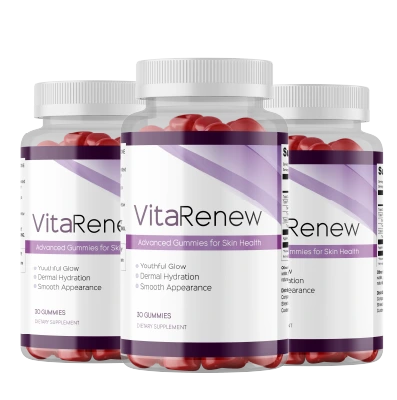
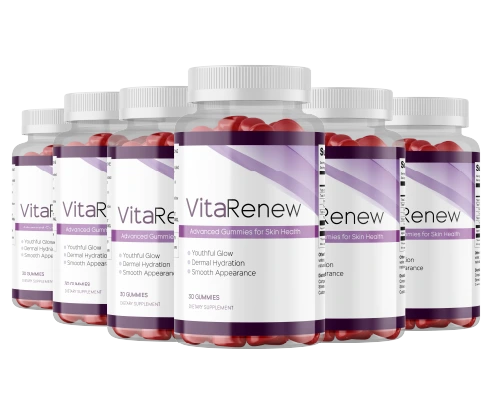
One approach that a growing number of women we hear from have found helpful is VitaRenew — a daily collagen gummy that covers the full picture:
- Type I & III collagen peptides — the specific types tied to skin firmness and elasticity in clinical research.
- Vitamin C included — so your body can actually use the collagen, not just absorb it.
- Hyaluronic acid — to support the skin's moisture-holding capacity alongside the structural work.
- Silica — which plays a role in the connective tissue matrix and supports hair and nails as well as skin.
- One gummy per day — no powder to measure, no large pills to swallow alongside breakfast.
The way we'd frame it: if you're looking for something that supports your skin's elasticity from within — not just on the surface — and you want it to be low-effort and low-risk, this is a sensible place to start. The 60-day money-back guarantee means a two-bottle supply is essentially a free trial if your skin doesn't respond. Most women who write to us report noticing their skin feeling more hydrated in the first two to four weeks, with changes in texture and firmness becoming clearer between four and twelve weeks.
Referenced in this article
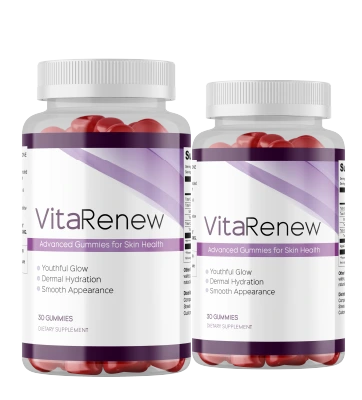
VitaRenew
Daily collagen gummy — Type I & III peptides with vitamin C, hyaluronic acid, and silica. One gummy, once a day.
For the morning your skin feels like it did a decade ago.
60-day money-back guarantee · One-time purchase, no subscriptionWhat some women are saying
"I'd been blaming my moisturizer for a year. Two months into VitaRenew, the skin on my cheeks stopped looking so loose. I still use the same moisturizer — but now it has something underneath it to work with."
"The pinch test was what got me. I did it one morning and couldn't believe how slow it was. Now, three months later, it's noticeably faster. My nails also completely stopped breaking."
These experiences are individual. Results are not typical and will vary from person to person.
A small, practical starting point
If your skin is losing elasticity after 40, the most important thing to understand is that it's not a product problem — it's a structural one. Moisturizers and serums can make a real difference to how your skin looks and feels at the surface. But if what you're missing is the bounce-back firmness that comes from deep in the dermis, the most direct approach is to support the production of what's declining down there.
A two-bottle supply of VitaRenew — 60 days — is the simplest way to test whether your skin responds to daily collagen support. There's no commitment beyond that, and the money-back guarantee means the risk is entirely removed. And as always, any sudden changes in your skin are worth a conversation with your doctor or dermatologist.