Perimenopause Made My Skin Crepey. Here's What I Found Out About Why.

I was 46 when my period started getting irregular. Around the same time — I don't know if it was months earlier or months later, I wasn't paying careful attention — I noticed that the skin on my chest, just below my collarbone, had changed. Not wrinkled in the way I expected wrinkles. More like crêpe paper: fine-grained, slightly crinkled, somehow both softer and thinner than it used to be.
I noticed it on my upper arms too. The inside of my elbows. The backs of my hands. I'd spent years treating my face with care and had more or less ignored the rest. Now the rest was announcing itself.
I asked my dermatologist about it. I expected her to recommend a body lotion. What she gave me instead was an explanation — and it was the first time I understood what was actually happening.
What she told me about estrogen and the skin
"Your skin has estrogen receptors," she said, and I remember thinking: that's not something I ever learned in health class.
She explained that the deeper layer of skin — the dermis, the structural layer beneath the surface — contains cells called fibroblasts. Their job is to produce and maintain the collagen and elastin network that gives skin its thickness and elasticity. And those fibroblasts are directly responsive to estrogen. When estrogen is at the levels typical of reproductive years, they stay active. When estrogen declines — as it does through perimenopause and menopause — fibroblast activity slows.
The result is a gradual net loss of the structural protein that makes skin feel firm and spring back when touched. The crepey texture I was seeing was what that loss looked like from the outside.
The part I didn't learn in the appointment
My doctor is wonderful, but appointments are fifteen minutes. She explained the hormonal mechanism and then moved on. What I spent the next few weeks doing was reading, because I had follow-up questions she didn't have time to answer.
The most useful thing I found was this: the body's ability to produce collagen doesn't disappear at menopause. It slows. And the slowdown is partly hormonal — driven by the estrogen drop — but partly biochemical. The manufacturing process depends on specific cofactors, and if those cofactors are in short supply, production stays limited regardless of what else is happening.
Three kept coming up in the research:
- Vitamin C — required by two enzymes that shape collagen molecules into their functional triple-helix structure. Without it, the collagen produced is weaker. This is well-established biochemistry, not a supplement claim.
- Copper — needed to activate the enzyme that cross-links newly made collagen and elastin fibers into a connected, resilient network. Without copper, fibers form but don't bind properly.
- Zinc — involved in ongoing skin cell renewal and the continuous repair processes that happen throughout the dermis.
The implication I kept coming back to: if my collagen production was already under pressure from the hormonal shift, the last thing I wanted was the assembly line running short of the materials it needs to operate. These weren't exotic compounds. They were nutrients — and they were addressable.
Why the chest and arms go first — and it made sense once I understood it
One of my follow-up questions was about location. Why was I noticing it on my chest and arms before my face? My face looked essentially the same. The rest of me had changed.
It turns out to be predictable. The skin on the upper arms and décolletage is naturally thinner than facial skin. It sits over looser connective tissue with less fat beneath it — less cushioning when the underlying structure changes. The face has more subcutaneous fat and generally receives more deliberate topical care. The chest and arms are thinner, less padded, and have typically accumulated more sun exposure over a lifetime.
When the dermis starts to thin and elastin becomes less resilient, those areas show it first. There's less reserve to absorb the change. It wasn't that my face was spared — it was that the arms and chest had less margin to begin with.
What I started doing — and what I noticed
I'm not someone who tries many supplements. I've always been skeptical of products that promise things they can't measure. What drew me toward a supplement in this case wasn't a promise — it was the cofactor idea. I wasn't trying to reverse anything. I was trying to make sure the process I understood was happening had what it needed to keep happening.
What I use
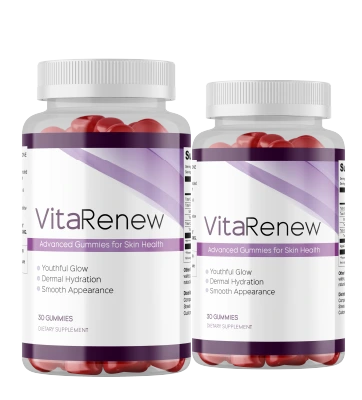
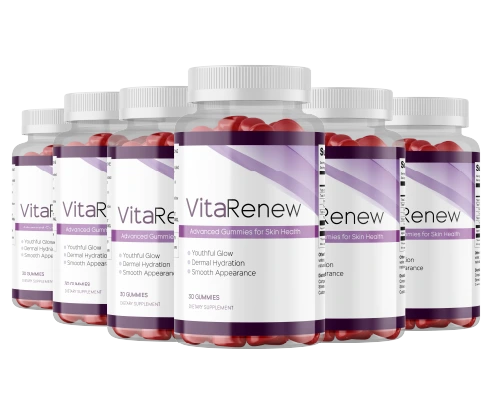
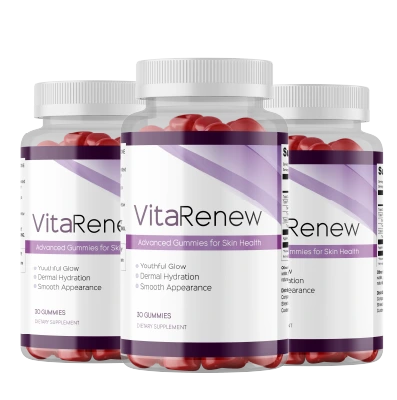
VitaRenew
Built around vitamin C, copper, and zinc — the three cofactors I kept reading about. A daily gummy from an FDA-registered, GMP-certified facility. 60-day money-back guarantee.
For the days when wearing what you want feels uncomplicated again.
What I started with was simple: a daily gummy that combined vitamin C, copper, and zinc in forms the body can actually use. I wasn't expecting dramatic results. I photographed my décolletage and upper arms on day one, in morning light by the bathroom window, because I knew I'd forget what the baseline looked like.
By the eight-week mark, the texture felt different. Not transformed — different. Less papery. Slightly more give when I pressed a finger into the skin of my upper arm. The visual change was subtle enough that I might have missed it without the photograph. With the photograph, it was clear.
By month three, I'd stopped thinking about it much. I wore the things I wanted to wear. That, more than any measurement, was the shift I'd been looking for.
What a realistic timeline looks like
The dermal layer is slow. Research on skin-directed supplementation typically measures outcomes at eight to twelve weeks because collagen remodeling is a months-long process. The surface layer of skin turns over faster — every three to six weeks — so some changes in texture may appear sooner. The structural changes are slower and harder to see in a mirror.
What I'd tell anyone starting this: photograph the same area in the same light on day one and set a reminder to check again at eight weeks. Don't expect dramatic. Expect gradual. And expect that genetics, sun history, hydration, sleep, and diet all influence how your skin responds — which means no two people see the same result on the same timeline.
What I can say honestly: this was the first time an explanation made sense to me, and the first approach I tried that seemed to work in a way I could actually see.
"I'm 51 and went through perimenopause early. The texture change on my arms and chest was the first thing I noticed. After about two months I started to feel like the skin had more... structure, if that makes sense. Less tissue-paper quality."
"I was in full menopause when I found this. The décolletage area was what I was most self-conscious about. A few months in, it's noticeably different — softer but also more resilient somehow. I'm not hiding it anymore."
These statements reflect individual experiences. Results are not typical and will vary from person to person.
Mentioned above
VitaRenew
Vitamin C, copper, and zinc in a daily gummy. Supports skin, hair, and nails from within.
For the week you stop reaching for a cover-up.