I Blamed My Moisturizer, My Sleep, and My Age — But the Real Reason My Skin Lost Firmness Was Estrogen
The connection between low estrogen and crepey, less-firm skin is real, measurable, and rarely explained clearly. Here’s what I learned — and what I started doing about it.

The first thing I tried was a richer cream. Then a collagen powder from the grocery store. Then cutting back on sugar, because someone mentioned glycation. Then “drinking more water,” which I was already doing.
None of it touched what I was seeing on my arms and chest — skin that had, somewhere in the last two years, begun to look thinner. Papery. The kind of texture you notice at a particular angle in certain morning light and then can’t stop noticing.
I was 47. I wasn’t in menopause yet. My cycles had become a little irregular, but nothing dramatic enough that I was connecting dots. I had always associated real skin changes with menopause — the full transition — not with the gradual hormonal shift I was already quietly in.
I was wrong about that. Once I understood the actual mechanism — not vaguely, but specifically — what was happening stopped feeling random and started making complete sense.
Why skin firmness and estrogen are connected at a structural level
Your skin has two main layers beneath the surface. The outer one — the epidermis — is what creams and serums reach. The inner one, called the dermis, is where the structural work happens. It’s built from collagen fibers (which give skin its thickness and resistance to wrinkling), elastin fibers (the snap-back quality), and glycosaminoglycans like hyaluronic acid that fill the space between fibers and hold water within the tissue from the inside.
All of that is actively maintained by cells called fibroblasts. And here’s the part that changed everything for me: fibroblasts have estrogen receptors. Estrogen directly signals these cells to stay active and productive.
When estrogen is relatively stable, fibroblasts receive a consistent signal to keep producing. When estrogen begins to fluctuate — as it does in perimenopause, sometimes for years before any dramatic hormonal milestone — that signal becomes unreliable. Collagen production slows. Existing collagen and elastin continue breaking down at their usual rate. Over time, the dermis thins. And the surface of the skin, especially in areas where it was already thin to begin with, begins to reflect that loss.
That was what I was seeing on my arms. Not menopause. Perimenopause — and the years of estrogen fluctuation that had apparently already been underway.
The areas that show it first — and the reason why
Upper arms. Inner elbows. Backs of hands. Chest and décolletage. If you’ve noticed changes in these areas, there’s a reason they showed up before your face did.
The skin in these areas is naturally thinner than facial skin. It has less underlying fat to cushion structural changes in the dermis. And it typically carries more cumulative sun exposure over a lifetime — which accelerates collagen breakdown through a mechanism entirely separate from hormones. These areas have the least structural reserve. When the dermis starts to thin, they show it first.
The face often holds longer: more subcutaneous fat, more topical attention over the years, a thicker starting baseline. So the arms and chest change while the face looks more or less the same — which is confusing if you’re not aware of why.
Mentioned in this article
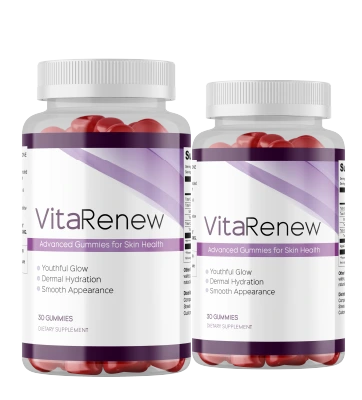
VitaRenew
A daily gummy with vitamin C, copper, and zinc — the cofactors collagen synthesis depends on. Made in an FDA-registered, GMP-certified facility. 60-day money-back guarantee.
Two bottles is a reasonable place to start.
60-day money-back guarantee · One-time purchase, no subscriptionWhat collagen synthesis actually requires beyond the hormonal signal
Here’s what I hadn’t found in any article I’d read on the topic: collagen production isn’t just a matter of getting the right signal from estrogen. It’s an enzymatic assembly process, and it depends on specific micronutrients at key steps. If those nutrients are in short supply, the collagen that does get produced is structurally weaker — or the process slows further than hormonal change alone explains.
Three nutrients matter here:
- Vitamin C is required by two enzymes — prolyl hydroxylase and lysyl hydroxylase — that shape each collagen molecule into its stable triple-helix structure. Without adequate vitamin C at this step, the collagen produced is less durable. This is established biochemistry, not supplement marketing.
- Copper activates lysyl oxidase, the enzyme that cross-links finished collagen and elastin fibers into the interconnected, load-bearing network the dermis requires. Fibers produced without adequate copper may end up present but poorly bound — a scaffold without bolted joints.
- Zinc supports ongoing skin cell renewal and governs the remodeling processes that maintain and repair the collagen matrix over time.
Most people aren’t dramatically deficient in any of these. But they’re also not specifically thinking about them in the context of skin structure during hormonal change. If collagen synthesis is already under pressure from estrogen fluctuation, running it with suboptimal cofactors compounds the problem.
Why topical products can’t fix this from the outside
Creams and serums work on the epidermis. They can genuinely improve surface hydration, smooth the feel of skin, and reduce water loss through the skin barrier. Those are real effects and there’s nothing wrong with a good moisturizer.
But the structural changes in the dermis — the thinning collagen matrix, the reduced elastin recoil, the declining glycosaminoglycans — are not accessible from the outside. The molecules involved are too large to penetrate the skin barrier, and the fibroblasts responsible for maintaining dermal structure aren’t in contact with anything applied topically.
This is what “the cream can’t reach where the problem is” means in practical terms. It’s not a criticism of skincare. It’s just the anatomy.
What I started — and what I noticed over three months
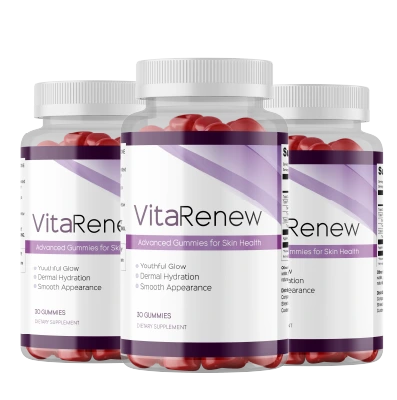
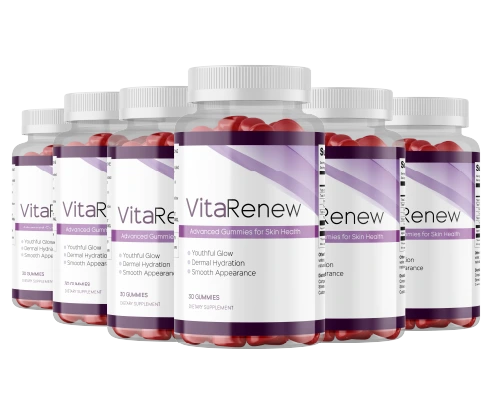
After understanding the cofactor mechanism, I looked for a consistently formulated source of vitamin C, copper, and zinc in a form I would actually take every single day. I wanted something that became part of my morning routine without thought or friction.
I started VitaRenew with the two-bottle option — 60 days, which felt like the right commitment for something new. The gummy format mattered for me. Capsules have a way of quietly disappearing from my routine. A daily gummy doesn’t.
I want to be clear about the timeline, because it’s important. At six weeks I wasn’t sure. Changes in skin texture are gradual — as gradual as the loss was. At ten weeks, the skin on my upper arms felt different when I touched it. More substantial. The fine crosshatch texture was still there, but visibly less pronounced in the morning light where I’d first noticed it. At three months, I was confident enough in what I was observing to continue.
I photographed the same area under the same light at the same time every three weeks. That’s the only way to assess something this subtle honestly — because memory and wishful thinking both distort perception when changes are gradual.
I can’t tell you my results will be yours. Skin responds individually to everything. What I can say is that the mechanism is real, the cofactors are real, and my experience is consistent with what I’d expect if they were making a difference.
“I’m 48 and started noticing crepey skin on my arms and chest about a year ago. I blamed the sun, then my moisturizer, then just ‘aging.’ Three months into VitaRenew I could see a real difference in texture. Not dramatic, but real — more substantial, less papery. I take a photo of the same spot in the same light every few weeks. The photos don’t lie.”
“What got me was the cofactor explanation. Once I understood that collagen synthesis is an enzymatic process with specific nutritional requirements, it made sense in a way a random collagen powder never did. Two and a half months in, the skin on my arms and hands feels more like it did a few years ago. I’m continuing.”
These statements reflect individual experiences. Results are not typical and will vary from person to person.
If you’re noticing the same pattern
If your skin texture started changing in the last one to three years — especially in the upper arms, chest, or backs of hands — and especially if it coincided with any other signs of hormonal shift, the connection may not be coincidental. The estrogen–dermis link is real and documented, and it doesn’t require full menopause to be active.
Perimenopause can begin in the early forties, and its effects on the dermis start well before the hormonal milestones most people associate with “the change.” I wasn’t in menopause when this started. I was in my mid-forties, with cycles that were only slightly different. That was enough.
What I focused on was what I could actually support: the cofactors. Consistently, daily, in a form I’d actually remember to take.
Product referenced above
VitaRenew
Vitamin C, copper, and zinc in a daily gummy. Supports skin firmness and elasticity from within. 60-day money-back guarantee.
I started with two bottles. That felt like the right first step.
60-day money-back guarantee · One-time purchase, no subscription