Skin Health · Explainer
Loose, Crepey Skin After Losing Weight: Why Doesn't It Snap Back?
You were told to expect some loose skin. You weren't told why it seems to stay — or what the skin's collagen and elastin network actually needs to regain the firmness it's lost.

There's a conversation happening in every gym locker room and in every weight-loss forum that nobody is finishing properly.
Someone lost twenty or thirty pounds. They did the work. They changed the number. And now they're left with loose, crinkled skin on their inner arms, their belly, their inner thighs — the kind of skin that drapes rather than fits — and the answer they keep getting is some version of "you lose some, you gain some."
That answer isn't wrong in the way that makes a bad answer satisfying to dismiss. It's wrong in the way that leaves a useful question sitting unanswered on the floor. The useful question is: what would it take for skin in this condition to do better?
There's a real answer, and it starts with understanding what "snapping back" actually requires of the skin — and why, for a lot of women in their forties and fifties, the prerequisites for that process were already running low before the weight loss began.
The skin's ability to recover after a change in volume isn't a fixed property. It depends on the state of the collagen and elastin network underneath — and that network has been quietly changing since your mid-twenties.
Snap-back requires something to snap with
Skin has a structural layer called the dermis, sitting beneath the thin, visible surface. That's where the architecture lives: dense collagen fibres providing thickness and resistance, elastin fibres providing recoil, and hyaluronic acid holding water between them to keep everything plump and supple.
In younger skin, losing a meaningful amount of weight often results in visible recovery — the skin retracts, re-drapes, and after some months begins to look closer to the new body underneath it. Not always perfect, but functional.
In midlife skin, the recoil is already diminished. Elastin fibres lose their springiness with age; stretched elastin doesn't contract as readily as it once did. The collagen mesh has thinned. There's less hyaluronic acid between the fibres. The underlying architecture that made snapping back possible has been gradually remodelling for decades.
So when the fat that was plumping the skin from the inside — filling the space between the dermis and the structures below it — thins significantly through weight loss, the dermis that remains may not have enough structural integrity to retract toward the new shape. The result is the loose, papery, crepey drape that most people recognize immediately and can't explain precisely.
The two overlapping processes that set the stage
Two things happen simultaneously in midlife that most discussions treat as separate problems:
The first is gradual collagen loss. Starting in the mid-twenties, the rate at which fibroblasts (the cells that build collagen and elastin) produce new material begins to fall. One percent per year is a rough estimate that appears in dermatology literature. Slow enough to be invisible, year by year.
The second is perimenopausal acceleration. Estrogen plays a significant role in maintaining dermal collagen density. As estrogen declines through the perimenopausal years — which can begin well before actual menopause — collagen loss accelerates sharply. Research has found that a meaningful proportion of skin collagen can be lost in a relatively short window around this transition.
When weight loss removes the subcutaneous fat padding during or after this window, it removes the cushion that was compensating for both processes at once. The skin reveals structural changes that were already present but obscured.
Why the obvious solutions don't help here
The first response most women try is topical: better lotions, firming creams, body oils applied twice a day. These genuinely improve the surface appearance for a few hours — the stratum corneum (the outermost layer of skin, a thin barrier of already-dead cells) becomes more hydrated, and the texture looks finer in the light.
Then it returns. Nothing about the dermis has changed, because nothing that can reach the dermis was applied.
The second response is collagen supplements — the powders and drinks that have become ubiquitous. These also have a real but limited effect. Collagen powder is protein; digestion breaks it into amino acids and short peptides, which enter the bloodstream as building material. The body then decides what to build. For a well-fed adult who isn't protein-deficient (which is most adults), the limiting factor isn't usually the building material.
It's the machinery.
What the collagen assembly line actually needs
Collagen synthesis is a process, not an event. Like any manufacturing process, it depends on more than raw materials — it depends on specific catalysts that the raw materials can't substitute for.
Vitamin C: required for structural stability
Collagen molecules work because of their shape: three protein chains wound into a tight triple helix. That configuration is maintained by two enzymes — prolyl hydroxylase and lysyl hydroxylase — and both are strictly dependent on vitamin C to function.
Without adequate vitamin C at the enzymatic level, collagen is still produced. It's just produced in an unstable form that doesn't hold its shape and can't form a functional network. This isn't a wellness-industry framing — it's the reason vitamin C deficiency (scurvy) causes connective tissue to break down. The mechanism is well-documented in biochemistry.
Copper: required for cross-linking
Newly made collagen and elastin fibres are, at first, separate threads. They do almost nothing in isolation. What converts them into a functional, resilient network is cross-linking — chemical bonds between fibres, performed by an enzyme called lysyl oxidase.
Lysyl oxidase requires copper to work. Without copper, fibres get produced and never bound together. The strands pile up without forming the structural network the skin depends on for firmness and recoil.
Copper is the most commonly absent ingredient in skin-support formulas. It's left out often enough that its absence explains a significant share of "I tried collagen powder and nothing happened" experiences. Raw material isn't the bottleneck. Cross-linking is.
And zinc
Zinc supports normal skin integrity and the continuous maintenance work the dermis does every day, almost all of which is invisible until it stops. It belongs on the same list.
Supply the material without the machinery and output doesn't change. This is why the supplement drawer full of collagen tubs often produces underwhelming results — the rate-limiting step is upstream of the building material.
What a useful formula looks like
Whatever you decide to do — and doing nothing is a legitimate answer — these are the questions worth asking before you spend money on anything for skin support after weight loss:
Six things worth checking
- Is vitamin C there in a real dose? Not a token trace for label purposes.
- Is copper there at all? Most skin formulas omit it. If it's absent, cross-linking isn't supported — that's the structural binding step.
- Is zinc included? For basic dermal integrity and repair.
- Is there antioxidant support (vitamin E and selenium are the standard pairing) to slow the oxidative degradation of existing fibres while the body works on rebuilding?
- Does the timeline in the marketing make sense? Dermal collagen remodelling takes months. Claims of results in days or a single week are about the seller, not the product.
- Is the guarantee long enough to actually evaluate it? Sixty days minimum, ninety is more honest given the timeline of how collagen remodelling works.
No. 1: VitaRenew
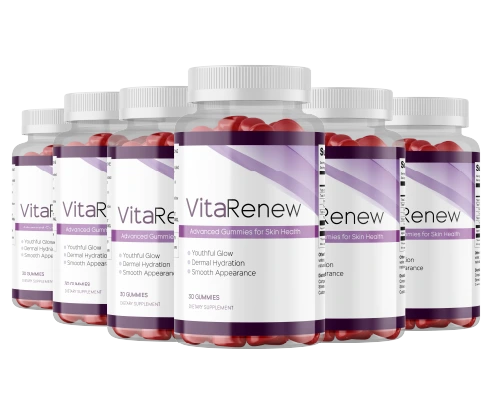
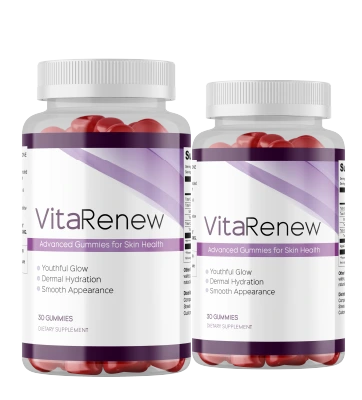
Of the formulas we looked at while putting this together, VitaRenew is the one built around the machinery side of collagen synthesis rather than the material side. It's a daily gummy containing vitamin C, zinc and copper, with vitamin E, selenium and beta-carotene for antioxidant support. Made in an FDA-registered, GMP-certified facility. Sixty-day money-back guarantee.
It is a supplement. It supports skin, hair and nails — it is not a treatment for any condition, and no responsible company would claim otherwise.
Referenced in this article
VitaRenew
Vitamin C, zinc and copper in a daily gummy — the three parts of the process most skin formulas leave out.
Because the collagen your body makes needs somewhere to go.
60-day money-back guarantee · One-time purchase, no subscriptionHow long to give it — and what to expect
The outer skin layer cycles roughly every four to six weeks — surface texture tends to shift first. The dermis is slower. Collagen remodelling in controlled study settings typically shows measurable results at eight to twelve weeks, and that's a reasonable benchmark to use as a starting point.
Three months is the minimum evaluation window that makes sense. Take a photograph on day one, in consistent lighting, without editing it. Expect gradual rather than dramatic. Individual results vary enormously depending on genetics, how much sun exposure the skin has had over a lifetime, sleep, stress and what the rest of the diet provides.
"I'd lost about 35 pounds over 18 months and the skin on my inner arms and belly was the part I hadn't anticipated. I tried a collagen powder for four months and genuinely couldn't tell any difference. When I read about the cofactor side — that vitamin C and copper are what make the process work — I switched to something that had all three. About ten weeks in, the texture started to feel denser. Not like I was 30 again, but meaningfully better."
"The loose skin on my thighs was my biggest frustration after losing 22 pounds. I'd assumed it would gradually improve on its own. When it didn't, I started looking into the why — not just the 'what to buy.' The cofactor explanation made sense to me because I'd seen nothing from collagen alone. Three months in on VitaRenew, I notice the texture is firmer and the skin feels less papery. Gradual but real."
These statements reflect individual experiences. Results are not typical and vary significantly between people.
The short version
Skin that's loose and crepey after weight loss isn't responding to a new problem — it's revealing a structural change that was underway for years and was masked by the fat that kept it plump. The skin's collagen and elastin architecture thinned through the natural aging process; the weight loss removed the cushion that was compensating for that thinning. The dermis still has the cells it needs to maintain its network. What's often running low is what those cells' assembly line depends on: vitamin C to stabilize each collagen molecule it makes, and copper to cross-link those molecules into a network that holds.
Understanding the difference between the material and the machinery turns out to be the most useful reframe in this conversation. The material isn't the bottleneck. The machinery usually is.
Product referenced above
VitaRenew
Vitamin C, zinc and copper in a daily gummy. FDA-registered, GMP-certified facility. 60-day guarantee.
For the next three months to end differently than the last four.
60-day money-back guarantee · Supports skin, hair and nailsOne practical note. If a skin change appears suddenly, feels different from the gradual bilateral changes described here, thickens, discolours, or includes a spot that changes shape — that's a dermatologist question. The kind of loose, crepey skin that follows significant weight loss in midlife is predictable, gradual and affects the same areas symmetrically. Things that don't fit that pattern should be evaluated by a professional, not a supplement.
Background reading
- Pullar JM, Carr AC, Vissers MCM. "The Roles of Vitamin C in Skin Health." Nutrients, 2017.
- Rucker RB et al. "Copper, lysyl oxidase, and extracellular matrix protein cross-linking." American Journal of Clinical Nutrition, 1998.
- Thornton MJ. "Estrogens and aging skin." Dermato-Endocrinology, 2013.
- Ogawa Y et al. "Zinc and skin disorders." Nutrients, 2018.
- Choi FD et al. "Oral Collagen Supplementation: A Systematic Review of Dermatological Applications." Journal of Drugs in Dermatology, 2019.