Skin Health · Deep Dive
Is Crepey Skin Permanent? The Honest Answer Starts Beneath the Surface
The structural change doesn't undo itself. But the question most women are really asking is a different one: is the door closed? The biology says it's more open than most answers suggest — and what you do about it depends on understanding where the process actually lives.

You know the moment. You are getting dressed or washing your hands and you notice that the skin no longer sits the way it used to. It is fine-textured, slightly loose, and when you press it, the impression takes a beat longer to settle. Maybe you run your fingers across the inside of your arm and think: this is new. And then you type the question.
The first ten results will either tell you to accept it gracefully or sell you a topical product that has a surface-level explanation attached to it. Neither quite answers what you're actually asking.
What you're asking is whether anything meaningfully changes what is happening — not whether a cream will make it look a little better temporarily. And that question has a real answer.
The structural shift — what changed and where
Below the skin surface you can touch is a layer called the dermis. It is a dense matrix of collagen fibres that provide firmness and thickness, elastin fibres that give skin its rebound, and hyaluronic acid that holds water between them. When skin springs back the instant you press it, that is the dermis functioning well.
Crepey skin is the visible result of this layer thinning. Not the outer surface — the structural layer beneath it. Fewer collagen fibres. Less cross-linking between them. Less elastic recoil. The outer layer may still hold moisture just fine. The scaffolding behind it has changed.
This explains something that confuses a lot of people: why a very good moisturizer can make crepey skin look noticeably better for a few hours — the barrier plumps with water and light reflects more evenly — and then look exactly the same by evening. Nothing was wrong with the moisturizer. Nothing structural was ever reached. The source of the texture is one layer deeper than any topical product reliably acts.
Why the forties are when most women notice it
Collagen production declines gradually starting in the mid-twenties — roughly one percent per year by the estimates most often cited. That rate is slow enough that most people don't notice the cumulative effect for a long time.
What accelerates the process in the forties is the hormonal shift. Estrogen has a documented role in maintaining collagen density and skin thickness. As estrogen falls through perimenopause, dermal collagen loss accelerates significantly. Research on the perimenopausal transition has found that a substantial proportion of skin collagen can be lost in the years immediately surrounding it.
So two curves meet: the slow gradient of age-related collagen decline and the steeper slope driven by the hormonal shift. When they intersect, the effect becomes visible — often rapidly, even though the underlying process had been building for years. This is not a consequence of neglect. It is a biological transition.
What the body still has the capacity to do
Here is what almost never appears in these discussions, and it changes the framing entirely: your skin has not forgotten how to maintain itself.
The cells that build and maintain collagen and elastin — fibroblasts — are still present in the dermis. The genetic instructions for collagen synthesis are intact. The enzymatic pathways are still running. Your body does not lose the ability to support dermal structure as you age. What it may be short on are specific inputs those pathways depend on.
Collagen synthesis is a multi-step biochemical process, and each step requires particular cofactors. Two of them are rarely discussed in the context of skin support, even though their roles are well-documented in the scientific literature.
Vitamin C and the stabilization step. After amino acids are assembled into a collagen molecule, the molecule must be folded into a stable triple-helix shape before it can function structurally. This folding is carried out by two enzymes — prolyl hydroxylase and lysyl hydroxylase — and both are entirely dependent on vitamin C as a cofactor. Without adequate vitamin C, collagen forms in a structurally weak, unstable shape that breaks down faster than healthy tissue. This mechanism is not a supplement-industry claim; it is the established biochemical explanation for why scurvy destroys connective tissue, documented in textbooks long before anyone marketed it for skin.
Copper and the cross-linking step. Newly synthesized collagen and elastin begin as loose, unbound threads. An enzyme called lysyl oxidase links them into the tightly woven, mechanically strong network that gives the dermis its properties. Lysyl oxidase is copper-dependent. Without adequate copper, fibres are produced but never assembled into functional structure — like building materials that are delivered but never bolted together.
Zinc supports normal skin integrity and the continuous maintenance processes the dermis performs throughout life. It is frequently included in skin formulations but often in amounts too small to matter against the background of an ordinary diet.
The machinery is there. The question is whether it has what it needs to run at the rate your body is asking of it.
Why oral collagen powder often disappoints
This is a useful parallel. Several controlled trials of oral collagen peptides have shown modest improvements in skin elasticity — the research is not nothing. But in most people eating a reasonably varied diet, amino acid supply is not the rate-limiting step in collagen synthesis. The rate-limiting step is often the cofactors — the enzymatic machinery that processes the raw material.
If vitamin C and copper are the bottleneck, adding more amino acids to the input end of a line that cannot fully process what it already receives will not change the output. The bottleneck remains a bottleneck. This may explain why supplementing collagen directly has produced modest and inconsistent results across individuals, while an approach targeting the cofactors has a more mechanistically coherent basis.
Referenced in this article
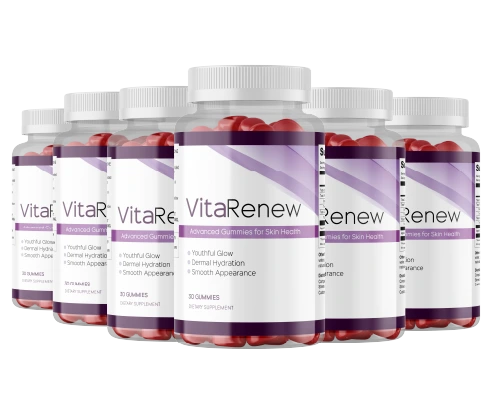
VitaRenew
Vitamin C, zinc and copper in a daily gummy — the cofactors collagen synthesis depends on, formulated for the step most products skip.
Not a promise. A mechanism with an address.
60-day money-back guarantee · One-time purchase, no subscriptionTwo things worth adjusting before you start anything
1. Your timeline expectation
The outer skin layer — the stratum corneum — turns over roughly every four to six weeks. Surface texture, tone, and hydration responses happen on that schedule. The dermis is considerably slower. Collagen remodeling is a process measured in months. This is why the controlled studies that look at supplements targeting dermal structure almost universally use eight to twelve week evaluation windows: that is the actual pace of the biology, not a design choice.
If you try something and evaluate it at six weeks, you are evaluating a process that takes at minimum three months to show structural change. Take a photograph in consistent light on day one. Look at it again at the three-month mark. Gradual change is invisible without a reference point — and gradual is what the dermis does.
2. What to look for in a formulation
A practical checklist
- Vitamin C in a meaningful dose — enough to actually support enzymatic function, not a trace added to justify the label claim.
- Copper and zinc together. They act on different steps of the same pathway and are rarely found together in skin formulations. Copper in particular is absent from most products — it doesn't market as aspirationally as collagen, but it is the cofactor for the cross-linking step.
- Antioxidant support (vitamin E, selenium) — collagen degradation from oxidative stress runs in parallel with synthesis. Addressing only one side of the equation is incomplete.
- A guarantee long enough to actually evaluate the product. Sixty days minimum — the dermis does not show structural change in thirty.
- A realistic timeline in the marketing. Any brand promising visible results in seven days is telling you something useful about itself, not the science.
- Third-party manufacturing standards. In a supplement category where label claims are not uniformly enforced, GMP certification and independent testing are the best available proxies.
What women report after approaching it this way
"I spent two years trying different topicals. Good ones — not drugstore things. Nothing changed the underlying texture. When I understood the cofactor argument — that it's not about more collagen peptides, it's about what the body needs to actually process them — I switched approaches. Three and a half months in. The skin on my arms and the back of my hands is less papery. I photographed it. The difference is real."
"I was skeptical because I'd been disappointed before. The sixty-day guarantee was what got me to try it — I figured worst case I'd get a full refund. I'm four months in now. I wouldn't call it dramatic, but my skin has a different quality than it did. Firmer. Less tissue-thin. I kept going. I'm on my third bottle."
These are individual accounts. Results vary and are not typical. No supplement can diagnose, treat, cure or prevent any disease or condition.
Product referenced above
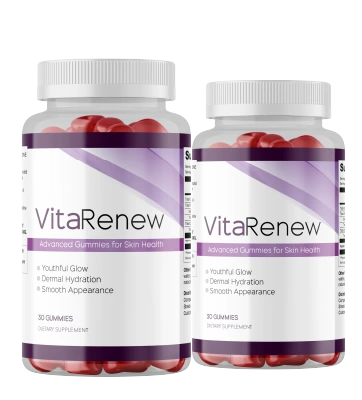
VitaRenew
Made in an FDA-registered, GMP-certified facility. Vitamin C, zinc and copper in one daily gummy. 60-day money-back guarantee.
The cofactor approach, for the skin that's still capable.
60-day money-back guarantee · Supports skin, hair and nailsBackground reading
- Pullar JM, Carr AC, Vissers MCM. "The Roles of Vitamin C in Skin Health." Nutrients, 2017.
- Rucker RB et al. "Copper, lysyl oxidase, and extracellular matrix protein cross-linking." American Journal of Clinical Nutrition, 1998.
- Thornton MJ. "Estrogens and aging skin." Dermato-Endocrinology, 2013.
- Proksch E et al. "Oral supplementation of specific collagen peptides has beneficial effects on human skin physiology." Skin Pharmacology and Physiology, 2014.
- Shuster S, Black MM, McVitie E. "The influence of age and sex on skin thickness, skin collagen and density." British Journal of Dermatology, 1975.