I Thought Crepey Skin Was Just Hereditary. Then I Actually Looked Into It.
My mother said it runs in the family. For years I believed her — and stopped asking what else might be going on.

I was washing dishes after a holiday dinner, the kind of task you do on autopilot, when I caught my own hand in the reflection of the kitchen window. The light was coming at an angle I don't usually see myself in, and what I noticed stopped me.
The skin on the back of my hand looked like my mother's. Not vaguely similar — genuinely alike in a way I hadn't registered before. The same fine texture, the same slight papery quality when I turned my hand over and pinched it gently. It didn't spring back the way it used to. I was 44.
I went into the living room and looked at my mother's hands on the armrest of her chair. She was in her early seventies, and her hands had looked this way for as long as I could remember. She had always waved it off with the same phrase: "It runs in the family. Nothing you can do about it."
I had heard that my whole life and never thought to question it. Standing there in the kitchen with dish soap still on my hands, I thought: is that actually true?
The assumption I had been carrying for twenty years
I grew up watching the women in my family age a particular way. My grandmother's arms, my mother's hands, my aunt's chest — the same loose, slightly crinkled texture by their mid-forties. I had always filed this under "what we get." Genetics. Destiny. Not a thing to research, just a thing to accept.
The problem with that kind of inherited belief is that it does the work of a conclusion without doing any of the work of a question. I had never actually looked into whether crepey skin was primarily hereditary. I had just absorbed the idea from the women who raised me, and it had sat there undisturbed for two decades.
After that holiday dinner, I decided to actually find out.
What I found when I looked at the genetics research
The short answer is: genetics does play a role. There is genuine evidence for this. Studies that compare identical and fraternal twins — which tease apart what's genetic from what's environmental — have found that roughly 60% of visible skin-aging variation can be attributed to genetic differences between individuals. That is a real and meaningful contribution, and it explains something I had observed my whole life: why some women age faster than others with similar sun exposure and habits.
But 60% heritability is not the same as inevitability. Here is the distinction that changed everything for me.
Heritability measures variation between individuals. It explains why your skin ages at a different rate than your cousin's. It does not explain why either of you is aging at all — because the underlying process is the same for both of you, running at different speeds. Genetics is the throttle. It is not the engine.
The engine is something else entirely. And once I understood what it actually was, I stopped feeling like I was watching a predetermined outcome unfold.
The mechanism no one had explained to me
The structural layer of skin — the part that gives it thickness, firmness, and the ability to spring back — is called the dermis. It lies beneath the surface you can touch, and it is built from three main components: collagen fibers, elastin fibers, and water-binding compounds called glycosaminoglycans. All of these are produced and maintained by specialized cells called fibroblasts.
Fibroblasts do not stay active at the same level throughout life. With age, their activity naturally declines. Collagen is lost at roughly one percent per year from the mid-twenties onward — slowly at first, in ways the body compensates for, and then more visibly as the years accumulate. Elastin, which provides the snap-back recoil of younger skin, breaks down gradually and is replaced slowly if at all. The water-binding compounds decrease alongside the structural proteins.
The result is a dermis that is progressively less dense. And skin that sits over a less dense dermis develops the fine, crinkled surface that my mother had called "just how we age."
In women, this process picks up speed around the hormonal transitions that come with perimenopause and menopause. Fibroblasts have estrogen receptors — they respond to estrogen as a maintenance signal. When that signal becomes inconsistent, their output slows further. The decline that was already happening accelerates.
Why arms, hands, and chest show it first
The pattern I had observed in my family — arms first, then chest, then hands — made more sense once I understood the anatomy. The skin in these areas is structurally thinner than facial skin. There is less subcutaneous fat beneath it. The face has more natural cushioning, tends to receive more deliberate skincare attention, and has a thicker dermal layer as a starting point.
The arms, chest, and backs of the hands also tend to accumulate more lifetime UV exposure — and UV radiation breaks down collagen through a mechanism separate from hormonal change, by activating enzymes that degrade existing fibers. These areas have less structural reserve, so when the dermis starts to thin, they are the first to show it at the surface.
My mother's hands had not aged in a uniquely hereditary way. They had aged the way arms and hands age — a little faster in our family than in some others, perhaps, because of whatever genetic variants we carry that influence collagen synthesis efficiency. But the process was the same one that runs in everyone.
Mentioned in this article
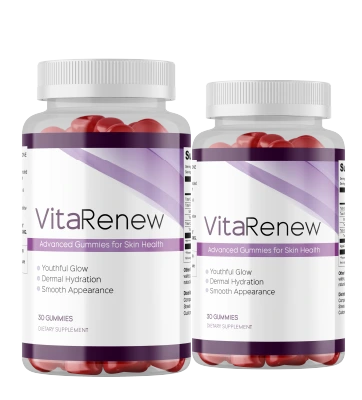
VitaRenew
A daily gummy with vitamin C, copper, and zinc — the cofactors collagen synthesis depends on. Made in an FDA-registered, GMP-certified facility. 60-day money-back guarantee.
I started with two bottles. That felt like the right amount of commitment for something new.
60-day money-back guarantee · One-time purchase, no subscriptionThe part I hadn't expected: what collagen synthesis actually needs
This is where the research went somewhere I hadn't anticipated. I had assumed that if collagen production was slowing because of age and hormones, there was nothing nutritional to do about it. The biological forces were the biological forces.
But collagen synthesis is not just a matter of having the right signal. It is an enzymatic assembly process — and like most enzymatic processes, it depends on specific nutrients as cofactors at key steps. This is basic biochemistry, not supplement logic. And it turned out to matter:
- Vitamin C is required for two enzymes — prolyl hydroxylase and lysyl hydroxylase — that give each collagen molecule its stable, functional structure. Without adequate vitamin C, the collagen produced is weaker and more prone to breakdown. The body cannot store it in meaningful amounts, so ongoing intake levels matter.
- Copper activates lysyl oxidase, the enzyme that cross-links collagen and elastin fibers into the load-bearing network the dermis needs to function. Fibers that are synthesized without adequate copper end up poorly connected — present, but not doing their structural job effectively.
- Zinc plays roles in fibroblast activity, in regulating the enzymes that govern collagen turnover, and in supporting the ongoing renewal of skin cells throughout the dermal layer.
The implication, once I understood it: if my collagen synthesis was already running slower because of age and the beginning of hormonal transition, and I was also potentially running the process with insufficient cofactors — not because of any dramatic deficiency, but simply because most people don't specifically think about these nutrients in the context of skin — then there might be room to help by addressing that gap.
What I decided to do — and how honest I want to be about it
I wasn't looking for a miracle. I've tried enough things over the years to know the difference between a promise and a mechanism. What I was looking for was a well-formulated, consistent source of these three specific cofactors in a form I would actually take every day.
I found VitaRenew. I started with two bottles — sixty days' worth — because that felt like the right level of commitment for testing something new. The gummy format helped; it became part of my morning routine instead of a capsule I'd have to remember separately.
I want to be honest about what I can and can't say. I can't tell you what your experience will be. I can tell you mine. And I can tell you the actual timeline — because the expectation management matters more than the result.
What I noticed, and when
At six weeks, I wasn't sure. I was looking too often, and with too much wishful thinking, to trust my own perception.
At ten weeks, I was more confident. I had started photographing the same spot on the back of my left hand in the same light every few weeks, specifically to cut through the noise of daily perception. In the photos, the difference was real. The texture was less pronounced. The skin, when I pinched it, felt more substantial — not dramatically, but noticeably.
At three months, I stopped second-guessing it. My husband, who had not been following along with my experiment, commented on my hands unprompted. That felt like the most reliable confirmation.
What I know now: my skin will continue to change. I am still in my mid-forties, still moving through the same hormonal transition as millions of other women. The process I was watching in my family will continue in me. But I feel differently about what I am doing in response to it — not watching a predetermined outcome, but supporting the biological machinery that is still working, with the inputs it actually needs.
"Crepey skin does run in my family, but I finally stopped treating that as the full answer. At 48 I started looking at the science instead of just accepting it as fate. Three months with VitaRenew and the skin on my arms genuinely looks and feels different. Not reversed — but noticeably improved in texture and the way it holds when I move. I'll keep going."
"My mother and grandmother both had the same crepey texture on their arms by their mid-forties. I assumed I was heading the same direction. The cofactor explanation was new to me — I had never thought about what collagen synthesis actually requires to run. Two and a half months in and I can see a real difference in the photos I've been taking. The skin is smoother and more cohesive-looking."
These statements reflect individual experiences. Results are not typical and will vary from person to person.
Product referenced above
VitaRenew
Vitamin C, copper, and zinc in a daily gummy. Supports skin firmness and elasticity from within. 60-day money-back guarantee.
Heredity shapes the pace. Giving the process its required inputs is still something you can do.
60-day money-back guarantee · One-time purchase, no subscription