Skin Health · Personal Investigation
Is Crepey Skin a Sign of Dehydration? What the Science Actually Says
I tracked my water intake for three months, used every moisturizer recommended to me, and the texture on my arms barely changed. When I actually looked into the biology, the reason was straightforward — and it isn't dehydration.

A year ago I convinced myself I had a hydration problem.
The skin on my inner arms and the backs of my hands had developed that thin, crinkled texture — the kind that looks like tissue paper in the wrong light and doesn't respond when you press it. I was 51. I'd seen it coming for a few years and kept telling myself the answer was simple: drink more water, find a better moisturizer, be more consistent with my routine.
So I got more consistent. I tracked my water intake. I tried a higher-end body lotion that cost me more than I want to admit. And at the end of three months, standing in my bathroom in the same kind of light, my arms looked essentially the same.
That's when I stopped blaming myself and started asking better questions.
Why the dehydration explanation feels right but isn't quite
Here's the logic that keeps the dehydration theory alive: dry skin looks rough and dull. Water plumps things up. Lotion helps dry skin. Therefore: crepey skin equals dry skin equals a hydration problem.
Each of those individual statements is partially true. The chain they form is where it falls apart.
Dehydrated skin and crepey skin are two different conditions. Dehydrated skin — genuinely parched, water-deficient skin — looks dull, feels tight, may flake slightly, and responds when you address it. It lives in the outermost layer of the skin, the barrier layer, and that's where products can reach it.
Crepey skin sits one layer deeper. It's not a barrier problem. The texture comes from structural changes inside the dermis — the thick, complex layer beneath the barrier where your skin's actual scaffolding lives. No matter how well you address the outer layer, you aren't reaching what's driving the texture change.
I was putting very good products on the right street but the wrong building. Moisturizer reaches the surface layer. Crepey skin is a dermis problem — one floor down.
What the dermis actually contains
When I read up on skin anatomy properly for the first time — not the marketing version, the actual biology — two proteins kept coming up in the context of the texture I was dealing with.
The first is collagen. This is the structural protein that gives skin its firmness, thickness, and volume. It's what makes skin press back against your finger. Collagen production in the dermis runs continuously, but it declines gradually from the mid-twenties — roughly one percent per year on average. That pace is slow enough that nothing obvious happens for a long time.
The second is elastin. This is the protein that gives skin its snap-back quality — the ability to return immediately to its original shape after being stretched or folded. When elastin function is strong, skin bounces back. When it's declined, skin settles slowly into folds and creases. The papery quality that makes crepey skin recognizable is partly a loss of this rapid recoil.
Neither of these proteins is located in the outer barrier layer. They're in the dermis. And that's why the topical products that work on the barrier layer — hydrating serums, body lotions, even high-quality moisturizers — can make the surface look and feel better temporarily, but can't reach the source of the texture.
Why the forties feel like the turning point
I'd been losing collagen gradually since my late twenties without knowing it. The system was thinning slowly — too slowly to see in the mirror, too slowly to feel. What changed in my forties wasn't the start of a new process but the convergence of two processes that had been running at different speeds.
Estrogen actively maintains dermal collagen density throughout a woman's reproductive years. When estrogen levels begin declining through perimenopause, the pace of collagen loss accelerates — considerably. Research on skin changes around menopause has found that a notable proportion of skin collagen can be lost in the years immediately around it. Not over decades — in years.
So what felt like something that happened quickly — a threshold crossed sometime around 48 or 49 — was actually two declining curves meeting. The slow background slope of age-related collagen loss intersecting with the sharper decline that comes with hormonal change. By the time the texture was obvious in the mirror, the process had been building quietly for years.
I found this oddly reassuring, honestly. It wasn't a failure of my skincare routine. It was biology — and biology can at least be understood.
The part that actually helped me
What I found when I kept reading was this: collagen synthesis doesn't stop in your fifties. The cells that produce it — fibroblasts — are still present in the dermis. The assembly line is still running. What changes is the efficiency and completeness of the process, and that depends heavily on whether certain nutritional inputs are available.
Two of them are essential in ways most people don't know:
- Vitamin C is required for the enzymes that stabilize newly formed collagen into its structurally useful final shape. Without adequate vitamin C, the collagen produced is weak and unstable — this is the same mechanism behind scurvy, which destroys connective tissue when vitamin C is severely depleted. The relationship isn't a supplement claim; it's been in biochemistry textbooks for decades.
- Copper activates the enzyme that cross-links individual collagen and elastin fibres into the dense, woven network that gives skin its firmness and snap-back. This cross-linking is what turns loose fibres into functional structure. Copper is almost never in skin supplements despite being essential to the process that actually builds the matrix.
Zinc rounds out the picture — involved in skin cell turnover and the continuous maintenance processes in the dermis throughout life.
What struck me about this was the contrast with what I'd been taking. A collagen peptide supplement — amino acids that serve as raw material. The research on those products is real, but modest. And reading through why they're modest made sense once I understood the mechanism: in most well-nourished adults, raw material isn't the bottleneck. The enzymatic steps are. And those run on vitamin C, copper, and zinc — the tools of the assembly line, not the raw material going into it.
Referenced in this article
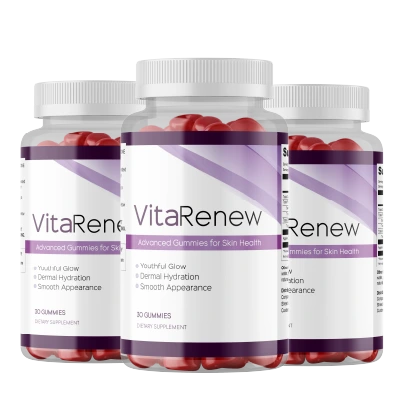
VitaRenew
Vitamin C, zinc and copper — the specific nutrients the dermis depends on for its structural maintenance — in one daily gummy.
Reach the layer that actually determines how the skin looks and feels.
60-day money-back guarantee · One-time purchase, no subscriptionWhat I looked for in a product
After understanding the mechanism, the criteria for a useful product became straightforward:
- Vitamin C in a quantity that could actually support enzymatic activity — not a token amount added for the label
- Zinc and copper together, since they operate at distinct steps and copper is the one most consistently left out
- A realistic guarantee period — at least 60 days, ideally longer, because dermal remodelling happens on a timeline of months, not weeks
- Manufacturing transparency: FDA-registered facility, GMP-certified production
- Marketing that doesn't claim visible results in seven days, because anything promising that is telling you something about the seller
On timeline and honesty
The outer skin layer turns over every four to six weeks, so you can notice surface changes — tone, smoothness — relatively quickly. The dermis is slower. Collagen remodelling is measured in months. Most controlled studies of skin-directed supplements use eight to twelve week evaluation periods for exactly this reason.
I took a photo on the first day in the same light I always hated. I gave it three months. The change I noticed wasn't dramatic or sudden — it was gradual and real. Less papery. Not like being in my thirties. But genuinely different from where I started.
Individual results vary. I say that because it's true, not just because it's the disclaimer.
What others are finding
"I went into it skeptical. I'd tried everything topical and nothing lasted. My daughter suggested I look at what the skin's structure actually needs internally. Three months later I took a photo in the same window light I'd been avoiding for two years. My arms looked better. Not fixed — better."
"What convinced me was that the approach finally made biological sense. Not a moisturizer, not a serum — nutrients for the layer underneath. The 60-day guarantee made trying it a practical decision. I'm on my second bottle and I intend to stay on it."
These are individual accounts. Results are not typical and vary considerably based on individual factors including genetics, sun history, diet and overall health. No supplement is intended to diagnose, treat, cure or prevent any condition.
Product referenced above
VitaRenew
Vitamin C, zinc and copper in a daily gummy — the cofactor approach for the structural layer. Made in an FDA-registered, GMP-certified facility. 60-day guarantee.
For the days when a mirror should feel like information, not a verdict.
60-day money-back guarantee · Supports skin, hair and nailsBackground reading
- Pullar JM, Carr AC, Vissers MCM. "The Roles of Vitamin C in Skin Health." Nutrients, 2017.
- Rucker RB et al. "Copper, lysyl oxidase, and extracellular matrix protein cross-linking." American Journal of Clinical Nutrition, 1998.
- Thornton MJ. "Estrogens and aging skin." Dermato-Endocrinology, 2013.
- Proksch E et al. "Oral supplementation of specific collagen peptides has beneficial effects on human skin physiology: a double-blind, placebo-controlled study." Skin Pharmacology and Physiology, 2014.
- Ogawa Y et al. "Zinc and skin disorders." Nutrients, 2018.