Skin Health · Personal Essay
Does Smoking Cause Crepey Skin? I Finally Stopped Blaming the Wrong Thing
I quit over six years ago. But my arms still tell the story. Understanding what cigarettes actually do below the surface was the starting point I needed.

I quit smoking when I was forty-four. After fourteen years, I put them down — not easily, but I did it, and I was proud of myself. I figured my health would catch up to me eventually. And a lot of things did improve.
But there was one thing I kept noticing in my fifties that I couldn't seem to explain away. The skin on my arms — the inner forearms, the upper arms, the backs of my hands — had a quality to it that felt different from what I'd expected. Thin. A little papery. When I pinched it lightly it folded in a way it hadn't used to fold, and it was slow to spring back. My friend Denise, who is exactly my age and never smoked a day in her life, didn't have the same thing going on. I asked her about it once and she said, genuinely puzzled, "I don't know what you mean."
That told me something. I started blaming the sun, or my mother's genetics, or just bad luck. But eventually I came across a more specific explanation — one that made sense of what I was seeing and pointed me somewhere useful.
What I got wrong about how smoking ages skin
I'd always assumed smoking aged the face — the lines around the mouth, the dullness, the gray undertone I remembered from my smoking years. I knew that was real. What I didn't understand was that the skin changes that come from smoking are not mainly about the surface. They happen in a deeper layer, and that is why they can stick around after you quit.
Skin has layers that matter differently. The top is the barrier — the thin outer coat that holds moisture in and keeps irritants out. Below it is the dermis: a living structure of collagen fibers that give skin its thickness, elastin fibers that let it spring back, and water-retaining molecules that keep everything plumped and supported. When we talk about skin that looks firm and "bouncy," we're describing a dermis with good architecture. When we talk about crepey skin — that thin, folded, tissue-paper quality — we're describing what a thinning dermis looks like from the outside.
Smoking does something specific to this deeper layer. And it does it through mechanisms that are still operating, in their effects, even when the cigarettes are gone.
The three things tobacco does inside your skin
I am going to explain this as plainly as I can, because once I understood it, I stopped feeling confused and started feeling like I could actually do something.
First: cigarette smoke activates a family of enzymes in the dermis called matrix metalloproteinases — MMPs. These enzymes are not unusual; healthy skin uses them for ordinary tissue repair and remodeling. The problem is that tobacco smoke causes them to become chronically overactivated. MMP-1, in particular, is what researchers call a "collagenase" — it digests collagen. When it is running at higher-than-normal levels for years, it breaks down the collagen scaffolding faster than the body can replace it. The visible result is thinner skin that has less structural support.
Second: nicotine causes the small blood vessels in the skin to narrow — a process called vasoconstriction. This reduces the blood flow that delivers oxygen and nutrients to the fibroblasts, which are the cells responsible for producing and maintaining the collagen and elastin in the dermis. One of the key things those cells need is vitamin C — an essential cofactor for the enzymes that build functional collagen. Lower blood flow may mean chronically lower vitamin C delivery to skin fibroblasts, even when your diet looks fine.
Tobacco smoke also generates a very high free-radical load. Elastin — the protein behind your skin's "snap-back" quality — is particularly vulnerable to this kind of oxidative damage. Once oxidized, elastin loses its elasticity. It no longer recoils the way it should. This is a structural change, not a surface dryness that moisturizer can address.
All three things were happening simultaneously in my skin for fourteen years. And while the ongoing insult of smoking stops when you quit, the structural changes that have already occurred — the thinning, the disorganized fibers, the less-elastic elastin — are not simply reversed. The body still has the capacity to support the repair process. But it depends on what you give it to work with.
The missing piece I hadn't thought about
This is where my understanding shifted. I'd tried a couple of collagen powders and topical serums, both of which did something for surface texture but nothing for the underlying issue I could point to. A dermatologist I spoke with put it this way: "Collagen supplements give you raw material. But if the building process has a bottleneck, more raw material doesn't fix it."
The bottleneck she described was cofactors — specific nutrients that function as the enzymatic machinery for collagen assembly:
- Vitamin C is required by two enzymes that give each collagen molecule its functional triple-helix structure. Without enough of it, the collagen produced is unstable. This relationship is not speculative — it is the biochemistry of scurvy, documented for over a century. The concern for former smokers is that years of impaired blood flow to the skin may have chronically limited delivery to the cells that needed it most.
- Copper is required by the enzyme that cross-links finished collagen and elastin fibers into an organized, load-bearing network. Without it, fibers are produced but never properly bound together. Skin that can't cross-link its collagen effectively has the same outcome as skin not producing enough — it lacks structural stability. Copper is also one of the most commonly missing nutrients on supplement labels, which I found frustrating once I knew to look for it.
- Zinc supports ongoing skin integrity and is involved in the continuous low-level repair that happens in the dermis all the time, even without injury.
The gap, in short, is not usually the collagen itself — it's the enzymatic process that assembles and organizes it. That's what the cofactors address.
What I've been using
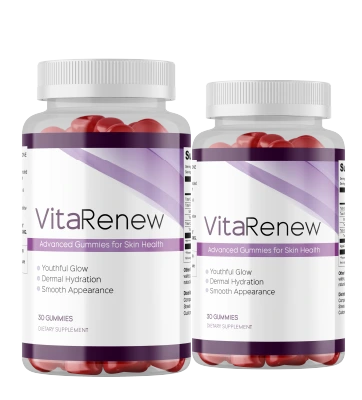
VitaRenew
A daily gummy with vitamin C, zinc, and copper — the three cofactors I couldn't find together on a single label — plus vitamin E, beta-carotene, and selenium.
For the repair process that runs on nutrients, not just topicals.
60-day money-back guarantee · One-time purchase, no subscriptionWhat I actually look for now
After going down this road, here's my checklist — the things I look for when evaluating any skin support supplement:
- Vitamin C in a real dose. Not a trace amount added for the label. Enough to actually support the hydroxylase enzymes that depend on it.
- Copper, explicitly named on the label. Not assumed to be "in there somewhere." It is the most commonly missing piece, and it is non-negotiable for the cross-linking step.
- Zinc alongside the copper. They work at different points of the same assembly process. Both matter.
- Antioxidant support — vitamin E and selenium — to slow the ongoing oxidative degradation of existing fibers while synthesis works to build new ones.
- A genuine money-back guarantee — sixty days minimum. Dermal collagen remodeling takes months, not days. Anything shorter doesn't give you enough time to evaluate whether it's working before you're out the door.
- GMP-certified facility. A verifiable claim, not a marketing phrase.
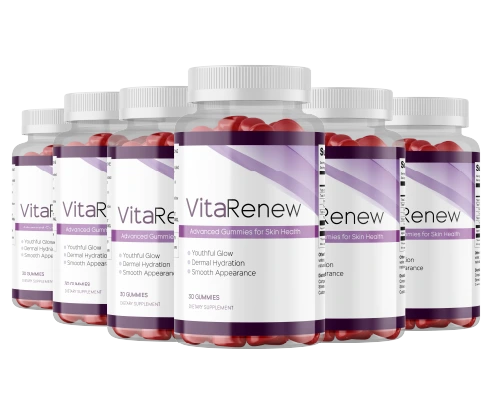
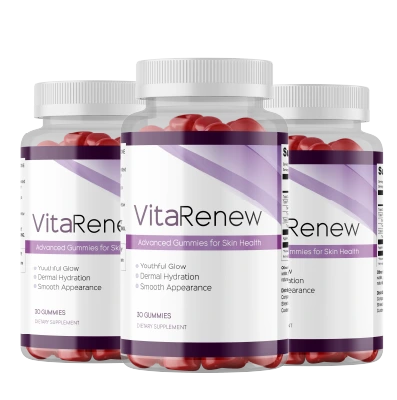
The formula that matched all of these for me is VitaRenew — a daily gummy built around vitamin C, zinc, and copper, with vitamin E, beta-carotene, and selenium for antioxidant support. Made in an FDA-registered, GMP-certified facility, sixty-day guarantee. It is a supplement: designed to support skin, hair, and nails. Not a treatment, not a cure.
A two-bottle supply — sixty days at the lowest upfront cost — is how I started. That's enough time to run a genuine evaluation of whether something is working for you before committing to more.
What to expect honestly
I want to be straight with you about this, because unrealistic expectations are how supplement disappointment usually starts.
The outer skin layer turns over in four to six weeks, so some surface texture changes can show relatively early. The dermis is slower. Meaningful collagen remodeling is measured in months — most clinical studies in this area run eight to twelve weeks for good reason. I started noticing something at about seven weeks: the crepey texture on my inner arms was less pronounced, and the skin on my hands felt more like it used to. Not dramatically different. Noticeably different.
Your results will depend on your genetics, your sun history, your smoking history, your diet, your sleep — all the factors that vary from person to person. A supplement that genuinely supports the repair process doesn't override those factors. It is one more thing pointing in the right direction.
"I smoked from eighteen to forty-two. Quit cold turkey and never looked back. But my skin — especially my chest and upper arms — kept looking thinner every year. I started VitaRenew after reading about the cofactor angle. About nine weeks in, my chest skin looks noticeably fuller and my arms less papery. I didn't expect anything dramatic and I didn't get it, but the change is real."
"Never smoked myself, but lived with a smoker for twelve years. I've wondered about secondhand exposure a lot. Whatever the cause, my hands and arms had this thin, crepe-paper look by my early fifties that was really bothering me. Two months on VitaRenew and the texture has genuinely improved. I tell people about it now."
These statements reflect individual experiences. Results are not typical and will vary from person to person. Results depend on many factors including smoking history, genetics, diet, and age.
The short version
Does smoking cause crepey skin? Yes — through three specific mechanisms: MMP enzyme activation that breaks down collagen and elastin, nicotine-driven vasoconstriction that limits cofactor delivery to skin cells, and oxidative stress that degrades elastin's ability to recoil. These effects can persist well after quitting, because they represent actual structural changes in the dermis, not surface dryness.
What helps is not more collagen powder or a heavier moisturizer. What helps is supporting the enzymatic process that assembles and maintains the dermal scaffolding — and that means looking at vitamin C, copper, and zinc, which are the cofactors that process runs on. That is where most skin-support formulas have a gap, and it is the most useful place to start.
Product referenced in this article
VitaRenew
Vitamin C, zinc, and copper in a daily gummy. FDA-registered facility, GMP-certified, 60-day money-back guarantee.
For the skin that tells a story you'd like to start changing the ending of.
Supports skin, hair, and nails · No subscription