Skin & Aging · Personal Story
I Got Fit at 52 — Why My Arms Still Had Crepey Skin
I lost twenty pounds, built real muscle tone, and felt better in my body than I had in years. The crepey skin on my inner arms stayed exactly the same — and I spent two years not understanding why.

It started with a fitness challenge at work. Fifty-two years old, mostly sedentary for a decade, and my coworker Dana convinced me to sign up for a twelve-week program at the gym near our office. I thought I'd get through four weeks and quietly stop. Instead something clicked. By week eight I was going four times a week. By week twelve, I was down eighteen pounds and every number my doctor tracked had improved.
My arms, though — specifically the inner surface from shoulder to elbow — stayed the same. The loose, thin, papery skin that had quietly appeared sometime in my mid-forties didn't shift at all. If anything, it looked more visible as some of the fat around it reduced. I could feel my triceps working. I could see definition in places I hadn't had it in twenty years. But the texture? Unchanged. Like soft crepe paper draped over newly toned muscle.
My trainer said to give it more time. That building the muscle beneath would eventually "fill it out." I gave it more time. A lot more time. And eventually I stopped believing that and started actually trying to understand what was happening.
The layer that exercise doesn't reach
Here is the thing no one told me when I started this search: crepey skin and muscle tone are two entirely separate biological conversations. Exercise is extraordinarily good at one set of things — improving cardiovascular efficiency, building contractile muscle tissue, regulating blood sugar, improving mood. It does not directly address what creates crepey texture, because that texture originates in a completely different layer of the body.
Crepey skin is a structural change in the dermis — the layer of tissue between your muscles and the surface you can touch. The dermis is made of collagen fibres that provide thickness and structure, elastin fibres that let skin snap back after movement, and hyaluronic acid that keeps the whole matrix hydrated and cushioned. When that layer loses density — when the collagen fibres thin and the elastin cross-links weaken — the surface above it changes. It folds more easily. It loses its tension. It moves with more give than it used to.
Exercise has no meaningful pathway to reach this layer directly. You can build every muscle beneath it to absolute peak condition and the dermal matrix works on its own schedule, responding to its own set of inputs. This is why I had well-functioning triceps inside skin that hadn't changed at all.
I was solving for something the gym was never designed to fix. The problem wasn't discipline — it was the wrong target entirely.
What the dermis actually runs on
The part that finally made everything click was understanding what the dermis's collagen assembly process actually needs. The body doesn't stop making collagen in your forties. The fibroblasts — the cells that manufacture it — continue their work throughout life. What changes is how efficiently that production goes, and how well organized the output is.
It turns out that efficiency depends heavily on specific cofactors that most people never think about. Three in particular:
- Vitamin C is required for two enzymes — prolyl hydroxylase and lysyl hydroxylase — that give each collagen molecule its stable triple-helix shape. Without enough vitamin C in circulation, the collagen produced is structurally weaker. The fibroblasts are doing their job; the output just isn't organized correctly.
- Copper is needed by an enzyme called lysyl oxidase, which cross-links the collagen and elastin fibres into a resilient, organized network. Fibres can be produced without adequate copper, but they don't knit together properly — you get loose threads where you need woven fabric.
- Zinc supports normal skin cell turnover and the ongoing maintenance processes that keep the dermal matrix renewing itself. It's the quieter player, but without it the repair cycle slows in ways the surface eventually reflects.
The reason this matters is that firming creams — which I had spent a meaningful amount of money on — reach the epidermis. The outer layer. They genuinely don't penetrate to the dermis in any way that addresses structural change. And collagen powders, which I'd also tried, add raw material to a process that wasn't failing for lack of raw material. It was the assembly line that was running low on tools.
What I tried once I understood this
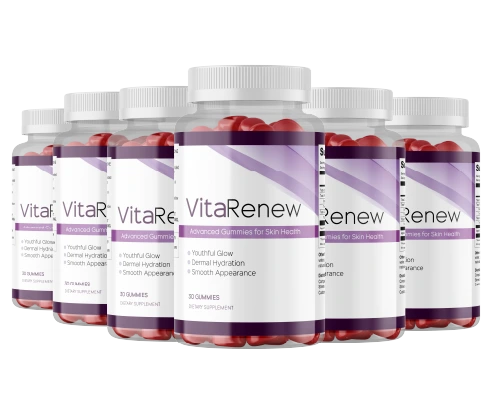
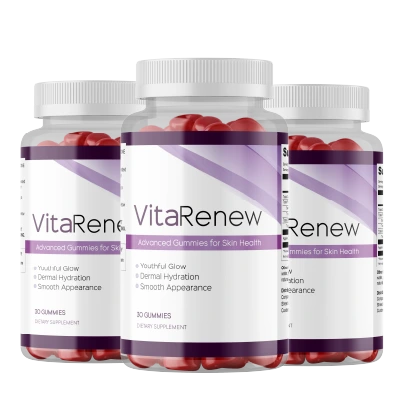
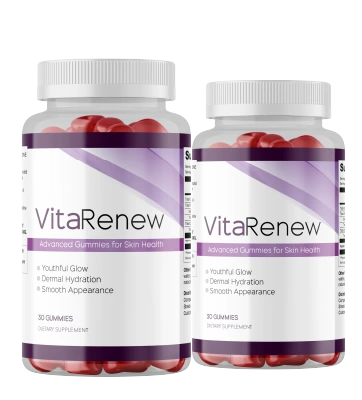
I spent a few weeks reading — actual biochemistry, not magazine summaries of it — and then looked for something that addressed the cofactor problem specifically. What I found was a gummy supplement called VitaRenew, which is built around vitamin C, copper, and zinc. Not a collagen powder. Not a firming cream. Something designed to support the process itself.
I started with the 2-bottle kit. It's $79 per bottle with a 60-day money-back guarantee — I figured the guarantee was worth testing it properly, which meant at least two months. One month isn't enough to evaluate anything in the dermis; the structural layer is slow. You need time.
What I use
VitaRenew
Vitamin C, copper, and zinc in a daily gummy — the cofactors the skin's collagen assembly process depends on. Made in an FDA-registered, GMP-certified facility.
For the tank top you earn at the gym but still hesitate to wear.
60-day money-back guarantee · One-time purchase, no subscriptionWhat happened, honestly
Month one: nothing I could point to. I almost stopped. Month two: something different in the feel of the skin on my inner arms when I pressed it — a little less give, slightly more resistance. Month three: a photo from a hiking trip where I'd been too busy to think about my arms, and I looked at it and noticed.
I want to be precise about what "noticed" means here, because I've heard too many miracle claims to add another one. The texture is still there. It hasn't disappeared. But it's less pronounced at rest. The skin behaves differently when I raise my arm or reach overhead. And for the first time in a few years, I've been wearing the clothes I want to wear without choosing based on arm coverage.
The timeline was slower than I wanted. But understanding the mechanism helped me actually give it the time it needed. The dermis doesn't work on a four-week cycle the way the surface layer does — it's months, not weeks, of continuous repair before the output becomes visible.
"I went back to the gym at fifty and got genuinely fit for the first time in years. The crepe on my arms was still there staring at me. Two things turned out to be separate. This was the second one."
"I thought the more toned I got, the better the skin would look. It didn't work that way. What worked was addressing the actual structural issue — and it took about three months to be sure I was right about that."
These statements reflect individual experiences. Results are not typical and will vary from person to person.
What I'd change if I could go back
I'd have stopped waiting for exercise to fix a problem that exercise was never designed to fix. Not because exercise doesn't matter — it matters enormously for everything else. But when it comes to the dermis, the inputs it responds to are different. Addressing both separately, with the right tools for each, is what finally worked.
If you've been putting in serious work at the gym and watching everything improve except the crepey texture on your arms or thighs, this is why. And the place to start doesn't have to be complicated. The 2-bottle kit gives you 60 days and a full guarantee — which is the right window to actually evaluate whether this changes anything.
Where to start
VitaRenew
The cofactor approach to supporting skin structure — vitamin C, copper, and zinc. No autoship, 60-day guarantee.
Start with two months. See what actually changes.
60-day money-back guarantee · One-time purchase, no subscription