Skin Aging · Explainer
Crepey Skin or Wrinkles? The Difference Most Women Miss
You kept treating it like a wrinkle problem. But the skin that creases on your arms, chest and neck isn't wrinkling — it's something else entirely, and it responds to entirely different things.

Almost every woman I've spoken with about this describes the same experience. They were doing everything right — consistent SPF, a retinol cream at night, a richer moisturizer as they moved through their forties. Their face was responding. And then somewhere on their arms or their chest or their neck, a different texture appeared that nothing touched at all.
The reason, almost always, is that they were treating a wrinkle problem that wasn't there.
Crepey skin looks related to wrinkles. It arrives around the same decade. But the two conditions have different biological causes, different locations, and different mechanisms — and most of what works for one does little to nothing for the other.
The difference you can see without any equipment
Start with where each one lives.
Wrinkles form in the places where faces move: around the eyes from years of squinting and smiling, at the corners of the mouth, across the forehead from expressions made so habitually you stopped noticing them decades ago. They are creases produced by repetition — the same fold, in the same place, for long enough that it becomes permanent.
Crepey skin appears where skin doesn't make expressions. The inner surface of your upper arm. The décolleté and chest. The back of your hands. The side of your neck just below the jaw. These are areas where you've never made a habitual expression, where no muscle has been repeatedly folding the skin — and yet the texture has changed anyway.
If the texture that concerns you is on your face and deepens when you make an expression, you're looking at wrinkles. If it's on your arms, chest or hands — at rest, without any expression — crepey skin is the more accurate name for it.
The location is often the clearest clue, and you don't need a dermatologist to use it.
The pinch test: a thirty-second check
If you want to be more certain, there is a simple test.
Gently pinch a small section of skin on your inner arm — the soft area near the armpit — and hold it for two seconds, then let go.
If it springs back promptly, the structural tissue underneath is largely intact. If it settles slowly, forming several fine parallel lines as it releases — like tissue paper that has been crumpled and smoothed again — that is crepey skin. The elasticity is diminished. The skin is thinner than it once was in that location, and it's not recovering the way it used to.
For comparison, try the same test on your forearm, which typically ages more slowly. The difference in how quickly the skin springs back can be striking once you're looking for it.
Why the same routine that helps your face doesn't help your arms
Most skincare products formulated for aging — moisturizers, topical acids, over-the-counter retinoids, even a lot of the serums marketed specifically for "anti-aging" — work at or near the outer surface of the skin. This is the barrier layer, the stratum corneum: a thin protective sheet that holds water in and keeps the outside world out.
For wrinkles, this makes partial sense. A well-hydrated surface catches light more evenly. The fine repetition lines appear softer when the barrier is full. Some topical retinoids, at prescription strengths, can meaningfully affect the layers just below. Fillers address the volume loss that drives deeper lines. The interventions, when they work, are working on a surface and volume problem.
Crepey skin is not a surface or volume problem. It's a structural problem in the layer below the outer surface — the dermis — and the outer barrier sits roughly as far above it as a sheet of plastic wrap sits above the tabletop it's covering.
Moisturizer temporarily improves how crepey skin looks, in the same way ironing a linen shirt smooths it. By evening, both are back to where they started. Nothing structural has changed. That is why the same approach that maintains your face has left your arms untouched — the two problems live at different depths.
What is actually happening in the dermis
The dermis is where the architecture of skin lives: a dense mesh of collagen fibres that give skin its thickness and firmness, elastin fibres that allow it to spring back after being stretched, and hyaluronic acid binding water throughout.
Crepey skin develops as this mesh loses density. The collagen fibres become fewer and less tightly woven. The elastin fibres lose their ability to recoil. The skin becomes genuinely thinner in a way that isn't about volume — it's about structural integrity throughout the entire layer.
Two factors accelerate this. The first is the gradual, lifelong decline in collagen production that begins in the mid-twenties — slow at first, and usually not noticeable until the cumulative loss crosses a threshold. The second arrives in the perimenopausal years: estrogen plays an active role in maintaining collagen density and skin thickness. As estrogen levels fall, the rate of loss increases considerably. Research on skin changes around menopause has found that a substantial proportion of dermal collagen can disappear in the years immediately surrounding it.
What this means is that what feels like a sudden change is actually two curves meeting: the long, slow slope of age-related collagen decline, intersecting with the sharper drop that accompanies hormonal change. The skin that seemed fine at forty-two can feel genuinely different at forty-seven — and it's because the biology changed twice, not once.
Referenced in this article
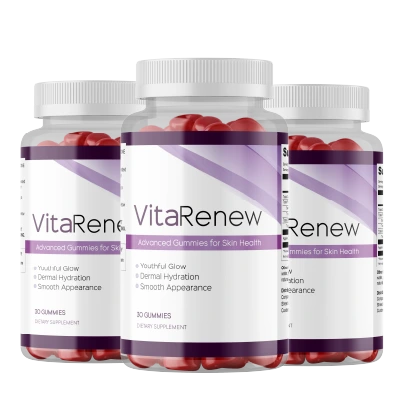
VitaRenew
Supports skin firmness and elasticity with the cofactors the dermis depends on — vitamin C, zinc and copper — in one daily gummy.
Working with the biology, at the layer that actually matters.
60-day money-back guarantee · One-time purchase, no subscriptionThe cofactor picture: what collagen synthesis actually requires
Here is something most skin articles skip entirely.
The cells that make collagen — fibroblasts — don't simply stop working as we age. They continue producing collagen throughout our lives. What changes is the rate and quality of that production, and part of what governs both is the availability of specific enzymatic cofactors that most people have never thought about.
Vitamin C is not just a skin ingredient — it's a strict biochemical requirement for collagen assembly. Two enzymes that stabilize a collagen molecule into its final triple-helix structure (prolyl hydroxylase and lysyl hydroxylase) cannot function without it. Produce collagen with inadequate vitamin C and you get structurally unstable fibres that can't contribute to tissue firmness. This is why scurvy produces connective tissue collapse — not because collagen stops being produced, but because it can't be properly assembled.
Copper is required by an enzyme called lysyl oxidase, which takes newly formed collagen and elastin fibres and cross-links them into the dense, load-bearing matrix that actually gives skin its spring and resistance. Without adequate copper, fibres are produced but remain structurally loose — like rope strands that were never braided together.
Zinc is involved in the ongoing maintenance processes in the dermis and in normal skin integrity throughout life.
The distinction worth holding onto: this isn't about raw material. In most adults, amino acid supply isn't the limiting factor. What's sometimes limited is the enzymatic machinery that assembles the raw material into functional structure. That's a different intervention from adding more building blocks.
Why a collagen powder alone sometimes isn't enough
This is the most common explanation when someone has taken a collagen supplement consistently for months without noticing meaningful change. The research on oral collagen peptides is real — there are controlled trials reporting improvements in skin elasticity and hydration, and the mechanism is biologically plausible. It isn't worthless.
But if the rate-limiting step is not amino acid supply — if it's the enzymatic assembly process — then adding more raw material to a line that is constrained elsewhere doesn't change the output. Vitamin C for structural stabilization, copper for cross-linking: these operate upstream of the raw material. They're part of the same process, but at an earlier stage.
What women report
"I'd spent years on wrinkle prevention — SPF every morning, a retinol routine at night, the full thing. My face looked fine. My arms looked like a different decade. A colleague mentioned the cofactor angle — that collagen doesn't assemble properly without certain nutrients. I gave it twelve weeks, photographing the same spot each month. The texture on my inner arms is genuinely different. Not transformed, but different — less papery, more like skin that has some weight to it again."
"I'm a skeptic, so I want to be precise: I don't know with certainty that the supplement is what changed things. What I know is that I tried everything else first — the collagen drinks, the topical oils, the more expensive moisturizers — and the crepey texture on my chest and neck didn't move. Three months after switching to something that included the full cofactor set, it has. That's the honest account."
These are individual accounts. Results vary and are not typical. No supplement can diagnose, treat, cure, or prevent any condition.
Product referenced above
VitaRenew
Vitamin C, zinc and copper in a daily gummy. Made in an FDA-registered, GMP-certified facility. 60-day money-back guarantee. One-time purchase — no subscription.
Two months to find out if the cofactors make a difference.
60-day money-back guarantee · Supports skin, hair and nailsOn realistic timelines
The outer skin layer — the part you can see and moisturize — turns over every four to six weeks. The dermis is considerably slower. Collagen remodelling is a process measured in months, which is why controlled studies of skin-directed supplements consistently use twelve-week evaluation windows.
Take a photograph of the area that concerns you, in consistent light, on day one. Evaluate after twelve weeks, not three. The biology of this layer does not move faster, regardless of what is being taken. Individual results depend on genetics, sun history, hormonal status, sleep and diet — these are genuine variables and no supplement overrides any of them. But for the enzymatic process described above, the mechanism is consistent. Whether it produces a visible difference for any given person is the question that only time and honest documentation can answer.
Background reading
- Pullar JM, Carr AC, Vissers MCM. "The Roles of Vitamin C in Skin Health." Nutrients, 2017.
- Rucker RB et al. "Copper, lysyl oxidase, and extracellular matrix protein cross-linking." American Journal of Clinical Nutrition, 1998.
- Thornton MJ. "Estrogens and aging skin." Dermato-Endocrinology, 2013.
- Shuster S, Black MM, McVitie E. "The influence of age and sex on skin thickness, skin collagen and density." British Journal of Dermatology, 1975.
- Ogawa Y et al. "Zinc and skin disorders." Nutrients, 2018.