Skin & Aging · Personal Story
Why My Upper Arms Started Looking Crepey — What Took Me Too Long to Understand
I thought it was just what happened after fifty. It wasn't — and once I understood what was actually going on, everything about my choices changed.

There's a specific way it announces itself. Not dramatically — just a photo where someone else is tagged and you end up in the background, arms relaxed at your sides, and you think: when did that start?
That was me at a backyard cookout two summers ago. My face looked fine. My legs looked fine. But my upper arms — the inner surface from shoulder to elbow — had this thin, papery quality. When I moved, the skin moved with too much latitude, like it had gotten looser than what was holding it up. I'd heard the phrase "bat wings" a hundred times. I'd never thought it would apply to me.
What I did next was what most women do: I bought a better body lotion. Then a firming cream. Then a different firming cream. Then I started reading about collagen drinks. And through all of this, the skin on my upper arms stayed exactly the same, because I was treating something from the outside that had nothing to do with the outside.
What nobody told me this texture actually is
It took a conversation with a dermatologist — my sister-in-law's, at Thanksgiving, which is not a normal context for this information — before I understood what crepey skin actually means structurally. I'd assumed it was about hydration, or collagen drinks, or perhaps just unavoidable aging. It's more specific than that.
The skin on your upper arm is thinner than skin elsewhere on the body. It sits over loose connective tissue rather than dense muscle. And beneath the surface layer — beneath what any cream can reach — there's a structural layer called the dermis, made up of collagen fibres that give thickness, elastin fibres that give snap-back, and hyaluronic acid that keeps everything hydrated and plump.
Crepey texture is what happens when that structural layer loses density. The surface layer above it settles differently. Instead of the smooth, firm appearance that comes from a full, bouncy dermis beneath, you get skin that folds on itself when compressed, moves with too much give when you raise your arm, and catches light in ways that emphasize every crinkle.
And the upper arm shows this first — before the face, before anywhere else — because there's less muscle and dense tissue below it to compensate, and because most of us spent decades not protecting that skin from UV exposure the way we did our faces.
I was moisturizing the surface of a problem that started in a layer moisturizer was never designed to reach.
The part that actually surprised me
What my sister-in-law explained — and what I subsequently read more about — is that the body doesn't simply stop producing collagen in your forties. The fibroblasts, the cells that manufacture it, are still doing their job. The problem is more nuanced: collagen production becomes less efficient, and a lot of that has to do with whether the body has the specific cofactors the assembly process needs.
The analogy that stuck with me: imagine a factory that still has workers but has run low on two or three specific tools. Production doesn't stop, but what comes off the line is structurally weaker and less organized.
In skin, those tools are:
- Vitamin C, which is essential for two enzymes — prolyl hydroxylase and lysyl hydroxylase — that give each collagen molecule its stable helical shape. Without adequate vitamin C, the collagen produced is structurally incomplete. This isn't a supplement claim; it's basic collagen biochemistry that's been established for decades.
- Copper, which is required by an enzyme called lysyl oxidase to cross-link newly formed collagen and elastin fibres into a resilient, organized network. The fibres can be made but not properly organized without it.
- Zinc, which supports normal skin cell turnover and ongoing dermal repair. It's the quieter player in the group but important for the continuous maintenance happening beneath the surface every day.
The reason this matters is that collagen powders — which I'd tried — add raw material. But if the factory doesn't have its tools, the extra raw material doesn't translate into structurally better output. That's likely why I'd seen minimal results from the powders.
What I tried instead
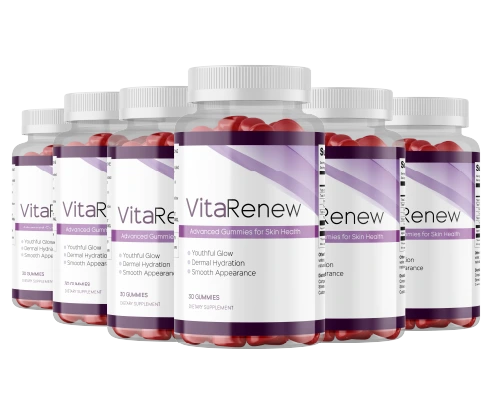
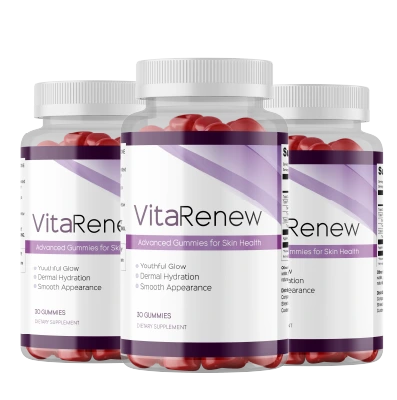
I spent some time looking for something that combined these three cofactors rather than just adding more collagen peptides on top of a deficiency. What I found — and what I've now been using for coming up for a year — is a gummy supplement called VitaRenew, which is built specifically around vitamin C, copper, and zinc. I started with the 2-bottle kit, which gave me two months with a money-back guarantee in case it didn't do anything notable. It's the lowest-cost entry point and honestly the right way to test it.
What I use
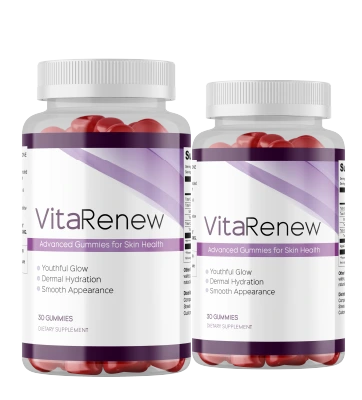
VitaRenew
Vitamin C, copper, and zinc in a daily gummy — the cofactors the skin's collagen assembly process depends on. Made in an FDA-registered, GMP-certified facility.
For the tank top you stopped second-guessing yourself about.
60-day money-back guarantee · One-time purchase, no subscriptionWhat three months actually looked like
I want to be honest about expectations, because I came in with too many and it took some recalibrating. The first month: nothing visible. Genuinely nothing I could point to. I almost stopped. The second month: the skin on my inner arms felt different when I pinched it — less loose, very slightly more resistance, though I couldn't tell yet if I was imagining it. The third month: a photograph at a different outdoor event where I didn't realize my arms were visible, and when I looked at it, they looked noticeably different from that cookout photo.
I still have the texture. It hasn't disappeared. But the texture is less pronounced, the skin moves differently when I reach overhead, and I haven't picked a cardigan based on arm coverage since February. For someone who spent three years doing exactly that, it's a meaningful change.
The timeline matters to set correctly: the dermis is slow. The surface layer of skin turns over every few weeks. The deeper structural layer that actually determines this texture takes months to remodel. You need at least 90 days to form any real opinion, and you need to photograph early because your eyes adapt to gradual change and won't register it.
"I started noticing something around the ten-week mark. Not a before-and-after moment — more like realizing I hadn't thought about my arms in a while. Which for me is the result."
"I'd given up on anything working after trying creams for years. This is different because it's not about the surface. I don't know how else to put it — it feels like it's addressing the actual thing."
These statements reflect individual experiences. Results are not typical and will vary from person to person.
The one thing I'd change if I could go back
I would have started earlier and not wasted so much time and money on firming creams. Not because creams do nothing — they help with surface hydration — but because the problem I had wasn't a surface problem. I was applying solutions to the wrong layer. Understanding the dermis, the cofactors, and why the upper arm specifically is so vulnerable to this change would have saved me about two years of the wrong approach.
If you're reading this because your upper arms have changed and nothing topical has made a real difference, that's likely why. And the starting point doesn't have to be complicated — or expensive. The 2-bottle kit is where I began, and the 60-day guarantee meant I had nothing to lose by trying.
Where to start
VitaRenew
The cofactor approach to supporting skin structure — vitamin C, copper, and zinc. No autoship, 60-day guarantee.
Start with two months. See what happens.
60-day money-back guarantee · One-time purchase, no subscription