Skin Health · Personal Story
What Causes Crepey Skin Under the Eyes — And What I Found That Actually Helped
The texture that shows up when you smile and doesn't fully go away is telling you something specific about what's happening beneath the surface.

I noticed it on a Tuesday morning in March. The bathroom light was direct — the kind that doesn't spare you — and I smiled at my reflection while reaching for the toothbrush. The skin below my eyes crinkled into a fine, papery texture. Not a single line. A pattern of them, like tissue paper folded and unfolded too many times. When I stopped smiling, the lines softened but didn't disappear. They had become the resting state.
I was 44. I had worn SPF every day for years. I drank enough water. I wasn't neglecting my skin. And yet there it was: crepey skin under my eyes when smiling — and increasingly, when not smiling too.
I spent the next few months researching what was actually happening and what, if anything, could realistically help. What I found changed where I was looking for the answer.
The under-eye area is not like the rest of your face
The first thing I learned is that the skin under and around the eyes is genuinely different from skin elsewhere on the face — and those differences explain why it shows structural change earlier than anywhere else.
The periorbital skin is the thinnest on the human face, averaging about half a millimetre deep, while skin on the cheeks and forehead runs two to three times thicker. A thinner dermis means a thinner scaffold: less collagen matrix, less elastin, and less of the hyaluronic acid that gives skin its physical fullness. The same amount of age-related structural loss that is barely visible in thicker areas becomes clearly visible in tissue that started thinner.
The eye area also has almost no sebaceous glands — the oil-producing structures that lubricate the skin's surface and maintain its moisture barrier. Without them, under-eye skin is drier at baseline, and dryness makes fine surface texture far more visible.
And there is no subcutaneous fat pad directly underneath. In most areas of the face, a cushioning layer of fat sits between the skin and the underlying muscle. Under the eye, that cushion is minimal or absent. The dermis sits close to the orbicularis oculi — the muscle you use when you blink, squint, smile, or make any expression involving your eyes. Which you do around 15,000 times a day.
That constant movement creates repetitive mechanical stress on the dermal matrix. Over decades, the compression and stretching of that specific zone accumulates as fatigue in the collagen and elastin fibres. The under-eye area is not just structurally thinner — it is also one of the most mechanically loaded areas of the face.
Thinner scaffold, no oil glands, no fat cushion, and 15,000 mechanical repetitions every day. Before age-related change even starts, the under-eye zone is working with narrower margins than anywhere else on the face. This is why it shows the change first — not because something is wrong, but because the margin was smaller from the beginning.
What collagen, elastin, and estrogen have to do with it
The dermis — the structural layer beneath the skin's surface — is built around a mesh of collagen fibres, which provide strength and volume, and elastin fibres, which allow skin to recoil after deformation. Collagen synthesis begins declining from the mid-twenties at about one percent per year. By 40, the cumulative loss is already meaningful. But the more significant accelerator is estrogen.
Estrogen receptors are distributed throughout the dermis. Estrogen supports the fibroblast activity responsible for producing collagen and elastin, and regulates hyaluronic acid synthesis. When estrogen begins declining during perimenopause — typically in the early-to-mid forties for many women — dermal collagen loss accelerates substantially. Research indicates a significant proportion of total dermal collagen can be lost in the years immediately surrounding menopause.
In thicker skin areas, this loss takes longer to show. In the periorbital zone, where the structural margin was already narrower, the change appears sooner and more clearly. Skin that used to spring back when you smiled now holds the impression a moment longer — then longer still — until it holds it all the time.
This is what I was looking at in the mirror. Not a cosmetic issue. A structural one. And understanding that changed where I looked for a solution.
Why I stopped looking for the answer in eye creams
I kept using eye cream while I was researching — partly habit, partly because it genuinely helped with surface dryness. But the more I read, the more clearly I understood why it wasn't going to address what I was actually seeing.
The outer barrier of the skin limits what can penetrate it based on molecular size. Molecules above roughly 500 daltons can't cross it in meaningful amounts. Collagen is many times larger than that threshold. Applied collagen stays at the surface. Even the best-studied topical ingredients — retinoids, peptides — work at or just below the surface layer, not in the deep dermis where the structural scaffold lives.
Eye creams can meaningfully improve how the surface looks and feels. That is real and worth doing. But the crepey texture I was seeing wasn't primarily a surface problem — it was a scaffolding problem. And the scaffolding lives beneath where anything applied to the skin can reach.
That's when I started reading about what the body's own collagen synthesis process actually requires to work.
What I found
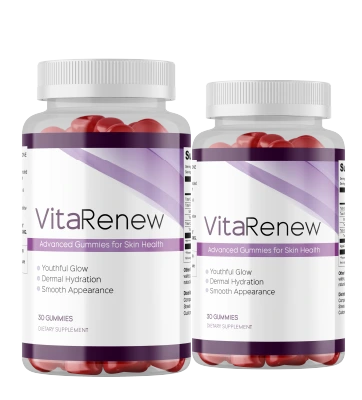
VitaRenew
The daily gummy with vitamin C, copper, zinc, vitamin E and selenium — the cofactor combination the body's collagen synthesis process depends on, in one formula.
I started with the 2-bottle supply — 60 days is the minimum window to assess what internal support can actually do for the skin.
60-day money-back guarantee · One-time purchase, no subscriptionWhat I learned about the cofactor model
The body doesn't lose the ability to produce collagen at 44. Fibroblasts — the cells that make collagen and elastin — are still active. What changes is the efficiency of the process. And that efficiency depends on cofactors: specific molecules the enzymatic machinery requires in order to do the work.
Three kept showing up in everything I read:
- Vitamin C is required by prolyl hydroxylase and lysyl hydroxylase — the enzymes that stabilise the collagen triple helix. Without adequate vitamin C, the body can produce collagen, but it is structurally incomplete. This is the same mechanism behind the skin deterioration in scurvy. It's not supplement marketing — it's been in the clinical nutrition literature for over a century.
- Copper is the required cofactor for lysyl oxidase, the enzyme that cross-links collagen and elastin fibres into a functional load-bearing network. Cross-linking is what converts individual protein strands into actual scaffold. Without copper, fibres are synthesised but the final bonding step doesn't complete. I had never seen copper listed in a skin product before this research — but it appears consistently in the dermal biology literature. Many skin supplements simply omit it.
- Zinc participates in regulating the enzymes that control collagen turnover and in wound-repair signalling. Its role is supportive throughout the process.
Alongside the synthesis cofactors, I kept reading about a second mechanism: oxidative degradation of existing fibres. The dermis is metabolically active tissue, and reactive oxygen species accelerate breakdown of collagen and elastin even while the body is trying to maintain them. Vitamin E and selenium — an antioxidant pair that appears together consistently in the dermal research — address this second mechanism. Not rebuilding what was lost, but slowing the degradation of what remains.
What I eventually tried — and what happened
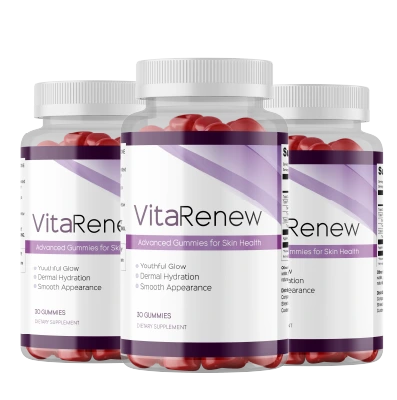
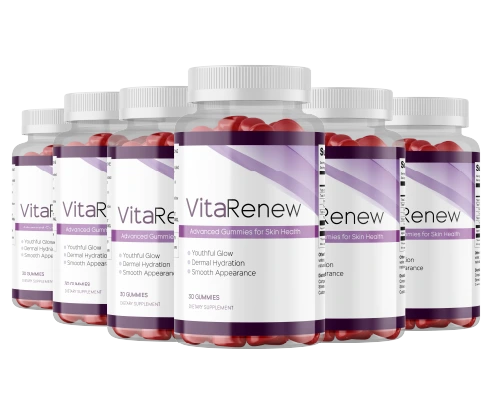
After several months of reading and a fair amount of comparing product labels against what I'd learned, I found VitaRenew. It's a daily gummy supplying vitamin C, zinc, copper, vitamin E, selenium, and beta-carotene — the specific cofactors the collagen synthesis and protection process requires, in one product rather than a stack of supplements.
I want to be honest about what I expected: not much. I'd been through enough products to carry a reasonable baseline of skepticism. I ordered the two-bottle supply — 60 days — because 60 days is the honest minimum to evaluate something that works at the rate the dermis actually remodels. Anything shorter is not a fair test.
Around week eight, my husband mentioned that my skin looked different. He couldn't say how exactly — just different. I had been photographing my face in the same bathroom light weekly, and looking back at the series I could see what he meant: the texture under my eyes when I smiled was noticeably less pronounced. The papery quality that had settled in was softer. My under-eye concealer stopped settling into the lines the way it had been doing.
I'm now on my fourth order. I'm not claiming a dramatic transformation. I'm describing a consistent change that has held for several months, in an area I had essentially stopped expecting to address.
VitaRenew is a supplement. It supports healthy skin, hair, and nails. It is not intended to diagnose, treat, or cure any condition, and these statements have not been evaluated by the FDA.
"Crepey skin under my eyes when smiling was my specific concern — it shows up with expression first, then eventually it's just there. I tried every targeted eye cream over two years. After about twelve weeks on VitaRenew the texture is noticeably smoother. My concealer no longer settles into the lines the way it was."
— Jennifer A., 46, verified purchaser
"I was skeptical that a gummy could do anything for skin. But I kept seeing the cofactor research come up and decided to try it — the under-eye area was my concern. Around ten weeks in I noticed the lines aren't as deep when I squint or smile. Subtle but real, and consistent over months now."
— Pamela G., 51, verified purchaser
Individual results vary. These testimonials represent personal experiences and may not reflect typical outcomes.
A note on when to see a doctor: age-related changes to under-eye skin are gradual and occur on both sides. If you notice changes that are asymmetric, rapid, accompanied by swelling or colour changes, those should be evaluated by a dermatologist first — not addressed with a supplement. Any change outside the pattern of gradual bilateral skin thinning warrants professional assessment before anything else.
If you're in the same place I was
Crepey skin under the eyes shows up first because the periorbital zone has less structural reserve than anywhere else on the face: thinner skin, no oil glands, no subcutaneous fat, and constant mechanical stress from expression and blinking. When age-related collagen loss and the estrogen decline of perimenopause reach that zone, the effect appears sooner and more clearly than in areas with more structural margin.
Topical products address the surface — genuinely, and worth doing — but have a ceiling. The scaffold beneath the surface depends on enzymatic processes that require specific cofactors to function. Those cofactors are separate from dietary protein and routinely missing from standard skin supplements. VitaRenew is one of the few products I found that actually maps to the research.
The 2-bottle supply is where I'd start. Sixty days gives the biology time to show a real response rather than just a surface-level change.
What I use
VitaRenew
Vitamin C, copper, zinc, vitamin E and selenium — the cofactor combination the body's collagen process needs. FDA-registered facility. No subscription.
Start with the 2-bottle supply — 60 days to give the biology time to respond.
60-day money-back guarantee · No subscription · Ships from the US