My Skin Turned Crepey at 43 — Before Menopause. Here's What Perimenopause Was Already Doing to It.
I assumed skin changes like this happened later. My gynecologist told me perimenopause had been affecting my dermis for over a year before I noticed.

I noticed it first on my upper arms. I was getting ready in the morning, catching my arm in the mirror at an angle I don't usually look at, and I saw it — the skin had changed. Not in a dramatic way. But there was a texture there that hadn't been there before. Fine lines, close together, giving the surface a slightly crinkled quality. Like tissue paper, but on my own skin.
I was 43. I was still getting regular periods. I had always associated skin changes like this with menopause, which I figured was a decade away. So I dismissed it, blamed the lighting, bought a richer hand cream, and moved on.
By the time I mentioned it to my gynecologist at my next appointment, it had spread to my chest and the backs of my hands. She looked at my arms, nodded slowly, and said: "You're in perimenopause. This makes sense."
I had heard the word. I hadn't understood what it actually meant for my body — or for my skin.
What my gynecologist explained that no article had
She described it this way: perimenopause isn't the moment before menopause. It's a years-long hormonal transition — one that can begin in the early forties, sometimes earlier — during which estrogen levels don't simply decline. They fluctuate. High one month, low the next. Swinging in ways that make cycles irregular and create a hormonal environment the body hasn't navigated before.
And the skin, she explained, is particularly responsive to estrogen. Not in a superficial way — not the kind of responsiveness that topical creams can substitute for. The structural layer of skin beneath the surface you can touch, called the dermis, contains cells called fibroblasts that have estrogen receptors. These cells are responsible for producing collagen and elastin — the proteins that give skin its thickness, its firmness, and its ability to spring back when stretched.
When estrogen is present at consistent levels, fibroblasts receive a relatively stable signal to stay active. When estrogen levels oscillate — as they do in perimenopause — that signal becomes unreliable. Collagen production slows and becomes irregular. The existing collagen and elastin continue breaking down at their usual pace. Over time, the dermis loses density. And the surface of the skin, particularly in thinner areas, starts to reflect that loss.
That was what was happening on my arms. Not menopause. Perimenopause — and the two years of estrogen fluctuation my body had apparently already been experiencing.
Why the arms and chest, and not (yet) the face
I asked why these particular areas. She explained that the skin on the upper arms, inner elbows, chest, and backs of the hands is structurally thinner than facial skin. It has less underlying fat to cushion against structural changes in the dermis. It also tends to carry more cumulative sun exposure over a lifetime — and UV radiation accelerates collagen breakdown through a mechanism entirely separate from hormones.
These areas, she said, have the least structural reserve. When the dermis begins to thin — from hormonal change, from age, from both — they are the first places it shows at the surface. The face often holds longer: more subcutaneous fat, more deliberate topical attention over the years, and a thicker starting point.
That matched exactly what I was seeing. Arms and chest first. Face still more or less unchanged.
Mentioned in this article
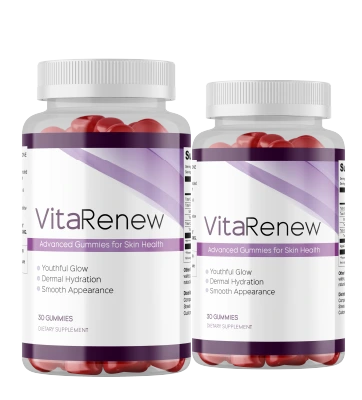
VitaRenew
A daily gummy with vitamin C, copper, and zinc — the cofactors collagen synthesis depends on. Made in an FDA-registered, GMP-certified facility. 60-day money-back guarantee.
For skin that still has time to feel different.
60-day money-back guarantee · One-time purchase, no subscriptionWhat the dermis actually loses — and why it matters
After that appointment I went home and read everything I could find. The science isn't buried — it's just rarely explained in plain language. Here's what I understood, eventually:
The dermis is not a passive layer. It's actively maintained. It contains three main components, all produced by fibroblasts, all sensitive to the hormonal environment:
- Collagen fibers — the primary structural scaffold of skin. Types I and III dominate. They give skin its thickness and its resistance to deformation. Their loss is the main reason crepey skin feels thinner and less substantial than it once did.
- Elastin fibers — responsible for the skin's recoil. The characteristic snap-back when you pinch skin and let go. When elastin degrades faster than it's replaced, that recoil slows. The skin stretches but doesn't spring back the way it used to.
- Glycosaminoglycans — including hyaluronic acid — fill the space between fibers and bind water within the tissue. When these decline, the skin loses plumpness from within, independent of surface hydration. You can moisturize the epidermis perfectly and still see a flat, slightly deflated quality in the dermis beneath.
None of these are accessible by anything applied to the surface. They're built and maintained from inside, by cells running biochemical processes that depend on specific inputs.
The part nobody told me: what collagen synthesis actually needs
This is where the conversation shifted for me. I had assumed that if collagen production was slowing, there wasn't much to be done about it from a nutritional standpoint. Hormones were hormones. Biology was biology.
But collagen synthesis isn't just a matter of having the right signal (estrogen). It's also a matter of having the right raw materials. It's an enzymatic assembly process, and it depends on specific micronutrients as cofactors at key steps:
- Vitamin C is required for two enzymes — prolyl hydroxylase and lysyl hydroxylase — that give each collagen molecule its stable, functional triple-helix shape. Without adequate vitamin C, the collagen produced is structurally weaker. This is established biochemistry, not supplement marketing.
- Copper activates lysyl oxidase, the enzyme that cross-links collagen and elastin fibers into the connected, load-bearing network the dermis requires. Fibers synthesized without adequate copper end up poorly bound — present but not forming an effective matrix.
- Zinc plays roles in ongoing skin cell renewal and in the metalloproteinase activity that governs how collagen is remodeled and repaired across the dermal layer.
The implication, once I understood it: if my collagen synthesis was already running slow because of estrogen fluctuation, I was potentially also running it with insufficient cofactors. Not because of any obvious deficiency — but because most people aren't specifically thinking about these three nutrients in the context of skin structure during perimenopause.
What I started doing — and what I want to be honest about
I wasn't looking for a miracle. I've been through enough health decisions to be skeptical of anything that promises dramatic transformation. What I was looking for was a consistent, well-formulated source of the specific cofactors the research pointed to — vitamin C, copper, and zinc — in a form I would actually take every day without thinking too hard about it.
I found VitaRenew and started with the two-bottle option. The gummy format meant it actually became part of my morning routine instead of joining the pile of capsules I open once and forget.
I want to be clear about what I can and can't say here: I can't tell you what your experience will be. I can tell you what mine was. And I can tell you the honest timeline — because it's important that you know what you're actually committing to.
Three months in — what I noticed
At six weeks, I wasn't sure. The change in skin texture is not a before-and-after event. It's gradual — as gradual as the loss was.
At ten weeks, I was more confident. The skin on my upper arms felt different. More substantial when I pinched it. The fine crosshatch texture hadn't disappeared, but it was visibly less pronounced. The skin on my chest looked slightly smoother in the mirror, even without changing my skincare routine.
At three months, I stopped second-guessing it. The difference was real enough that my husband commented on it unprompted. I've continued since.
I photographed the same spot on my arm in the same light every three weeks. That's the only way I trust myself to assess something like this, where the changes are subtle enough that memory and wishful thinking can both distort perception.
What I know: I'm still in perimenopause. My skin will continue to change. But I feel better about what I'm doing to support it than I did when I was just layering on creams and hoping for the best.
"I'm 46, deep in perimenopause, and the crepey skin on my arms was the thing that bothered me most. I'd tried everything topical. Starting VitaRenew was the first thing that actually seemed to change the texture from inside. By month three I could tell. It's not gone, but it's better — noticeably."
"I was skeptical because I've tried a lot of things. But the cofactor angle made sense to me once I understood how collagen synthesis actually works. Two and a half months in, my skin feels more substantial — especially on my arms. I'm going to keep going."
These statements reflect individual experiences. Results are not typical and will vary from person to person.
Product referenced above
VitaRenew
Vitamin C, copper, and zinc in a daily gummy. Supports skin firmness and elasticity from within. 60-day money-back guarantee.
I started with two bottles. That felt like the right amount of commitment to something new.
60-day money-back guarantee · One-time purchase, no subscription