Skin Health · Personal Story
Why Your Thighs Look Crepey After 40 — And What I Found Out
It's not sun damage, and it's not about weight. That papery texture on your inner thighs has a structural explanation — and it's one most women don't hear until they go looking for it.

It was the first real beach weekend of August. I pulled on a pair of shorts I hadn't worn since the previous summer — a light linen pair, nothing unusual — and looked in the full-length mirror before heading out the door. And there it was.
My inner thighs had changed. Not the way weight changes a body — I knew that feeling well enough. This was different. The skin itself looked different: thinner, somehow, and when I pressed my palm against it gently and lifted my hand away, the surface didn't spring back the way I expected it to. Instead there was a faint impression, like tissue paper that had been folded once too many times. Fine, closely spaced lines, running in no particular direction. Crepey is exactly the right word for it, and it's the word I found myself typing into a search bar twenty minutes later.
I was 45. I'd expected some changes. I had not expected this one, in this location, so suddenly.
I spent the next few weeks reading about what was actually happening and whether there was anything realistic I could do about it. What I found changed where I was looking for answers.
The first thing I learned: the thighs are not "protected" from skin aging
My first instinct was that this couldn't be sun damage — my thighs barely saw the sun. The inner thighs especially are covered most of the year. I had assumed, without ever consciously reasoning it through, that covered skin aged differently from exposed skin. Protected from UV, it would hold its structure longer.
That assumption turned out to be only partly right.
UV exposure does accelerate the breakdown of collagen and elastin — what dermatologists call photoaging. Skin that has seen decades of daily sun ages differently, and often faster in the visible-aging sense, than skin that's been covered. So yes, the inner thighs show less photoaging. They don't show accelerated UV-driven breakdown the way the forearms or décolletage do.
But photoaging is one mechanism. The deeper mechanism — intrinsic aging, the structural change that happens in skin regardless of sun exposure — doesn't spare covered skin at all. Collagen synthesis declines everywhere in the body from the mid-twenties, at roughly one percent per year. By 45, the cumulative structural loss is real and measurable in every region, including the thighs. The dermis there is not exempt from the biology. It simply shows a different pattern of aging than sun-exposed skin does.
And that pattern, I found, is shaped by factors specific to the thigh that make the crepey texture particularly visible there.
What makes thigh skin specifically vulnerable after 40
The inner and front thigh have a few anatomical characteristics that, taken together, explain why this is where crepey texture often appears first — and why it tends to surprise women who were expecting the more gradual changes they'd seen elsewhere.
The skin in these areas has relatively fewer sebaceous glands than the face or arms. Sebaceous glands produce the oily secretion that lubricates the skin's surface and maintains the moisture barrier. In areas with fewer of these glands, the surface of the skin is drier at baseline — and dryness makes fine surface texture far more visible. What might barely show on a well-hydrated arm shows clearly in areas that are chronically drier.
The thigh is also an area of significant mechanical loading. Every time you sit, stand, walk, or climb stairs, the skin over the thigh — especially the inner and frontal surfaces — experiences compression and stretching. Over decades, this mechanical cycling accumulates as fatigue in the dermal matrix. Collagen and elastin fibres that are repeatedly compressed and released without adequate repair capacity begin to lose their organised structure. The skin that should spring back starts to hold the impression instead.
And then there is estrogen. The thigh skin is substantially estrogen-responsive. Estrogen receptors are distributed throughout the dermis, and estrogen supports the fibroblast activity responsible for producing collagen and elastin. It also helps regulate hyaluronic acid synthesis — the water-binding molecule that keeps the dermal matrix plump and gives skin its physical volume. When estrogen begins declining during perimenopause, which for many women starts in the early-to-mid forties, the impact on estrogen-sensitive skin is not evenly distributed. The thighs, hips, and inner arms often show noticeable structural change earlier than other areas, precisely because the dermis in those regions is more dependent on estrogen-mediated maintenance.
Low sebaceous density, decades of mechanical stress from movement, and a dermis highly responsive to the estrogen decline of perimenopause. The inner thigh isn't showing aging faster than it should — it's showing it exactly as the biology predicts. The surprise is mostly that no one warned us what to expect here.
Why the usual answers don't fully reach the problem
Once I understood what was happening structurally, I went back and looked at what I'd already tried and what I'd been considering trying. The landscape of thigh skin products is dominated by firming creams, body lotions with collagen or elastin on the label, and caffeine-based formulas. I'd used some of them. They weren't useless — good hydration genuinely makes surface texture less visible, and I kept up a solid moisturising routine for that reason.
But the more I read about skin biology, the more clearly I saw the ceiling. The outer barrier of the skin restricts what can penetrate it based on molecular size. Collagen is vastly too large to cross that barrier in any meaningful amount. Applied collagen stays at the surface. Topical elastin does the same. Firming creams can affect how the skin looks and feels at the surface level — a real effect, worth having — but they cannot reach the dermal scaffold beneath the surface, where the structural change is actually occurring.
The crepey texture I was looking at wasn't a surface problem. It was a scaffold problem. And the scaffold lives beneath where anything applied to the skin can reach.
That's when I started reading about what the body actually needs to maintain its own collagen synthesis process.
What I found
VitaRenew
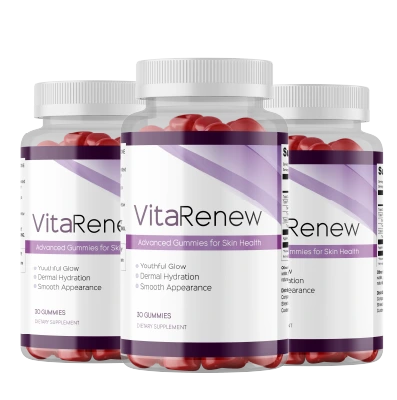
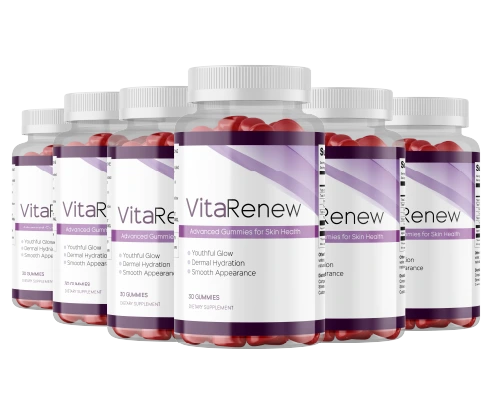
The daily gummy with vitamin C, copper, zinc, vitamin E and selenium — the cofactor combination the body's collagen synthesis process depends on, in one formula.
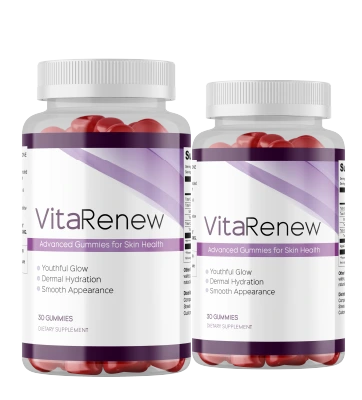
I started with the 2-bottle supply — 60 days is the honest minimum to assess what internal support can actually do for the skin.
60-day money-back guarantee · One-time purchase, no subscriptionThe cofactor model — what I kept reading about
The body doesn't lose the ability to produce collagen at 45. The fibroblasts — cells that manufacture collagen and elastin — are still active. What changes is the efficiency of the process, and that efficiency depends on specific cofactors: molecules the enzymatic machinery requires in order to complete the work.
Three kept appearing in everything I read, across independent sources:
- Vitamin C is required by the enzymes that stabilise the collagen triple helix — prolyl hydroxylase and lysyl hydroxylase. Without adequate vitamin C, the collagen produced is structurally incomplete. This is not a wellness marketing claim. It is the same mechanism documented in the clinical nutrition literature for over a century, visible in the skin deterioration of scurvy.
- Copper is the obligate cofactor for lysyl oxidase, the enzyme that cross-links collagen and elastin fibres into a functional, load-bearing scaffold. Cross-linking is what converts individual protein strands into structural tissue. Without copper, fibres are synthesised but the final bonding step doesn't complete. I had never seen copper in a skin product before this research — but it appears consistently in the dermal biology literature. Most skin supplements I found simply omitted it.
- Zinc participates in regulating collagen turnover enzymes and in wound-repair signalling. Its role is supportive throughout the synthesis process, and it shows up consistently alongside vitamin C and copper in the relevant research.
The second mechanism I kept reading about was oxidative degradation of existing fibres. Even while the body is trying to maintain collagen and elastin, reactive oxygen species — metabolic byproducts — can accelerate their breakdown. Vitamin E and selenium, two antioxidants that appear together consistently in the dermal oxidative-stress literature, address this mechanism: not rebuilding what was lost, but slowing degradation of what remains.
What I tried — and what I noticed
After several weeks of reading and comparing product labels against the cofactor list, I found VitaRenew. It supplies vitamin C, zinc, copper, vitamin E, selenium, and beta-carotene — the specific cofactors both the synthesis and the protection mechanisms require, in one daily gummy rather than a stack of separate supplements.
I want to be direct about my expectations going in: they were modest. I had been through enough supplements to arrive at this one without enthusiasm. I ordered the two-bottle supply — 60 days — because the dermal research I'd read measured structural changes at eight to twelve weeks, not four. A shorter trial wasn't going to tell me anything real.
Around week nine, I noticed something. I was getting dressed in the same bedroom with the same morning light, and I looked at my thighs in the mirror again — the way I had on that first August morning. The texture was different. Not dramatically transformed. But the papery quality that had settled in was genuinely softer. When I pressed and released my palm against the skin, it came back a little more completely than it had been doing. I photographed it and compared it to a photo I'd taken at the start. There was a visible difference in the quality of the surface texture.
I'm now on my third order. I'm not claiming a dramatic outcome — the change is real but subtle, and it has held consistently over four months. What I'm describing is that the progression I was watching stopped progressing, and the quality of the texture improved in a way that has been stable since.
VitaRenew is a supplement. It supports healthy skin, hair, and nails. It is not intended to diagnose, treat, or cure any condition, and these statements have not been evaluated by the FDA.
"I noticed crepey texture on my inner thighs this past spring — that was the thing that finally pushed me to try something different. Eye creams and face serums I had; something for the actual body skin structure I didn't. After ten weeks on VitaRenew the texture is noticeably smoother and the skin feels more resilient when I press it. My husband noticed before I pointed it out."
— Sandra M., 47, verified purchaser
"The crepey skin on my thighs appeared in my mid-forties out of nowhere, or so it felt. I spent about a year trying different body lotions. They helped with dryness but nothing touched the actual texture. About eight weeks into VitaRenew I noticed the crinkled pattern is less pronounced, especially on the inner thighs. Subtle and consistent — not a transformation, but a real change."
— Carol T., 51, verified purchaser
Individual results vary. These testimonials represent personal experiences and may not reflect typical outcomes.
A note on self-assessment: the changes I've described are gradual and bilateral. Age-related skin changes occur on both sides. If you notice changes that are asymmetric, rapid, or accompanied by other symptoms, those warrant evaluation by a dermatologist — not a supplement response. Any change outside the pattern of gradual bilateral structural shift should be assessed professionally first.
If you're looking at the same thing I was
The crepey texture that develops on the thighs — especially the inner thighs — after 40 is not primarily about sun exposure. It reflects the same structural biology that produces crepey skin on the arms, chest, and neck, modified by the specific characteristics of that area: lower sebaceous density, significant mechanical stress from daily movement, and a dermis that is meaningfully estrogen-responsive. When estrogen declines at perimenopause and the overall rate of collagen loss accelerates, the thighs feel it.
Topical products address the surface. That is genuinely worth doing — hydration reduces the visual prominence of fine surface texture, and a good body moisturiser makes a real difference. But the scaffold beneath the surface depends on enzymatic processes that require specific cofactors. Those cofactors are separate from dietary protein, and they are consistently absent or underdosed in standard skin products. VitaRenew is one of the few formulas I found that actually reflects the research on what the collagen synthesis process requires.
The 2-bottle supply is where I started. At 60 days, you are giving the biology enough time to show a real response.
What I use
VitaRenew
Vitamin C, copper, zinc, vitamin E and selenium — the cofactor combination the body's collagen process needs. FDA-registered facility. No subscription.
Start with the 2-bottle supply — 60 days to give the biology time to respond.
60-day money-back guarantee · No subscription · Ships from the US