Skin Health · Personal Story
Why the Skin on My Lower Legs Changed After 40 — and What I Found That Actually Helped
I noticed it while applying sunscreen before a beach trip in June — a fine, crinkled texture across my shins I hadn't really looked at before. It wasn't a tan or a rash. It was the skin itself. Here's what I learned when I went looking for answers.

We were packing for a long weekend at the shore — a trip we'd been planning for most of the spring. It was a Saturday morning in early June, the kind that makes you feel behind schedule before you've finished coffee. I was standing in the bedroom applying sunscreen to my legs, working methodically from ankle to knee, and I happened to pause with my hand on my shin and look at the skin beneath my palm.
What I saw stopped me. The skin across my shin had a texture I hadn't particularly noticed before — or hadn't looked at closely enough to register. It was fine and crinkled, the way tissue paper looks after it's been folded and smoothed several times. Not leathery, not rough to touch, but visibly changed from what I associated with that part of my body. When I pressed gently and lifted my hand away, the skin came back slowly, without the immediate snap I expected. I was 48. My legs were fine. And somehow the skin on them had become noticeably different.
I finished packing and went to the shore. But I spent the weekend thinking about it, and when I came home I started reading. I'd expected to find something about sun damage, or dryness, or needing to use a better moisturiser. What I found instead was a specific biological explanation — one that had nothing to do with how much water I was drinking or how good my lotion was. And eventually it led me to something that made a real difference.
What I thought at first — and why I had it partly wrong
My first assumption was sun damage. I've spent summers in shorts and skirts for decades. My shins and the fronts of my calves see more sun than most of my body. I'd been reasonably good about sunscreen in recent years, but I hadn't always been, and the idea of accumulated UV damage felt like the most obvious explanation.
It turned out sun damage — technically called photoaging — was part of it. UV radiation activates enzymes in the skin that break down collagen and elastin, and the lower leg is one of the more consistently exposed areas of the body for women who wear shorts and skirts. Photoaging was contributing to what I was seeing.
But it wasn't the whole story. The more I read, the more I understood that a separate process had been running in parallel — one that would have changed my lower-leg skin regardless of how much sun I'd seen. Intrinsic aging is the term for the structural decline in the skin that happens everywhere in the body, independent of UV history. Starting in the mid-twenties, the rate at which the skin produces collagen declines by roughly one percent per year. By the late forties, the cumulative structural loss is real and measurable, including in skin that has never seen the sun. What I was looking at on my shins was both: the intrinsic aging that was happening everywhere, concentrated at a site where it was particularly hard to miss.
What makes the lower leg its own kind of story
The shin is structurally different from almost every other part of the leg. The tibia — the large bone that runs the full length of the lower leg — sits close to the skin's surface. There's very little subcutaneous fat between the skin and the bone. The thigh has a generous layer. The upper calf has some. The shin, particularly over the flat front surface, has almost none.
That matters because subcutaneous fat acts as a volume buffer. In areas with significant fat beneath the skin, some of the visible effect of skin thinning — losing collagen and dermal thickness with age — is cushioned by the volume below. The skin may thin, but it sits against something plump and rounded. At the shin, that buffer doesn't exist. When the dermis loses structural density, there's nothing beneath to partially compensate. The change in the surface becomes visible immediately and proportionally.
The calf has a different but related vulnerability. The muscles of the lower calf — the gastrocnemius and soleus — are large and active. Every step stretches the skin over the calf as the muscle contracts; every landing releases it. Over a lifetime of walking, that repeated stretch and release imposes real cumulative wear on the collagen and elastin fibres that give the skin its elastic snap. The failure of that snap — the slow return when you press gently and lift — is exactly what I'd noticed that morning with my hand on my shin.
The shin has no fat pad to buffer structural loss. The calf accumulates mechanical stretch fatigue from every step you've ever taken. Decades of bare-leg sun exposure add photoaging on top of both. I hadn't thought about my lower legs as a structurally vulnerable site. The biology says otherwise.
The circulation fact that surprised me most
Of everything I read in those weeks, the detail that most reframed how I thought about it was about blood flow. The lower leg is the farthest point in the body from the heart. Venous blood returning from the foot and calf has to travel the greatest vertical distance of any peripheral circulation — and it has to do so against gravity, driven mostly by the calf muscles themselves acting as a kind of peripheral pump with every step.
This is relevant to the skin because the cells that build and maintain the collagen scaffold — the fibroblasts — depend on the bloodstream for the molecular inputs they need. The cofactors that power collagen synthesis arrive through the capillary network, not through the skin's surface. At the lower leg, those fibroblasts are at the terminal end of that supply system. Normal changes in vascular tone with age, and in calf muscle activity and mass, can subtly affect how efficiently that delivery works — not in a way that causes disease, but in a way that matters over decades for tissue that is already under structural stress from the fat pad absence and the mechanical load.
I'd never thought about my lower legs in terms of blood supply quality. But once I understood the supply-chain dimension, it changed how I understood why surface application alone wasn't going to reach the underlying cause.
Why what I was putting on my skin wasn't working
For a couple of years before that June morning, I'd been using a body lotion that advertised firming properties. It had collagen in the ingredient list and a good texture. I used it consistently after showers. My legs felt hydrated. The crepey texture on my lower legs did not change.
Reading the biology, I understood why. The outer layer of skin is a barrier, and it does its job by restricting what gets through based on molecular size. Large molecules — like collagen — cannot penetrate it in meaningful amounts. They stay at the surface. Even ingredients with real evidence for sub-surface activity, like retinoids, act near the outer layers of the skin — not deep in the dermis where the structural mesh is built.
The fibroblasts that maintain the collagen scaffold are fed by the bloodstream, not by what I rub onto the outside. Anything that reaches them has to come from inside. Moisturiser was doing something real — well-hydrated skin looks less crepey because the surface is smoother and more reflective — but it wasn't reaching the structural cause. No topical product could.
What I found
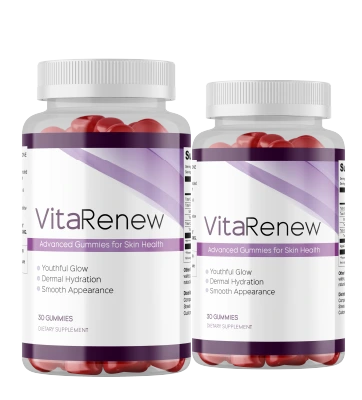
VitaRenew
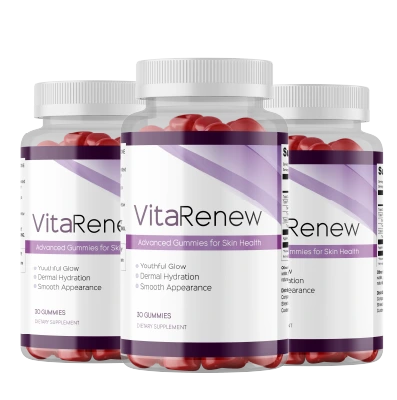
The daily gummy with vitamin C, copper, zinc, vitamin E and selenium — the cofactor combination the body's collagen synthesis process depends on, in one formula.
I started with the 2-bottle supply — 60 days is the honest minimum to assess what internal support can actually do for the skin.
60-day money-back guarantee · One-time purchase, no subscriptionWhat the body actually needs to maintain the scaffold
The skin doesn't stop producing collagen at 48. The fibroblasts are still working. What changes with age is how efficiently the process runs — and that efficiency depends on molecular cofactors that the enzymatic steps of collagen synthesis require.
Three kept appearing throughout everything I read, often in the same research papers:
- Vitamin C. The enzymes that stabilize the collagen triple helix — prolyl hydroxylase and lysyl hydroxylase — require vitamin C to function. Without it, the collagen produced at the cellular level is structurally incomplete. It can't form proper helices, and it gets degraded rather than incorporated into the scaffold. Most people aren't deficient in the clinical sense, but the question of whether dietary levels are adequate for the demands of active dermal maintenance in midlife is a different and less-answered question.
- Copper. An enzyme called lysyl oxidase takes individual collagen and elastin strands and cross-links them into the load-bearing mesh that makes the dermis structural tissue. Lysyl oxidase requires copper as its cofactor. Without it, fibres are synthesized but remain as loose strands — the cross-linking step that actually makes them into scaffold doesn't complete. I read about this in multiple papers. I then looked at every skin supplement I'd ever bought or considered buying. Almost none of them contained copper. Most contained zinc, which is related but does a different job. The copper omission turns out to be standard in the industry.
- Zinc. Regulates the enzymes that manage collagen turnover and participates in the repair signalling that keeps the dermis maintained throughout life. It shows up alongside vitamin C and copper consistently in the research literature.
The other thread running through what I read was the protection of existing fibres from breakdown. Reactive oxygen species — generated by UV exposure, by normal metabolism, by low-level inflammation — attack collagen and elastin in the dermis. Vitamin E and selenium consistently appeared together in the research on this mechanism as the pair that addresses it through complementary antioxidant pathways. At the lower leg, where decades of sun exposure means photoaging is part of the picture on top of everything else, this protective function seemed particularly relevant.
What I tried — and what I noticed
I spent a few weeks comparing supplement labels against what I'd read before I settled on VitaRenew. It was the only formula I found that contained vitamin C, copper, zinc, vitamin E, and selenium together in one product — in a daily gummy rather than requiring me to take several separate supplements. I ordered the 2-bottle supply, which gave me 60 days.
I went in without a lot of expectation. I'd been consistent with the body lotion for two years and seen nothing change in the texture of my lower legs. I wasn't optimistic that a gummy would move the needle either. I kept my moisturising routine going — I wasn't trying to isolate variables, I was just looking for a result.
Around week eight, I started noticing something. I was getting ready one morning, applying lotion after a shower, and I stopped with my hand on my shin the way I had in June. The crinkled texture across the front of my lower legs was less pronounced. The surface looked smoother in the natural light coming through the window. When I pressed gently and lifted, the skin came back more quickly than it had been doing. I took a photo and compared it to one I'd taken at the beginning. There was a real, visible difference in the surface quality.
I kept going — I'm now on my fourth order. The improvement has held. The crepey texture hasn't gone away entirely, but the quality of the surface is meaningfully different from where it was before I started. The slow-return, papery feeling that I noticed that morning in June is substantially reduced. I photograph my lower legs every month or so, in the same light, and the comparison is consistent.
VitaRenew is a supplement. It supports healthy skin, hair, and nails. It is not intended to diagnose, treat, or cure any condition, and these statements have not been evaluated by the FDA.
"I started noticing the crepey texture on my shins a few summers ago — I could see it clearly when I was wearing shorts and the light was right. I'd been using a firming body lotion that helped with the way my skin felt but didn't change the crinkled texture itself at all. After about nine weeks on VitaRenew the surface quality on my lower legs looked different — the papery pattern across my shins was much less defined. Four months in and the improvement has stayed."
— Carol R., 51, verified purchaser
"The crepey skin on the front of my lower legs was something I noticed after turning 47 — thinner, crinkled, slow to bounce back when I pressed on it. I tried a couple of firming creams without seeing any real change in the texture. I started VitaRenew and by the end of the second month the surface of my lower legs looked and felt noticeably better — more resilient, less papery. It's not dramatic but it's consistent and it's held for three months."
— Diana K., 49, verified purchaser
Individual results vary. These testimonials represent personal experiences and may not reflect typical outcomes.
On changes that are outside the normal pattern: the structural changes I've described are gradual and affect both legs in the same way. If you notice changes in your lower leg skin that are one-sided, rapid, or accompanied by swelling, redness, warmth, tenderness, or skin discolouration — particularly in or around the calf — those are symptoms worth discussing with a healthcare professional before considering any supplement response. Asymmetric or acute lower-leg changes can have circulatory causes that need proper evaluation.
If you're looking at the same thing
The crepey skin that develops on the lower legs after 40 is not primarily about dryness or sun damage alone, though both contribute. It reflects a convergence of structural factors that are specific to this site: the near-absence of subcutaneous fat over the shin, which removes the volume buffer that padded areas rely on; the cumulative mechanical stretch load on the calf skin from a lifetime of daily movement; and the UV exposure that adds photoaging to the intrinsic aging process at a consistently bare site. The lower leg's position at the far end of the body's circulatory supply chain means that the cofactor delivery to dermal fibroblasts here is the most distance-dependent of any lower-body site.
Good moisturiser reduces the visible prominence of surface texture — it is worth using for that reason, and I still use it every day. But the structural cause is below the surface, maintained by enzymatic processes that are fed through the bloodstream, not through the skin. Those processes require vitamin C, copper, and zinc to function, and vitamin E and selenium to protect existing fibres from oxidative degradation. Those cofactors are consistently absent or underdosed in standard skin products and most skin supplements.
The 2-bottle supply is where I started. Sixty days gives the biology enough time to show a real response — and for the lower leg specifically, where both synthesis support and antioxidant protection are load-bearing parts of the picture, I think the completeness of the formula matters as much as the dose.
What I use
VitaRenew
Vitamin C, copper, zinc, vitamin E and selenium — the cofactor combination the body's collagen process needs. FDA-registered facility. No subscription.
Start with the 2-bottle supply — 60 days to give the biology time to respond.
60-day money-back guarantee · No subscription · Ships from the US