Skin Health · Personal Story
Why Your Knees Look Crepey After 40 — What I Found Out
It showed up in August, in shorts, at the pool. That papery texture above and around my knees wasn't there last summer — or I hadn't looked closely enough to see it. Here's what I found when I went looking for answers.

We were at a friend's lake house on a Saturday afternoon in early August. I was sitting on the edge of the dock, legs dangling, wearing a swimsuit cover-up I'd pushed up above my knees to keep it dry. I looked down — the way you look at your own body when you're sitting outside and the light falls directly on everything — and noticed something I hadn't seen before.
The skin above my knees had changed. Not the weight kind of change, not the definition kind of change. The skin itself looked different. Thinner, almost, and when I ran my palm over it gently, it had a crinkled quality — the kind of fine, random wrinkles you see in tissue paper when it's been folded and unfolded too many times. Around the kneecap, the texture was more pronounced: a papery, closely spaced pattern that hadn't been there the summer before. Or hadn't been visible enough to catch my eye.
I was 46. I'd expected certain things to change. I had not made any particular predictions about my knees.
I spent a few weeks reading about what was actually happening. The explanation I found surprised me — not because it was alarming, but because it was so structurally specific. The knees are not just any aging body part. They have a particular set of vulnerabilities that explain exactly why this texture shows up there, in this season, at this age.
The thing I assumed first — and got wrong
My first instinct was sun damage. The knees see more sun than the thighs do — shorts, swimwear, outdoor years of walking and gardening. I figured I was looking at photoaging. UV exposure breaking down collagen, the way it does on the forearms or the chest.
That was partly right. UV exposure does accelerate the breakdown of collagen and elastin through a process called photoaging — and unlike the inner thighs, which spend most of the year covered, the knees really do accumulate UV damage over time. So photoaging was in the picture.
But photoaging was only part of the story. What I kept reading about was a separate, underlying process called intrinsic aging — the structural decline in the skin that happens everywhere in the body regardless of sun history. Collagen synthesis begins declining in the mid-twenties at around one percent per year. By the mid-forties, the cumulative structural loss is real and measurable in every region, whether it sees sun or not. The difference at the knees is that photoaging and intrinsic aging are both happening there, at the same time, in a site that is already structurally vulnerable for other reasons.
What makes the knees a perfect-storm location
Three things converge at the knee that don't converge anywhere else below the neck at the same intensity.
The first is the fat pad. The skin above and around the kneecap sits on a layer of subcutaneous fat that provides physical volume and cushioning beneath the surface. This fat pad is thinner at the knee than at the thighs or hips to begin with — the knee is a bony joint, not a padded region — and as midlife hormonal changes reduce subcutaneous fat in certain areas, the skin over the knee starts to lose the structural support beneath it. Instead of sitting against a rounded, supported surface, the skin begins to settle and drape. The "extra" quality above the knee — the way the skin seems to have stretched forward and not quite returned — is in large part the dermis resting on a support structure that has reduced.
The second is movement. Every step you take flexes and extends the knee. Sitting, standing, climbing stairs — the motion range is large, and the skin over the front and top of the knee participates in all of it. Over decades of daily movement, the collagen and elastin fibres in the dermis at that joint absorb enormous cumulative mechanical load. Skin is elastic, meaning it stretches and recovers. But recovery depends on intact, cross-linked fibres — a scaffold that can spring back. As intrinsic aging reduces collagen synthesis rates and the fibres themselves accumulate fatigue, the elastic recovery fails. The skin that stretched under load starts to hold the shape instead of returning. That failure of return is exactly what crepey texture is.
The third is estrogen. This one took me the longest to understand. The dermis has estrogen receptors throughout it, and estrogen actively supports the cells that produce collagen and elastin — the fibroblasts. It helps regulate hyaluronic acid production, which maintains the physical plumpness of the skin's inner layers. For estrogen-sensitive areas of the skin — and the knees, like the inner thighs and arms, are estrogen-responsive — the hormonal decline of perimenopause removes a layer of support that was quietly compensating for the structural vulnerabilities below.
A bony joint with a shrinking fat pad, the highest mechanical load cycle of daily movement, UV exposure from years of summer, and skin that's estrogen-responsive in a moment of estrogen decline. I wasn't imagining it. The biology was pointing directly at my knees.
Why everything I tried at the surface didn't reach the problem
Once I understood what was happening, I looked back at what I had tried and why it wasn't working. I'd been using a firming body lotion for a while — one with retinol in it, one that cost more than I should probably admit. And I'd been applying it consistently to the thighs and knee area. The skin was hydrated, I'll say that. But the texture — the crepey quality above and around the kneecap — was not responding.
Reading the skin biology, I understood why. The outer layer of skin — the stratum corneum — is a barrier. Its job is to keep things out, and it does so based on molecular size. Molecules above a certain weight threshold don't penetrate it in meaningful quantities. Collagen is far above that threshold; applied collagen stays at the surface. Elastin does the same. Even retinoids, which have the strongest evidence of any topical for sub-surface effects, act at or near the junction between the outer and inner layers of skin — not deep in the dermis where the actual scaffold lives.
The crepey texture I was looking at was a scaffold problem. The scaffold is under the surface. Anything applied to the surface hits the biology of the dermis indirectly at best. Good hydration makes surface texture less visible — the moisturiser was doing something real — but it couldn't reach the structural cause.
The structural cause requires something the body delivers through the bloodstream, not through the skin.
What I found
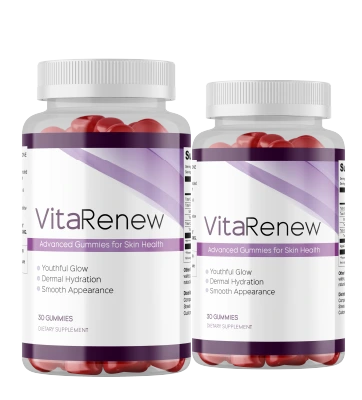
VitaRenew
The daily gummy with vitamin C, copper, zinc, vitamin E and selenium — the cofactor combination the body's collagen synthesis process depends on, in one formula.
I started with the 2-bottle supply — 60 days is the honest minimum to assess what internal support can actually do for the skin.
60-day money-back guarantee · One-time purchase, no subscriptionWhat the body actually needs to maintain the scaffold
The body doesn't stop producing collagen at 46. The fibroblasts — cells that build and maintain the collagen and elastin mesh in the dermis — are still active. What changes is the efficiency of the process. And that efficiency depends on specific cofactors that the enzymatic machinery needs to function.
Three kept coming up across everything I read:
- Vitamin C. The enzymes that stabilise the collagen triple helix — prolyl hydroxylase and lysyl hydroxylase — require vitamin C to function. Without adequate vitamin C, the collagen produced at the cellular level is structurally incomplete. It cannot form proper helices. This is not a wellness claim; it is the mechanism behind the skin deterioration seen in scurvy, documented in clinical nutrition for over a century. Most people have enough vitamin C to prevent deficiency symptoms, but the question of what constitutes adequate supply for active dermal maintenance at 46 is a different question.
- Copper. An enzyme called lysyl oxidase cross-links collagen and elastin fibres into the load-bearing mesh that makes the dermis structural tissue. Lysyl oxidase requires copper as its obligate cofactor. Without copper, fibres are synthesised but remain as disorganised strands — they never complete the bonding step that converts them into scaffold. This is the step where the dermis actually becomes structural. Copper appeared consistently in the biology I read. It almost never appeared in skin supplement ingredient lists. Most formulas I compared simply omitted it.
- Zinc. Regulates the enzymes that govern collagen turnover and participates in the wound-repair signalling that maintains the dermis throughout life. It shows up consistently alongside vitamin C and copper in the relevant research literature.
The second mechanism I kept reading about was oxidative degradation — the breakdown of existing collagen and elastin fibres by reactive oxygen species. This is relevant everywhere, but particularly at a site like the knee where UV exposure adds a photoaging load on top of intrinsic decline. Vitamin E and selenium consistently appeared together in the dermal antioxidant literature as the pair that addresses this parallel mechanism. Not rebuilding fibres, but slowing their degradation while the synthesis pathway works to maintain the supply.
What I tried — and what I noticed
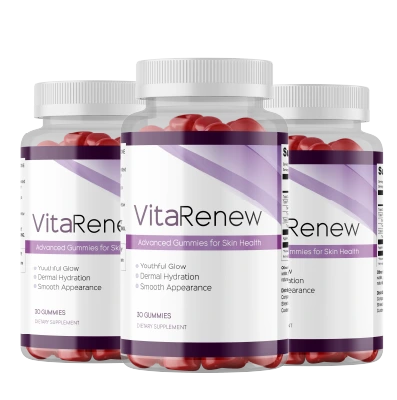
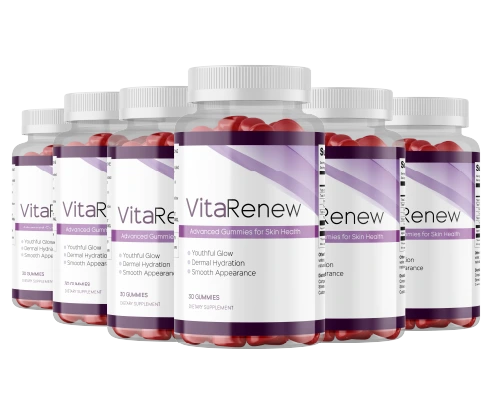
I spent a few weeks comparing product labels against the cofactor picture before settling on VitaRenew. It contains vitamin C, zinc, copper, vitamin E, selenium, and beta-carotene — the specific combination the research consistently describes, in a daily gummy rather than a stack of separate supplements.
I went in with realistic expectations. I had been through enough supplements to arrive at this one without any particular enthusiasm. I ordered two bottles — a 60-day supply — because the biology I'd read suggested that structural changes in the deeper dermis take eight to twelve weeks to become measurable, and a shorter trial wouldn't give me real information.
I kept my moisturiser routine going through those two months. I wasn't looking to isolate variables — I was looking to see if there was a meaningful change I hadn't been getting.
Around week eight, I started noticing something different in the texture above and around my knees. I was getting dressed one morning, same light, same mirror, and I looked at my knees the way I had on the dock in August. The papery quality above the kneecap was less pronounced. The skin still wasn't the way it looked at 35, but the crinkled pattern when I extended my leg was visibly softer. When I pressed my palm gently against the skin above my knee and lifted it away, it came back a little more completely than it had been doing. I photographed it and compared it to a photo I'd taken at the start of the two months. There was a real difference in the surface quality.
I'm on my third order now. The improvement has held and continued slightly in the months since. I'm not describing a dramatic transformation — I'm describing a visible, consistent improvement in the quality of the texture that has remained stable over four months. The progression I was watching in August stopped progressing, and the texture that was already there has partially resolved.
VitaRenew is a supplement. It supports healthy skin, hair, and nails. It is not intended to diagnose, treat, or cure any condition, and these statements have not been evaluated by the FDA.
"I noticed the crepey texture above my knees during a beach trip this past June — it was the first summer I really saw it. I'd been using a body lotion with collagen in it, which did nothing for the texture itself. After nine weeks on VitaRenew the skin above my knees looks noticeably smoother and less folded. I can see the difference especially when I stand and look down at my legs. It's not dramatic but it's real and it's held."
— Joanne M., 48, verified purchaser
"The crepey texture around my kneecaps was my main concern — it looked papery even when my legs were straight. I tried a firming body lotion for a few months without seeing any change in the texture. About ten weeks into VitaRenew I noticed the crinkled quality around the kneecap is less defined. Also the skin above my knee looks less draped. Subtle but consistent and it has stayed."
— Vera L., 52, verified purchaser
Individual results vary. These testimonials represent personal experiences and may not reflect typical outcomes.
On how to assess changes: the structural changes I've described are gradual and affect both knees equally. Age-related skin texture changes are bilateral. If you notice changes that are one-sided, rapid, or accompanied by swelling, warmth, pain, or redness at the knee joint or surrounding skin, those warrant evaluation by a healthcare professional before any supplement response. Asymmetric or acute changes are outside the pattern of gradual structural aging and should be assessed first.
If you're looking at the same thing
The crepey texture that develops on and above the knees after 40 is not primarily about dryness, or weight, or sun damage alone. It reflects the convergence of three structural factors unique to that site: the progressive reduction of the subcutaneous fat pad over the patella, the cumulative mechanical load of a lifetime of daily movement through the knee joint, and the UV exposure that compounds intrinsic aging at a site that sees the sun. Estrogen decline in perimenopause accelerates the timeline by removing a layer of fibroblast and hyaluronic acid support from skin that was already under structural stress.
A good body moisturiser reduces the visible prominence of surface texture through hydration — it is worth using for that reason. But the scaffold beneath the surface depends on enzymatic processes that the body delivers through the bloodstream, not through topical application. Those processes require vitamin C, copper, and zinc to function, and vitamin E and selenium to protect existing fibres from degradation. Those cofactors are consistently absent or underdosed in standard skin products and supplements.
The 2-bottle supply is where I started. Sixty days gives the biology enough time to show a real response — and at the knee specifically, where mechanical load is constant and UV history matters, I think the antioxidant component is as relevant as the synthesis support.
What I use
VitaRenew
Vitamin C, copper, zinc, vitamin E and selenium — the cofactor combination the body's collagen process needs. FDA-registered facility. No subscription.
Start with the 2-bottle supply — 60 days to give the biology time to respond.
60-day money-back guarantee · No subscription · Ships from the US