Why My Forehead Skin Looks Crepey After 40 — And What Finally Helped


It started with a birthday photo. Not a professional one — just a casual shot a friend took at dinner, with her phone, at close range. When I saw it, I stopped scrolling. Something about my forehead looked different. Not the lines I'd been watching for, the ones that deepen when I squint or raise my eyebrows. This was a different texture underneath those — a fine, crinkled quality that covered the whole area, even with my face relaxed. Like the surface had gone slightly papery.
I knew immediately what it was, because I'd seen it on other women and wondered when it would arrive for me. Crepey skin. I just hadn't expected to see it on my forehead first, or to feel so unprepared for it at 43.
My first instinct was to moisturize more
I did what I imagine most people do. I upgraded my skincare. Richer moisturizer, a dedicated retinol serum, a peptide eye cream I started using all over the forehead. My routine became genuinely elaborate. And for a while I convinced myself it was working — the skin looked better when I first applied things, plumped up by the hydration. Then within a couple of hours, the texture was back.
After months of this, I admitted to myself that I was treating something I didn't fully understand. I decided to actually research what crepey skin on the forehead is — not how to cover it, but what's causing it.
It turned out to be a deeper problem than I thought
What I learned changed how I looked at the whole issue. Skin has layers, and the one that gives it its structure — its thickness, its bounce, its ability to hold a smooth surface — is called the dermis. That's where collagen and elastin live. It's also a layer that topical products generally can't reach. The outer skin is a barrier, and a very effective one. Most of what we apply sits in the epidermis, the surface layer, where it hydrates temporarily. The dermis is underneath all of that.
Crepey skin happens when the dermis thins. Collagen production starts declining from our mid-twenties — slowly at first, about one percent a year. That's gradual enough that it's invisible for two decades. What made mine appear now, at 43, is that other changes are compounding it. As estrogen levels shift in perimenopause, dermal collagen loss speeds up considerably. Research suggests a significant share of total skin collagen can be lost in just a few years around this transition.
Add to that the fact that the forehead gets more direct sun exposure than most of the face — and UV light degrades collagen fibers over time — and you have a zone where structural thinning arrives earlier and progresses faster than it might on protected areas of skin.
The piece that finally made sense of it
Here's what surprised me most. The body doesn't lose the ability to make collagen in your forties. The cells that produce it — fibroblasts — are still active. Collagen synthesis is a biochemical process that depends on specific nutrients to run: cofactors that drive the enzymes doing the work. Without them, the assembly line slows down even when the workers are present.
Vitamin C is one of the most important. It's a required cofactor for the enzymes that give each collagen molecule its stable structure. This isn't a wellness trend — it's established biochemistry. Copper plays a similar, less well-known role: it's essential for the enzyme that cross-links newly made collagen and elastin fibers into the dense, organized matrix that gives young skin its resilience. Zinc rounds out the picture, supporting skin integrity and protecting existing collagen from oxidative damage.
Reading this, I had an uncomfortable realization. All those months of serums and moisturizers, I had been trying to solve an internal problem from the outside. Not because the products were bad — they were fine — but because the actual cause was something no topical product could address.
What I started using — and what I'd suggest looking into
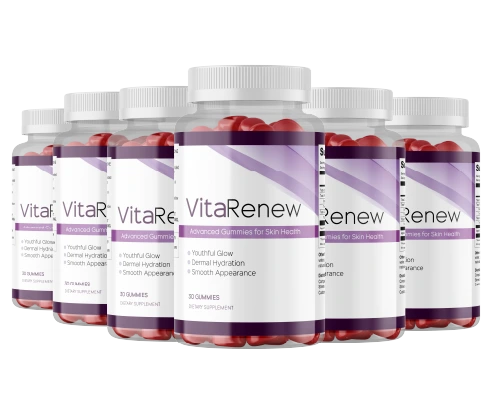
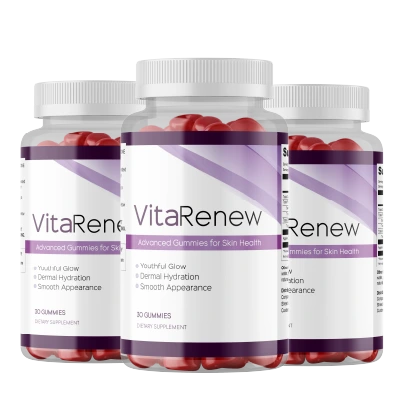
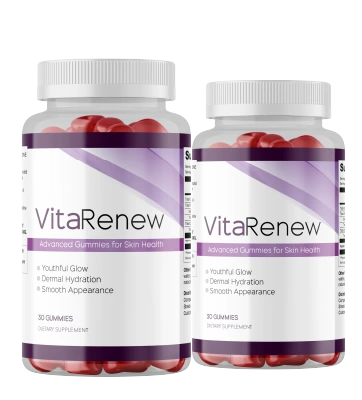
After doing this research, I tried several things. The one I came back to consistently was VitaRenew, a daily collagen-support gummy made specifically for women in their 40s and 50s. It doesn't deliver collagen directly — it provides the micronutrients that the body's own collagen synthesis depends on:
- Vitamin C & copper — the essential cofactors for collagen production and structural cross-linking in the dermis
- Zinc & antioxidant support — for skin integrity and protection from oxidative damage
- Daily gummy format — easy to actually maintain, not another step in an already long routine
It's a supplement, not a cure, and I want to be clear about that. The crepey texture on my forehead didn't disappear — that would be an unrealistic expectation at 43. But about six weeks in, I noticed it had softened. My skin looked slightly less papery in photos. And the quality I'd always wanted from my serums — that sense of the skin having more internal support — was something I started to actually feel.
What other women are saying
"I noticed it in a selfie too — that fine papery texture on my forehead that looked nothing like my regular wrinkles. VitaRenew was the first thing I tried that actually addressed it from the inside. About two months in, my skin genuinely looks more supported."
"I'd been spending a lot on face serums without really understanding why they weren't helping. The cofactor explanation clicked immediately. Three months in, the texture on my forehead and around my eyes is noticeably smoother. I feel like I'm finally working with the biology instead of against it."
These statements reflect individual experiences. Results are not typical and will vary from person to person.
If you've been where I was
If you've been frustrated by the texture on your forehead and felt like every topical product hits the same ceiling, it might be because you're solving at the wrong layer. Crepey skin is a structural change that begins in the dermis — below where any serum can reach. Adding the nutritional cofactors that collagen synthesis depends on, from the inside, addresses the part of the problem that skincare can't. That's where I'd start. It's where I wish I'd started sooner.