Skin & Aging · Personal Story
Why Your Cheeks Look Crepey When You Smile — What I Finally Understood About the Skin Underneath
I spent a year trying to fix it from the outside. What nobody told me — until someone finally did — is that the problem doesn't start at the surface.

You know the moment. You're in a group photo — a birthday, a brunch, something bright and outdoor — and when you see the image later, there it is. Not on your forehead, not around your eyes. On your cheeks. That fine, papery, crinkled texture across the fullest part of your face, the part that should look round and smooth, looking instead like it's been slightly crumpled. And when you smiled for the camera, it showed more. The fold lines radiated outward from the apples of your cheeks the way crepe paper does when you press it.
I was 49 when I first noticed mine. Not in a mirror — mirrors were manageable because I controlled the light and the angle. It was a candid photo taken at a summer wedding, afternoon sun, the worst possible light for this kind of thing. My sister looked at the same photo and said my makeup looked heavy. My makeup wasn't heavy. My skin just had a texture that foundation was settling into and magnifying.
What followed was the usual sequence. Better primer. A "smoothing" foundation. A different moisturizer. A collagen drink a friend swore by. None of it changed what I was seeing, because none of it was reaching the layer where the problem actually was.
Why the cheeks are where you see it first
Here's what took me an embarrassingly long time to understand: the cheeks aren't just skin over bone. The mid-face has what's called the malar fat pad — a layer of soft tissue that gives the cheeks their forward, rounded shape when you're young. Beneath and around that pad is the dermis: a dense, structured layer made of collagen fibres, elastin, and hyaluronic acid. Together these create what you see on the surface — firmness, bounce, the smooth appearance that comes from having structure below.
The cheeks also face the sun more directly than almost any other part of the face. The angle of the cheekbone puts that skin in direct UV exposure every time you're outdoors. Years of sun accumulate there in the dermis, degrading the fibres that hold the structural layer together — long before you're old enough to make the connection.
By the late forties, two things tend to be happening at once. The dermis has lost density from years of normal aging and UV exposure. And estrogen levels — which actively support collagen density in skin — have begun declining. The cheeks are convex, forward-facing, and central to expression. When they lose structural support, you see it in every smile, every photograph, every window reflection with the light behind you.
Foundation was settling into lines that moisturizer couldn't smooth — because those lines weren't a surface problem. They started an entire layer lower than anything I was applying.
What topical products are actually designed to do (and where they stop)
I'm not saying moisturizers are useless. Surface hydration does help the skin's appearance, and the right formula can temporarily reduce the look of fine lines. But crepey texture — the crinkled, papery quality that shows up when you move your face — comes from changes in the dermis. That's the structural layer just beneath the surface. And the dermis is not a layer that creams or serums are designed or able to meaningfully penetrate.
This is the thing dermatologists have been saying for years that the skincare industry has very little incentive to amplify: the dermis is the structural layer, and it's only accessible from within. What you apply to the outside makes the surface look better or worse. It doesn't change what's happening underneath.
This is also why collagen drinks produced such mixed results for me. They add raw material. But if the body can't assemble that material efficiently — because it lacks specific tools the manufacturing process depends on — the extra collagen doesn't translate into structurally better output. I was adding ingredients to a factory that was short on the tools to use them.
The cofactor insight that changed how I approached this
A dermatologist explained this to me about two years after I first noticed the cheek texture. Collagen synthesis is a complex, enzyme-driven process. The fibroblasts — the cells that make collagen — are still working in your forties. The problem is that the process requires certain cofactors to run efficiently:
- Vitamin C is essential for two enzymes — prolyl hydroxylase and lysyl hydroxylase — that give each collagen molecule its stable, helical structure. Without adequate vitamin C, the collagen produced is structurally weaker. This is basic biochemistry, not a supplement claim.
- Copper is required by lysyl oxidase, the enzyme that cross-links newly formed collagen and elastin fibres into an organized, resilient network. The fibres can be made, but they won't form the strong matrix they're meant to form without copper enabling the cross-linking step.
- Zinc supports normal cell turnover and the daily maintenance processes that run in the dermis. Less dramatic than the other two, but it keeps the repair cycle running at its normal pace.
The practical implication: if collagen drinks haven't delivered results, the bottleneck might not be raw material. It might be that the assembly process is running inefficiently — and no amount of extra collagen peptides fixes an inefficient process.
What I use
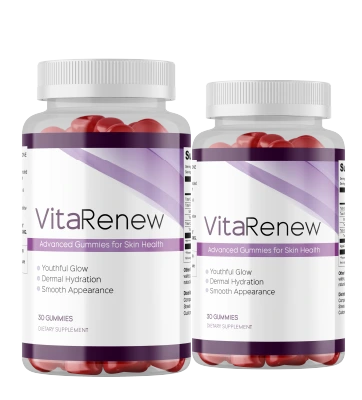
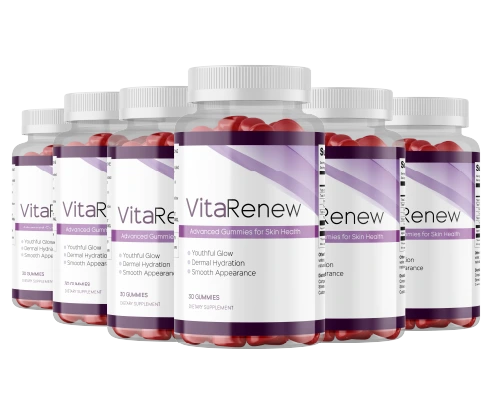
VitaRenew
Vitamin C, copper, and zinc in a daily gummy — the cofactors the skin's collagen assembly process depends on. Made in an FDA-registered, GMP-certified facility.
For the smile that doesn't make you look away from the photo.
60-day money-back guarantee · One-time purchase, no subscriptionWhat I actually tried — and what three months looked like
I found VitaRenew after spending two months reading about cofactors and looking for something that combined them specifically, rather than just adding more collagen on top of what might be a process deficiency. It's a gummy — which I was skeptical about — containing vitamin C, copper, and zinc at levels targeted to skin support.
I started with the 2-bottle kit. Sixty days, money-back guarantee, the lowest entry price. My logic was simple: the guarantee meant I had nothing material to lose, and two months was long enough to form a real opinion without committing to a large supply if nothing happened.
The first month: genuinely nothing visible. I almost stopped. Week five: the skin on my cheeks felt slightly different when I pressed my fingers against the apples — a little more resistance, less give. I couldn't tell if I was imagining it. Week eight: something I could point to. The texture across my cheekbones was less pronounced in photographs. Not gone. Noticeably less pronounced.
Three months in, I photographed myself in the same afternoon window light that had produced the wedding photo. The crinkled texture when I smiled was still there — I'm not going to pretend otherwise — but the lines were shallower. Foundation no longer settled into the same channels. A photo my husband took without warning, with me mid-laugh, looked different from anything I'd been taking the year before.
"The cheeks were the part of my face that bothered me most in photos. After about two months I realized I'd stopped thinking about my angle and just smiled normally. For me, that's the result."
"I'd been using expensive serums for two years with no change in that crepey texture around my cheekbones. Three months in, I can see a real difference in how the skin sits. My husband noticed without me prompting him."
These statements reflect individual experiences. Results are not typical and will vary from person to person.
What I'd tell myself two years ago
Start earlier. Stop chasing the surface fix for something that doesn't start at the surface. Understand that the dermis — the layer that actually determines what your skin looks like and how it moves — is only reachable from within, and that it has specific nutritional needs most of us aren't thinking about when we reach for another moisturizer.
The cheeks are the most forward part of your face. They're what people see when you smile, and what cameras catch in unforgiving light. If the texture there has been bothering you and nothing topical has made a real difference, the reason is probably not the products you haven't tried yet. It's that you've been working on the wrong layer.
The 2-bottle kit is where I'd suggest starting. It's the lowest price point, and the 60-day guarantee means the risk is essentially the cost of not trying sooner.
Where to start
VitaRenew
The cofactor approach to supporting skin structure — vitamin C, copper, and zinc. No autoship, 60-day guarantee.
Start with two months. See what happens.
60-day money-back guarantee · One-time purchase, no subscription