Why the Skin on My Arms Changed Before the Rest of Me Did


I've never been someone who worries much about how I look. But when the skin on my upper arms started looking the way it did — thin, crinkled, like wrapping tissue that had been balled up and smoothed out — I found myself reaching for cardigans in July. Not because I was cold. Because I'd stopped feeling like myself in a tank top.
I asked a dermatologist about it at my next appointment. I expected her to recommend a cream. What she gave me instead was an explanation, and it changed the way I think about the whole thing.
Why the arms, specifically
The skin on the upper arm is naturally thinner than most other areas. It also sits over loose connective tissue rather than muscle, which means it has less internal scaffolding. When the deeper structure of skin begins to change — and it does, in all of us, as we move through the forties — the arms tend to show it first.
The change happens in the dermis, the middle layer of skin where collagen and elastin live. Collagen fibres give skin its thickness and resistance. Elastin lets it snap back. When the dermis loses density — which begins gradually in our twenties but accelerates as estrogen falls in the perimenopausal years — the result shows up on the surface as fine, crinkled texture. That is what crepey skin is: the outside view of a loosening, thinning middle layer.
The thing I hadn't considered
My dermatologist said something I've thought about since: the body doesn't stop producing collagen just because the skin changes. The fibroblasts — the cells that make it — are still working. What changes is the efficiency of the production process, and in particular the availability of certain cofactors the process depends on.
Two stuck with me. Vitamin C is required by the enzymes that give each collagen molecule its structural shape — without it, the body produces weaker, less stable collagen, not no collagen at all. Copper is needed by the enzyme that cross-links loose collagen and elastin threads into the resilient mesh that gives skin its recoil. Zinc plays a supporting role in skin cell turnover and repair.
She was careful to say this doesn't make any single supplement a solution. But it does suggest that if the manufacturing line is missing its tools, adding more raw material — like collagen powder — won't do very much.
What I've been looking into
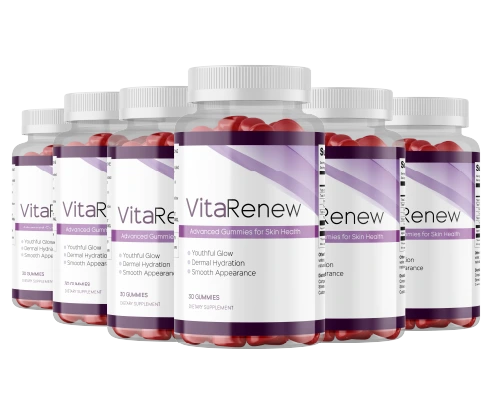
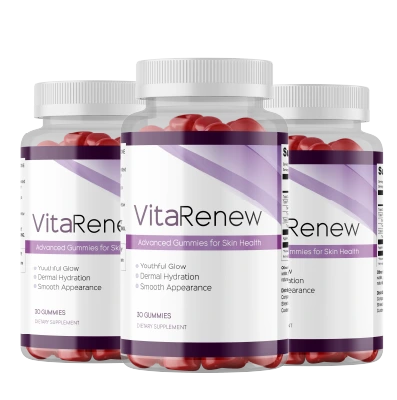
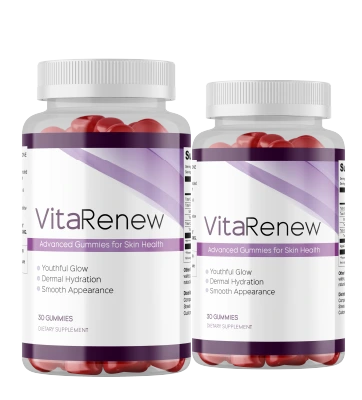
I started reading about formulas built around the cofactor side rather than the raw-material side, and VitaRenew was the one that kept coming up — a daily gummy with vitamin C, zinc, copper, vitamin E, and selenium. Not a medication; a supplement that supports skin, hair, and nails, made in an FDA-registered facility.
- Focused on cofactors — the micronutrients the synthesis process actually requires.
- Daily gummy — simple routine, no powders to mix.
- 60-day guarantee — enough time to evaluate honestly.
It isn't going to undo years of change in a few weeks, and any brand promising otherwise is one to walk away from. But as a small, low-risk daily step aimed at supporting the process, it felt like the sensible place to start.
What other readers have shared
"I wore sleeveless for the first time in two summers at a family event. Didn't spend the whole evening tugging at my clothes."
"Eight or nine weeks in, the texture on the inside of my arms felt less papery. That was the only change I was looking for."
These statements reflect individual experiences. Results are not typical and will vary from person to person.
What I'd tell anyone starting out
Give it a full three months and photograph the same spot in the same light on day one. The dermis changes slowly — collagen remodelling is measured in months, not weeks — so anything you choose deserves a proper window to work in. And any persistent change to your skin that isn't the gradual, symmetrical kind is always worth a dermatologist's eye.