Personal Health · Skin & Aging
Why Is the Skin on My Ankles So Thin and Crepey After 40?
I had been watching my face for years and felt like I was staying ahead of things. It was my ankles that surprised me — and understanding why they changed early taught me something about how skin aging actually works in the body's extremities.

I noticed it during a yoga class. I was sitting cross-legged, and in the mirrored wall I caught a straight-on view of my ankles. The skin on my lower legs, right above the ankle bones, had a texture I hadn't seen there before — fine lines running across the surface in a grid pattern, the kind that makes skin look like it belongs to someone a generation older. Not on my face, which I monitor carefully. On my ankles, which I apparently hadn't thought to look at in years.
I went looking for an explanation. What I found was more specific than I expected, and it changed what I actually did about it.
The ankle has structural reasons for changing early
The first thing I learned is that the skin on the ankle and lower leg is anatomically thinner than skin elsewhere on the body. The dermis — the deeper layer where collagen and elastin live, where the structural support is — is measurably shallower there than on the face, chest, or upper arms. Thinner baseline means changes show earlier; there's less structural depth to work through before loss becomes visible.
The second thing: the ankle is the most distant point from the heart in the body's entire circulatory circuit. Blood pumped down to the lower extremity has to make the whole journey back up against gravity, relying on working vein valves and leg muscle movement to push it along. As both of those tend to become less efficient with age, circulation in the tiny capillaries of the ankle skin can slow. Those capillaries are how the dermis gets the nutrients it needs to run its own maintenance — building new collagen, clearing degraded material. Slower flow means slower upkeep.
There are two more factors specific to this zone. Sebaceous glands — the ones that produce natural skin oils — are sparse on the lower leg and ankle. That means the skin surface there loses moisture faster than, say, the face, which makes the crepe-paper texture more pronounced when the dermis is already thin. And then there's the mechanical reality: ankles flex constantly, rub against socks, press into shoes. A thinner skin in a high-friction zone shows wear differently.
The ankle has thinner dermis, slower circulation, lower natural oil production, and constant mechanical friction. It has structural reasons to show aging earlier — not because something is wrong, but because of what it is.
The systemic process that accelerated this for me in my 40s
The site-specific factors explain why ankles are vulnerable. They do not fully explain the timing — why this seemed to arrive more suddenly in my mid-forties than in my late thirties.
That part turned out to involve hormones. Estrogen plays a direct role in maintaining dermal collagen throughout the reproductive years. It promotes the activity of fibroblasts — the cells that build collagen — and it modulates the enzymes that break collagen down. When estrogen levels begin declining through perimenopause, both of those effects weaken. Research published in Dermato-Endocrinology documented that skin collagen content drops significantly in the years surrounding menopause, at a rate that exceeds the gradual background decline that's been occurring since our mid-twenties.
The ankle, with its already-thin dermis and compromised circulation, is one of the places where that systemic decline tends to land visibly first. It is not that it is aging faster — it is that it had less structural reserve to absorb the decline before it became apparent.
The year I spent using the wrong solution
My first response was to add collagen powder to my morning coffee. I did this consistently for close to a year — good quality, clean product, not cheap. My face felt hydrated. My ankles looked the same.
I eventually came across the research on collagen cofactors, which explained what I was missing. The body does not stop making collagen in the 40s. Fibroblast cells remain active and continue to synthesize it. What changes is the balance between how much is being made and how much is being broken down — and that balance is governed at specific enzymatic steps that depend not on collagen amino acids, but on micronutrient cofactors.
Three of them matter here:
- Vitamin C is required by two enzymes — prolyl hydroxylase and lysyl hydroxylase — that stabilize newly synthesized collagen into its functional triple-helix shape. Without adequate vitamin C, newly made collagen is structurally unstable and degrades before it can integrate into the dermal matrix. Most of us are not acutely deficient, but many adults are below the level needed to run these enzymatic reactions optimally.
- Copper activates an enzyme called lysyl oxidase, which cross-links individual collagen and elastin fibers into the load-bearing network of the dermis. Fibers can be present — synthesis can be occurring — while the cross-linking step remains incomplete. Copper is the most consistently missing piece in skin supplement formulations, even though without it the structural matrix doesn't fully assemble.
- Zinc supports fibroblast function and modulates the matrix metalloproteinases — enzymes that degrade structural proteins. Getting zinc consistently supports the balance between synthesis and breakdown.
I had been adding building blocks. I had not been supporting the construction process itself.
What I use now
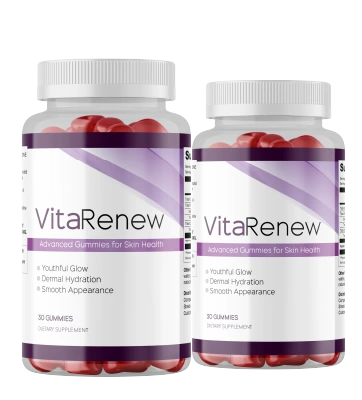
VitaRenew
Vitamin C, copper, and zinc — the three cofactors the dermis depends on — in a once-daily gummy formulated for women 40+. One-time purchase, no subscription.
The piece I was missing for a year before I understood what I actually needed.
60-day money-back guarantee · One-time purchase, no subscriptionWhat actually changed — and what timeline to expect
I want to be specific about this, because I have been burned by vague promises before.
The outermost skin layer turns over every four to six weeks. Surface texture can begin to respond within that window as the cells renewing there have better cofactor support to work with. The dermis is slower — the research that measures meaningful structural change in dermal studies uses eight-to-twelve-week windows, and for good reason.
By month three of consistently getting the cofactors, the texture on my ankles was noticeably different. The crumpled quality I had seen in that yoga mirror was less pronounced. My doctor, who I see regularly, commented without prompting on how my skin looked. I had not told her what I was taking.
I am not going to tell you that three months erased anything — that kind of language is not accurate, and it is not the kind of claim I want to stand behind. What I can say is that the texture changed in a way that collagen powder alone had not produced in a year of consistent use.
What to look for in any skin support supplement
- All three cofactors: vitamin C, copper, and zinc together. Each operates at a different step. Missing one leaves a gap the others cannot close.
- Copper at a dose that actually reaches the enzymatic threshold. Most products either omit it or include a trace amount that is too small to matter for lysyl oxidase activity.
- A 60-day return window, at minimum. Dermal change takes months. A 30-day guarantee is not enough time to evaluate honestly — and a manufacturer who offers one knows that.
- FDA-registered facility and GMP certification. These are the baseline quality signals. Third-party testing adds further confidence.
- Honest language about timelines. Any product claiming visible results in two weeks is making a claim the science does not support. That language tells you something about the company.
Other women who noticed their ankles first
"I thought I was paying attention to my skin — I had a whole routine. Then I looked at a beach photo from last summer and my ankles looked like crepe paper. Started getting vitamin C, copper, and zinc consistently. After about three months the texture on my lower legs is noticeably different. They don't catch me off guard in photos anymore."
"I asked my dermatologist about the crepey texture on my ankles and she said it was age-related structural change and to stay consistent with sun protection and hydration. I started focusing on the cofactors — which she hadn't mentioned — and by month three the change was enough that I asked her about it at my next visit. She said the skin looked noticeably firmer and asked what I'd added."
These are individual accounts. Results are not typical and vary based on individual factors including age, baseline skin thickness, diet, sun history, and consistency of use. No supplement is intended to diagnose, treat, cure, or prevent any disease.
Product referenced in this article
VitaRenew
Vitamin C, zinc, and copper in one daily gummy. Formulated for women 40+. FDA-registered facility, GMP-certified. 60-day money-back guarantee. One-time purchase — no subscription.
What I add to every morning. The piece collagen powder alone was missing.
60-day money-back guarantee · Supports skin, hair and nailsBackground reading
- Thornton MJ. "Estrogens and aging skin." Dermato-Endocrinology, 2013.
- Pullar JM, Carr AC, Vissers MCM. "The Roles of Vitamin C in Skin Health." Nutrients, 2017.
- Rucker RB et al. "Copper, lysyl oxidase, and extracellular matrix protein cross-linking." American Journal of Clinical Nutrition, 1998.
- Chung JH et al. "Molecular mechanisms of intrinsic skin aging." International Journal of Dermatology, 2003.
- Ogawa Y et al. "Zinc and skin disorders." Nutrients, 2018.
- Gniadecka M et al. "Dermal water distribution in normal and aging skin." British Journal of Dermatology, 1998.