Skin Health · Seasonal
The Winter Reason Skin Over 40 Turns Crepey & Thin
Every fall, the same question: did my skin actually change overnight, or did I just stop noticing? The answer involves two separate processes happening at two different depths — and most people are only addressing one of them.

Step out of the shower on a cold January morning and you’ll feel it before you see it: the skin on your arms and hands feels tighter, drier, and somehow more fragile than it did in August. Look in the mirror and it looks that way too — thinner, with a fine crinkled texture across the inner arms and décolleté that was barely visible three months ago.
The obvious explanation is dry skin. And that explanation is partly right. What it misses is the second half of what’s happening — the part that explains why your usual moisturizer, however faithfully applied, never quite catches up in winter the way it seems to in summer.
Two things happening at once
Crepey skin in winter is the product of two separate processes converging. Understanding them separately makes it clearer why both need to be addressed.
Process 1: What cold air and heating do to the surface
Cold outdoor air holds very little moisture. When your skin is exposed to it, water migrates outward through the skin barrier more rapidly than in humid conditions — a process called transepidermal water loss. Indoor heating compounds this: forced-air systems pull additional moisture from both the air and the skin surface, driving humidity in a typical heated home well below the range comfortable for human skin.
The outer skin layer — thin and mostly non-living — becomes dehydrated. It loses the slight plumping effect that even modest ambient humidity provides. Surface treatments like moisturizers partially compensate for this, but in a heated indoor environment, the compensation is constant and partial at best.
Process 2: What has been quietly happening in the dermis
Beneath the outer barrier lies the dermis: the structural layer of skin, roughly two millimeters thick, composed of tightly woven collagen fibres, elastin, and the water-binding matrix that surrounds them. Since the mid-twenties, the fibroblasts responsible for maintaining this structure have been gradually reducing their collagen output. The mesh slowly loses density.
In the warmer months, ambient humidity and the minor plumping effect of surface moisture partially smooth the visible texture that results from this structural thinning. When that effect disappears in winter, the texture the thinner dermis was always producing becomes unmasked. The skin hasn’t suddenly changed. The summer buffer has been removed.
Winter doesn’t create the crepey texture. It removes the seasonal hydration layer that was softening its appearance. The structural change was already there.
Why perimenopause accelerates what you see in winter
The gradual slowing of collagen production is a universal feature of skin aging — it begins in the twenties and continues steadily. But for women in their forties and fifties, a second process amplifies it considerably.
Estrogen plays a direct role in stimulating fibroblast activity and maintaining the rate of dermal collagen synthesis. As estrogen levels decline during perimenopause, the rate of collagen production slows more sharply. Researchers have documented that a meaningful proportion of dermal collagen can be lost in the years immediately surrounding menopause — a period when the gradual age-related decline meets a steeper hormonal one.
The result is that for many women, the first time the winter effect really becomes noticeable — the first time the seasonal texture change seems significant rather than trivial — is in their mid-to-late forties. Not because anything dramatic happened to the skin in that particular autumn. But because the cumulative structural change finally crossed a threshold where the loss of the humidity buffer in winter makes the difference clearly visible.
Where crepey skin appears in winter, and why those locations
The pattern is consistent. Crepey texture in winter shows first and most prominently on the inner surface of the upper arms, the backs of the hands and forearms, the décolleté, and the sides of the neck. Not the face, or not primarily.
These are areas where the skin is already thinnest, where there is no underlying muscle movement to maintain tone, and where structural changes in the dermis become visible earliest. They are also the areas most consistently covered by clothing in colder months — which means they are frequently out of sight from late September through April, making it easy to experience each autumn as a fresh surprise rather than a continuation.
A useful comparison: look at the skin on your inner arm in November and then in July, in similar lighting. The difference is not random variation. It’s the same dermis at two different ambient humidity levels — with the winter version showing what was always structurally present.
What surface hydration can and cannot do
Moisturizer works at the level of the outer skin barrier. It slows transepidermal water loss by forming a partial seal over the surface, and some formulations temporarily plump the stratum corneum by drawing moisture from slightly deeper layers. The improvement in texture this provides is real.
But the outer barrier is structurally above the dermis by a significant margin. Nothing applied topically at practical concentrations penetrates to the level where the collagen and elastin mesh lives. The dermis’s current density — whether it has been maintained or has thinned — is not changed by what is applied to the surface above it.
This is why moisturizer works in a different way for a forty-year-old than it did for a twenty-year-old: the twenty-year-old’s dermis had structural density that provided texture from below; the moisture was a complement to that underlying support. When that support has thinned, moisture alone is carrying the work the structure used to do for free.
What the dermis actually needs is addressed from a different direction entirely.
Referenced in this article
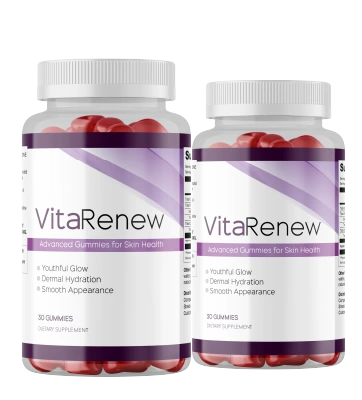
VitaRenew
Vitamin C, zinc and copper — the cofactors the dermis depends on for collagen synthesis — in one daily gummy. Supports the structural layer from within.
Working from the inside out, not the outside in.
60-day money-back guarantee · One-time purchase, no subscriptionSupporting the dermis: what the fibroblasts need
The fibroblasts in the dermis are still present and still producing collagen and elastin throughout adult life. The rate and quality of production decreases with age and hormonal change, but the process doesn’t stop. This matters because it means there are upstream factors in that process that, when present in adequate amounts, support the efficiency of what the fibroblasts are already trying to do.
Vitamin C is required by two enzymes — prolyl hydroxylase and lysyl hydroxylase — that stabilize each newly formed collagen molecule into its final triple-helix structure. Without adequate vitamin C in the tissue, the enzymes cannot complete this step, and the collagen produced is structurally unstable. This is not a marginal or disputed point; it is the biochemical mechanism behind why vitamin C deficiency destroys connective tissue. The threshold for active collagen synthesis support is not the same as the threshold for preventing deficiency, and most adults do not optimize for the former.
Copper is the cofactor for lysyl oxidase — the enzyme that cross-links both collagen and elastin fibres into the mechanically functional, tightly woven mesh the dermis depends on for firmness and snap-back. Fibres produced without sufficient copper are like individual cables that have never been woven together: they exist but do not function as a load-bearing network.
Zinc supports normal skin integrity, wound response, and the maintenance processes that occur continuously in dermal tissue.
Together, these three cofactors address the upstream enzymatic steps in collagen and elastin synthesis — the tools the fibroblast assembly line depends on to build correctly, not just the raw material supply.
Why adding collagen powder alone often disappoints
If you’ve taken a collagen supplement for six months or more and found the change underwhelming, the most common explanation is that in most well-nourished adults, the rate-limiting step in collagen synthesis is not amino acid supply. It is the availability of the enzymatic cofactors needed to stabilize and assemble those amino acids correctly. Adding more raw material to an assembly line constrained elsewhere does not change output rates. Addressing the cofactors is a different and prior intervention.
What people report
“I always thought I just had dry arms in winter. I’ve been using heavy body lotion for years. It helps while I apply it and for a few hours. This past year I read about the collagen assembly angle — that the issue is structural and that what the dermis needs can be supported from inside. I started in October. By late January the texture was noticeably different. Less papery. The lotion still helps, but now there seems to be something more solid underneath for it to work with.”
“I turned 46 this year and noticed for the first time that winter made my arms look much older than I thought they were. A friend mentioned the idea of supporting collagen production from within rather than just moisturizing on top. I was skeptical, but the 60-day guarantee meant I had nothing to lose by trying. Three months in, the crepey texture on my arms and décolleté has improved noticeably. I’m continuing.”
These are individual accounts. Results are not typical and will vary. No supplement can diagnose, treat, cure, or prevent any condition.
Product referenced above
VitaRenew
Vitamin C, zinc and copper in a daily gummy. Made in an FDA-registered, GMP-certified facility. 60-day money-back guarantee. One-time purchase — no subscription.
Dermal support, built for the layer that moisturizer can’t reach.
60-day money-back guarantee · Supports skin, hair and nailsOn timeline and winter as a baseline
Structural change in the dermis is slow. Controlled studies on skin-directed nutritional approaches routinely use twelve weeks as a minimum evaluation window. The tissue doesn’t respond faster — this is biology, not impatience.
Winter is a useful starting point precisely because the humidity buffer is removed. Progress measured against a winter baseline — in consistent lighting, same time of day, from the same distance — is less confounded by seasonal variation than progress measured across different seasons. Starting in October or November means a twelve-week evaluation window falls in late January or February, while the ambient conditions are similar. Individual results vary based on genetics, cumulative sun exposure, hormonal status, sleep, and current diet.
Background reading
- Pullar JM, Carr AC, Vissers MCM. “The Roles of Vitamin C in Skin Health.” Nutrients, 2017.
- Rucker RB et al. “Copper, lysyl oxidase, and extracellular matrix protein cross-linking.” American Journal of Clinical Nutrition, 1998.
- Thornton MJ. “Estrogens and aging skin.” Dermato-Endocrinology, 2013.
- Fluhr JW, Darlenski R, Berardesca E. “Transepidermal water loss and the barrier function in atopic dermatitis.” Current Problems in Dermatology, 2011.
- Ogawa Y et al. “Zinc and skin disorders.” Nutrients, 2018.