Personal Health · Reader Experience
Crepey Skin in Your 40s? Here’s What’s Really Changing
I was 42 when I first noticed it on my inner arm. I tried everything on the surface — richer creams, more water, vitamin E oil. None of it made a dent. Here’s what I finally found out about why it starts now, in the forties.

I remember the exact moment. I was sitting at my kitchen table with my arm resting on the edge, sleeve pushed up, and the light from the window caught my inner forearm at an angle I don’t usually see. There was a texture there that hadn’t existed three years earlier. Not a wrinkle. Not a sag. Something that looked like the skin itself had changed material — papery, slightly crumpled, like tissue paper that had been wet and then dried.
I was 42. I thought: this isn’t supposed to happen yet. I’d always assumed this kind of change was a fifties thing, maybe sixties. Not now.
I spent the next several months trying to fix it the obvious way — switching to thicker creams, adding hyaluronic acid, drinking more water, taking collagen powder. Some things improved the feel of the skin temporarily. But the texture was still there. It wasn’t going away, and I didn’t understand why.
What I eventually learned changed how I thought about what was happening, and what I could actually do about it.
It’s not dehydration — it’s the layer below
The first thing I had wrong was the address. I was treating the outer surface when the change was happening in the layer underneath — the dermis, which sits below the epidermis and contains the structural proteins that give skin its thickness, resilience, and shape.
Two proteins do most of the work in the dermis:
- Collagen provides the scaffolding. It gives skin volume, thickness, and resistance — the quality that makes it feel substantial when you press on it. As collagen density drops, the surface above starts to show the geometry of what’s no longer fully filling the structure underneath.
- Elastin provides the snap-back. It’s the network of fibers that lets skin deform and return to its original shape. When elastin activity is reduced, skin holds a crease longer than it should, or settles slowly after being touched.
Crepey texture — that papery, slightly loose quality — is what the surface looks like when these two proteins are at reduced density. No amount of external moisture changes the density of what’s happening a layer down. The skin feels better hydrated, looks temporarily smoother, and then goes back to looking the same.
I was applying solutions to the outside of the problem. The problem was happening below the surface entirely.
Why the forties — specifically — are when this starts
This was the second thing I got wrong. I assumed that what I was experiencing at 42 was somehow premature — that I’d done something wrong, or that I was aging faster than I should be. Neither of those was true.
Collagen production in the dermis starts declining gradually in your mid-twenties, at roughly one percent per year. For most of the thirties, there’s enough structural reserve that nothing visible happens. The scaffolding thins imperceptibly. The skin compensates. You don’t notice.
Then the forties arrive — and with them, a second decline that runs alongside the first. Estrogen plays a direct role in maintaining dermal collagen throughout the reproductive years. It stimulates the cells that produce collagen and inhibits the enzymes that break it down. As estrogen begins to fall in the perimenopausal transition — which often starts in the early-to-mid forties, well before periods change — both of those protections weaken.
Research has estimated that women may lose a substantial portion of dermal collagen in the years surrounding menopause, with changes starting in the perimenopausal window. The slow background decline of the previous fifteen years suddenly has a faster, hormonally-driven decline piling on top of it. The two curves intersect — and that intersection has a visible threshold. For many women, that threshold arrives in their early-to-mid forties.
So what I was experiencing at 42 was not premature. It was, in fact, almost exactly on schedule. That was oddly reassuring — and also changed what I was looking for in terms of a response.
Why the standard approaches kept missing
Once I understood the address — the dermis, not the surface — the limitations of what I’d been trying became clear.
Topical products, even very high-quality ones, work at the level of the stratum corneum: the outermost skin layer. They can hydrate, reduce moisture loss, and temporarily plump the surface. Some active ingredients can stimulate cell turnover in the upper epidermis. But none of them reach the dermis, where collagen and elastin live and are produced. The skin barrier is designed to keep external substances out — and it does its job even when those substances are expensive.
Collagen powders are a more interesting story. Oral collagen peptides do show some evidence of benefit in skin elasticity and hydration in controlled trials. But in a well-nourished adult, the limiting factor in collagen synthesis is rarely amino acid supply — it’s usually the enzymatic steps that convert those raw materials into functional structural protein. And those enzymatic steps depend on specific micronutrients that most collagen supplements don’t include in meaningful amounts.
What I found that made a difference
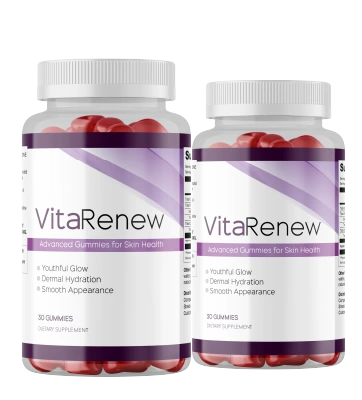
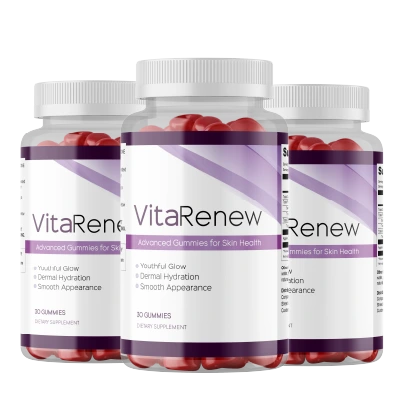
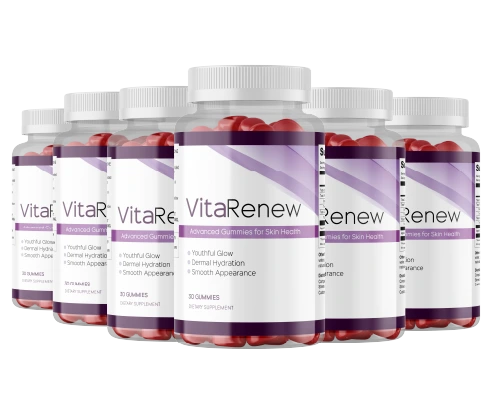
VitaRenew
Vitamin C, zinc and copper — the cofactors that support the dermis’s own collagen maintenance process — in a once-daily gummy formulated for women 40+.
The layer that moisturizer can’t reach may need support from the inside.
60-day money-back guarantee · One-time purchase, no subscriptionThe cofactors — what the dermis actually needs to do its job
When I learned this, it clicked into place. The dermis doesn’t stop producing collagen in your forties. Fibroblast cells are still present and still running the synthesis process. What changes is the efficiency of that process — and how much depends on specific micronutrients being available.
Three of them are especially important:
- Vitamin C is required by two enzymes — prolyl hydroxylase and lysyl hydroxylase — that stabilize newly made collagen chains into their final structure. Without adequate vitamin C, synthesized collagen is weak and degrades quickly. This is the biochemistry behind scurvy: connective tissue falls apart when this pathway fails completely. At sub-optimal levels, you get a slower, quieter version of the same problem.
- Copper activates lysyl oxidase — the enzyme that cross-links individual collagen and elastin fibers into the dense network that gives skin its firmness. Individual fibers can be present; without copper, they don’t assemble into functional structure. Copper is consistently left out of skin supplements despite being the step that turns raw fiber into load-bearing tissue.
- Zinc plays multiple supporting roles: maintaining the outer skin layers, modulating the enzymes that break collagen down, and contributing to the continuous repair processes in the dermis.
A supplement that includes meaningful amounts of all three — not just amino acids or a trace of vitamin C — is addressing the actual process, not just the raw material supply.
How I approached the evaluation
I took a photograph of my inner arm in natural light before I started, and set a reminder for twelve weeks. The research on dermal-level changes in skin supplements uses eight-to-twelve-week evaluation windows because that’s when effects become measurable — the dermis doesn’t remodel overnight.
What I noticed at around ten weeks was a change in the texture when I pressed the skin gently and released — it had a different quality of response. By week twelve, the papery appearance in raking light was less pronounced. My husband pointed it out before I said anything to him, which I took as a reasonably objective data point.
I’m still using it. The change has continued to be gradual and cumulative — which is exactly what the mechanism would predict.
Important: I’m not a medical professional and this is not medical advice. Individual results vary based on many factors — age, sun history, diet, genetics, consistency of use. No supplement is intended to diagnose, treat, cure, or prevent any disease. If you’re managing a health condition or taking medication, speak with your healthcare provider before starting anything new.
What other women report
"I started noticing the texture on my arms at 41 and just assumed it was normal aging I couldn’t do anything about. When I learned about the cofactor piece, I decided to try a supplement built around that instead of just peptides. About nine weeks in, I noticed the texture on my inner arms was different — less pronounced in morning light. It’s been consistent."
"I’d used a high-end moisturizer faithfully for two years. The crepey texture on my hands and arms never changed. I switched my focus to what was happening inside, gave it three months, and the difference has been noticeable enough that my sister asked what I was doing differently."
These are individual accounts. Results are not typical and vary based on individual factors including age, sun history, diet, and consistency of use. No supplement is intended to diagnose, treat, cure, or prevent any disease.
What I use and recommend
VitaRenew
Vitamin C, zinc and copper in one daily gummy. FDA-registered, GMP-certified facility. 60-day money-back guarantee. One-time purchase — no subscription.
For the forties skin that changed before you expected it to.
60-day money-back guarantee · Supports skin, hair and nailsBackground reading
- Thornton MJ. "Estrogens and aging skin." Dermato-Endocrinology, 2013.
- Pullar JM, Carr AC, Vissers MCM. "The Roles of Vitamin C in Skin Health." Nutrients, 2017.
- Rucker RB et al. "Copper, lysyl oxidase, and extracellular matrix protein cross-linking." American Journal of Clinical Nutrition, 1998.
- Proksch E, Segger D, Degwert J et al. "Oral supplementation of specific collagen peptides has beneficial effects on human skin physiology." Skin Pharmacology and Physiology, 2014.
- Ogawa Y et al. "Zinc and skin disorders." Nutrients, 2018.
- Chung JH et al. "Molecular mechanisms of intrinsic skin aging." International Journal of Dermatology, 2003.