Personal Health · What I Learned
Why The Skin Around Your Mouth Goes Crepey After 40
I noticed it when applying lipstick — a slight gathering of the skin above my upper lip, fine lines that collected color instead of letting it sit flat. I searched for answers for months before I found the structural explanation that actually made sense of it.

I was 44 when I first really noticed it. Not in the bathroom mirror during my routine — in a photo from a friend's birthday dinner, good light, someone with an actual camera. There was a fine crepey texture around my mouth that the phone camera never caught. It wasn't dramatic. But it was there. And once I saw it in that photo, I couldn't stop seeing it everywhere.
I want to tell you what I spent the next year trying — because it's probably the same list you've tried or are thinking of trying — and then what I actually learned about why this particular area changes the way it does. Because the answer changed what I looked for, completely.
What I tried first (and why it couldn't work)
My first instinct was topical. I added a retinol product specifically around my mouth, switched to a heavier overnight cream for the perioral area, tried a vitamin C serum that a dermatologist had mentioned in an interview I'd read. None of it touched the texture. The skin would look plumped up and smooth immediately after application, and an hour later it was back to exactly what it had been before.
I wasn't doing anything wrong with the products. The problem was that I was treating the surface of a problem that wasn't at the surface. It took a conversation with a physician friend — someone who works with skin in a clinical rather than cosmetic context — to get the explanation that finally made sense.
"The crepey texture you're describing comes from the dermis," she told me. "The layer underneath the skin. Topical products are working on the epidermis. They can't reach the structural layer that's actually changed."
That was the thing I'd been missing for twelve months of trial and error.
Why the area around the mouth changes this way
The dermis is the structural layer below the epidermis — the one that gives skin its physical properties: firmness, thickness, the ability to fold and return to shape. It's built primarily from two protein networks, collagen and elastin, and both decline progressively from early adulthood.
That decline happens everywhere. But the perioral zone — the area around the mouth — has three properties that make the effect visible there earlier and more dramatically than almost anywhere else on the face.
First: the skin around the mouth is thinner than almost anywhere else on the face. There's less dermis to begin with, so there's less margin before the structural change becomes visible at the surface. Think of it like a cushion that starts thinner — the same wear shows faster.
Second: the muscle directly beneath this skin — the orbicularis oris — is almost always in use. Every word you speak activates it. Every smile, every sip, every expression. It folds the skin above it thousands of times per day. Elastin is what allows skin to fold and recover without leaving a mark. When elastin function declines, those folds start to hold their shape longer after the muscle releases. Do that for years in a high-frequency movement zone, and the vertical lines above the lip stop being transient expressions and become structural ones.
Third: unlike the eyelids — which are partially shaded by the brow — the upper lip is a sun-exposed surface. UV radiation accelerates collagen breakdown through a process called photoaging, compounding the decline that's happening through age alone. Decades of sun exposure on an already thin, high-movement zone produces the combination I was seeing in that photo.
I'd been thinking of it as a surface problem because it was visible at the surface. But the cause was a layer deeper, in the dermis — and that's a place topical products simply can't reach.
The estrogen piece I hadn't considered
My physician friend had one more thing to add, and it explained the timing — why this had become noticeable in my mid-forties rather than earlier.
Estrogen plays a direct role in dermal collagen throughout the reproductive years. It supports the fibroblast cells that produce collagen, and it moderates the enzymes that break it down. As estrogen levels shift in the perimenopausal transition, both of those protective effects weaken simultaneously.
Research in Dermato-Endocrinology has documented measurable decreases in skin collagen content in the years surrounding menopause that go beyond what chronological aging alone would predict. The perioral area — already the thinnest, most mechanically active zone — reflects that acceleration before it becomes obvious elsewhere.
The lines hadn't suddenly appeared. They'd been building slowly for years. What changed in my mid-forties was the rate — and the threshold had been crossed.
What the dermis actually needs
Once I understood that this was a structural issue in the dermis, the next question was obvious: what can actually support the dermis from the inside?
The answer my friend gave me was about cofactors, not collagen. "Most people think about adding collagen. But collagen synthesis already happens — your fibroblast cells are still there, still trying to produce it. What changes with age is the efficiency of the enzymatic steps that complete the process. And those steps depend on specific micronutrients."
The three she named were:
- Vitamin C. It's the required cofactor for the enzymes that stabilize collagen chains into their functional triple-helix structure. Without adequate vitamin C, newly synthesized collagen doesn't complete its assembly correctly and degrades quickly. This isn't fringe science — it's the mechanism behind what happens to connective tissue in scurvy. Adequate vitamin C is what allows synthesis to finish.
- Copper. It activates lysyl oxidase, the enzyme that cross-links individual collagen and elastin fibers into the interconnected network that gives skin its firmness and elasticity. Individual fibers can be synthesized without copper, but they stay unassembled — like raw lumber that never gets nailed together. Copper is consistently missing from skin supplements despite being the step that converts material into structure.
- Zinc. It supports fibroblast function and helps regulate the balance between collagen production and breakdown. Adequate zinc tilts that balance toward net maintenance rather than net loss.
These aren't adding collagen from outside. They're supporting the machinery the dermis already uses to produce and maintain its own structure — machinery that was always there but becomes less efficient with age when the cofactors aren't consistently available.
I had never thought about this angle before. My entire supplement approach for skin had been about collagen peptides — which address a different bottleneck, and one that research suggests is rarely the limiting factor in a well-nourished adult. The limiting factor is more often enzymatic.
Referenced in this article
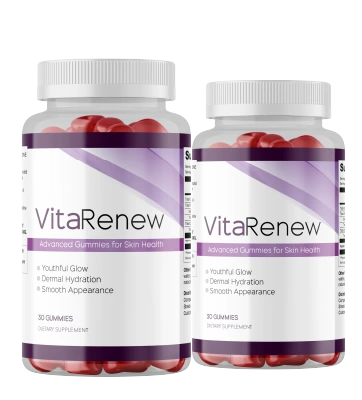
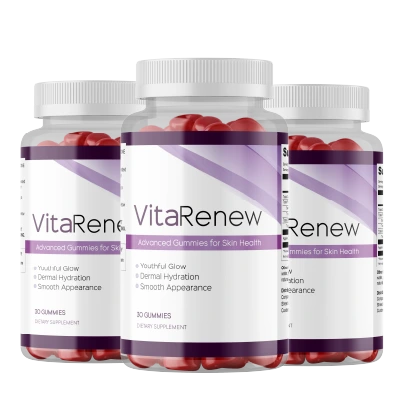
VitaRenew
Vitamin C, zinc and copper in a once-daily gummy — the three cofactors the dermis's own collagen synthesis depends on, formulated for women 40+.
Support what's happening a layer below the surface you can see.
60-day money-back guarantee · One-time purchase, no subscriptionWhat I actually looked for
Once I understood the cofactor angle, I wanted to evaluate products properly rather than just buying whatever came up first in a search.
The things I paid attention to:
- All three cofactors present. Vitamin C alone is the most common formulation. Products with copper as well are less common, even though copper governs the cross-linking step that completes the structural network. I wasn't interested in a product that left half the process unsupported.
- Return window. Dermal remodeling takes months, not weeks. Clinical studies on skin supplements use eight-to-twelve-week evaluation periods as standard. A product with a 30-day guarantee is signaling the manufacturer doesn't expect results within any biologically meaningful window. I looked for 60 days minimum.
- Language. Any product that promises to reverse, eliminate, or erase crepey texture is making claims that don't reflect how the dermis works. I looked for "supports," "may help maintain" — language that's honest about what a supplement can do. Claims that something will turn back the clock twenty years are a red flag, not a selling point.
- Manufacturing standards. GMP certification and an FDA-registered facility are the minimum floor. I wasn't interested in anything that couldn't clear that bar.
How I approached the evaluation period
I took photos of the perioral area on day one — natural light, same angle, same time of day — and committed to not adjusting anything else in my routine for twelve weeks. No new topicals, no new supplements. I wanted to isolate the variable.
At week four, I noticed the surface texture seemed slightly smoother, though I wasn't sure if I was seeing what I wanted to see. At week twelve, the before photo made the change clearer than I expected — the fine vertical lines above my lip were still present, but meaningfully less defined. The gathered quality I'd noticed in the birthday dinner photo had softened.
I've continued since then. What I've found is that consistency matters more than intensity: this isn't a treatment that produces dramatic results in days. It's the kind of support that compounds over months. Which is exactly how the biology of the dermis works.
What others have found
"The crepey skin around my mouth was the part of my face I felt the most self-conscious about. I'd tried fillers once — they helped briefly but weren't something I wanted to keep doing. I spent about six months consistently supporting my skin internally, and by month four I was genuinely surprised. The texture didn't disappear but it became much less prominent. My foundation sits better now."
"I thought the lines above my lip were just something I had to accept. I'd never considered that there was a nutritional piece missing. Three months in, I happened to compare photos from a work event to photos from a few months earlier — the difference was noticeable enough that I pointed it out to my sister. She thought I'd had something done. I hadn't."
These are individual accounts. Results are not typical and vary based on individual factors including age, sun history, diet, genetics, and consistency of use. No supplement is intended to diagnose, treat, cure, or prevent any disease.
Product referenced above
VitaRenew
Vitamin C, zinc and copper in one daily gummy. Made in an FDA-registered, GMP-certified facility. 60-day money-back guarantee. One-time purchase — no subscription.
What I wish I'd understood two years earlier.
60-day money-back guarantee · Supports skin, hair and nailsBackground reading
- Thornton MJ. "Estrogens and aging skin." Dermato-Endocrinology, 2013.
- Pullar JM, Carr AC, Vissers MCM. "The Roles of Vitamin C in Skin Health." Nutrients, 2017.
- Rucker RB et al. "Copper, lysyl oxidase, and extracellular matrix protein cross-linking." American Journal of Clinical Nutrition, 1998.
- Varani J et al. "Decreased collagen production in chronologically aged skin." American Journal of Pathology, 2006.
- Ogawa Y et al. "Zinc and skin disorders." Nutrients, 2018.
- Wlaschek M et al. "Solar UV irradiation and dermal photoaging." Journal of Photochemistry and Photobiology B, 2001.
- Krutmann J et al. "The skin aging exposome." Journal of Dermatological Science, 2017.