Personal Account · Skin Health
Why Your Eyelids Look Crepey After 40 (And What Helps)
I'd been putting eye cream on my upper lids for three years before I understood why it wasn't working. When I finally looked into the cause, it turned out I'd been treating the wrong layer entirely.

I noticed it in the bathroom at 7 a.m., in the kind of flat morning light that doesn't soften anything. I'd just washed my face and was about to reach for my moisturizer when I saw it clearly for the first time: the skin on my upper eyelids had gone papery. Not at the outer corners, which is where I'd been watching for crow's feet. On the lids themselves — a fine horizontal creasing, a tissue-paper quality that appeared when I blinked slowly and stayed after my eyes opened fully.
I was 44. I hadn't expected this specifically. I had every product the beauty industry makes for eye aging. None of them had been designed for what I was looking at.
What I found out over the months that followed changed what I understood about skin, what I looked for in products, and — finally — what actually started to make a difference.
The part no eye cream reaches
My first instinct was the obvious one: more eye cream. Better eye cream. Something specifically for the lid rather than the under-eye. I tried several formulas over the course of a year. Some helped with puffiness. Some made the under-eye area look smoother. None of them touched the crepey texture on the upper lid itself.
The reason, I eventually learned, is simple. Eye creams — like all topical skincare — address the outermost layer of the skin, the epidermis. They can hydrate the barrier, improve the immediate feel of the surface, reduce transepidermal water loss. What they cannot do is reach the dermis: the structural layer that sits beneath, where collagen and elastin live and where the support that gives skin its firmness and smoothness actually originates.
Crepey texture on the eyelid is not a surface problem. It is a structural one. The surface is just where it shows up — and no product applied to the surface addresses what is happening below it.
What I learned about the eyelid specifically
The upper eyelid holds the thinnest skin on the human body. At its most delicate point, it measures roughly 0.5 millimeters — about one-third the thickness of the skin on the cheek. That single fact explains something I hadn't understood before: the eyelid doesn't age faster than the rest of the face. It starts from a structurally thinner position, which means structural changes become visible there earlier.
There's another factor that makes the eyelid uniquely exposed. Each eye blinks somewhere between 15,000 and 20,000 times per day. That's tens of thousands of repetitions of the same motion — fold, stretch, release. The elastin fibers in the dermis, which allow skin to deform and return to shape, absorb that mechanical load continuously. In a younger, denser dermis, the wear is repaired constantly. In a dermis that has begun to thin, the creases formed during blinking settle in and hold longer after the eye opens. That is the horizontal pattern I was seeing in the mirror.
What surprised me most: the eyelid is one of the areas on the face least affected by UV damage. The brow shades the upper lid; the natural closing motion protects it further. What shows up on the lid is not primarily sun damage. It is the underlying structural decline that was always going to become visible here first — because the skin there was always the thinnest.
I'd been treating it like a surface problem for three years. It wasn't. The cause was below anything a cream could reach.
Why the forties accelerate it
I also learned why so many women describe the change as sudden — feeling like it appeared almost overnight — when in fact the underlying process had been underway for years.
Collagen in the dermis declines from the mid-twenties, slowly and consistently. Through the thirties, most women have enough structural reserve that the decline stays below the visual threshold. What changes in the forties is that a second, faster process arrives on top of it.
Estrogen plays a direct role in maintaining dermal collagen throughout the reproductive years. It stimulates the fibroblast cells that produce collagen and inhibits the enzymes that break it down. As estrogen levels fall through perimenopause, both of those protective effects diminish at once. Research published in Dermato-Endocrinology found that skin collagen content and thickness drop significantly in the years surrounding menopause — more sharply than the background rate of age-related decline would predict.
The result: two rates of decline intersecting on the thinnest skin of the face. That is what looks sudden. That is what I saw in the bathroom mirror at 44, in flat morning light, when there was nothing left to soften it.
What I started taking
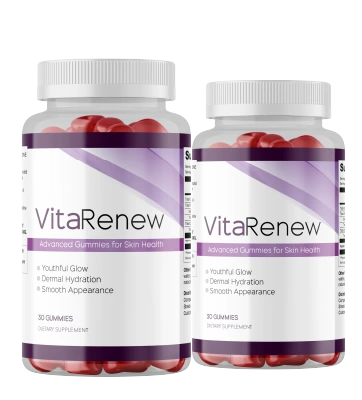
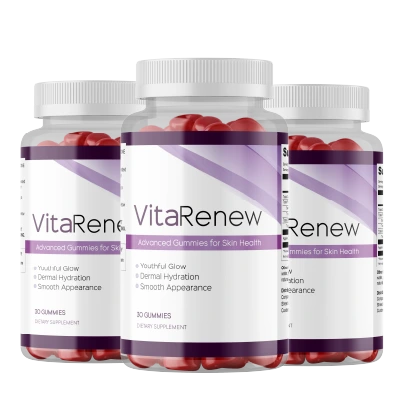
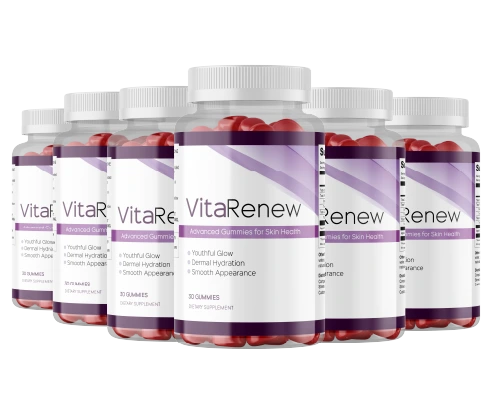
VitaRenew
Vitamin C, zinc and copper — the cofactors your skin's own structural maintenance process depends on — in a once-daily gummy formulated for women 40+.
The layer below the surface is where the work happens.
60-day money-back guarantee · One-time purchase, no subscriptionThe cofactors I didn't know about
The shift in my thinking came when I stopped focusing on collagen as a raw material to add, and started paying attention to whether the body had what it needed to maintain its own synthesis process.
Collagen production doesn't stop in midlife. Fibroblasts — the cells that synthesize collagen in the dermis — are still active throughout life. The bottleneck is not raw material. It is whether the enzymatic steps that complete the process have what they need to work. Three nutrients are directly load-bearing there:
- Vitamin C is a required cofactor for two enzymes — prolyl hydroxylase and lysyl hydroxylase — that stabilize newly formed collagen chains into their functioning triple-helix structure. Without sufficient vitamin C, newly synthesized collagen is structurally incomplete and degrades quickly. This is documented biochemistry, not supplement marketing. It is the mechanism behind scurvy's destruction of connective tissue. The gap between adequate and insufficient vitamin C supply is the gap between collagen assembly completing correctly and producing compromised fibers.
- Copper activates lysyl oxidase, the enzyme that cross-links individual collagen and elastin molecules into the dense, interconnected matrix that gives skin its firmness and elasticity. Individual fibers can exist; copper is what assembles them into structure. It is the most consistently underrepresented nutrient in skin supplements, despite governing the step that turns material into functioning tissue.
- Zinc supports the maintenance processes in both dermal and epidermal layers and helps moderate the activity of the enzymes that break collagen down. Adequate zinc tips the ongoing balance toward structural preservation.
I had spent years looking at ingredient labels for collagen peptides, retinol, hyaluronic acid. I had never once looked for copper. When I started, I found that most of the products I'd been using didn't contain it at all.
The checklist I wish I'd had earlier
What to actually look for
- Vitamin C at a meaningful level — not a trace amount for the label, but enough to actually support the enzymatic steps in collagen synthesis.
- Both copper and zinc together. They act at different points in the same process. Products that include one without the other are leaving part of the system unsupported.
- A 60-day money-back guarantee, minimum. Dermal remodelling is measured in months. Any product that only offers 30 days is signaling it doesn't expect visible change within a real evaluation window.
- GMP certification and an FDA-registered facility. These are table stakes for quality. Third-party testing adds a further layer.
- Honest language about what to expect. If a product promises to reverse or eliminate crepey eyelids, read the rest of the label carefully. Dermal biology doesn't work that way. The language to look for is "supports," "may help maintain," "in conjunction with" — not transformation claims.
The timeline I actually experienced
I started taking a supplement that contained all three cofactors — meaningful doses of vitamin C, copper, and zinc — and committed to three full months before drawing any conclusion. I photographed my eye area every Sunday morning, same lighting, same time.
At four weeks I noticed almost nothing. I had read that the outermost skin layer turns over every four to six weeks, so I wasn't surprised. Weeks six through eight is when I started to see something different — not dramatic, not a transformation, but a change in how the skin on my upper lids appeared in that morning light that had previously shown every fold clearly. The horizontal creasing softened. The papery quality was less pronounced.
At twelve weeks the difference was real enough that I showed the photographs to my sister, who hadn't known I was trying anything. She asked what I'd changed. I told her. She started the same week.
I want to be honest about what this is and isn't. The eyelid skin I have at 46 is not the same as at 36. But it is measurably different from what it was at 44 when I started, and the change has continued. What I found is that consistently supporting the dermis's maintenance process over time produces results that no topical product I tried for three years could deliver.
What others have found
"I had the same experience — years of eye creams, none of them touching the lid texture. When I switched to supporting the process internally instead of treating the surface, everything shifted. About eight weeks in the horizontal lines on my upper lids were noticeably less defined. My husband said my eyes looked lighter somehow."
"My dermatologist said the lid area is nearly impossible to treat topically because the skin is too thin to tolerate most actives. She suggested a collagen-supporting supplement. I did my own research and ended up focusing specifically on the cofactors. Twelve weeks later I'd call the result real — not a reversal, but a genuine and visible improvement in the texture I'd hated for two years."
These are individual accounts. Results are not typical and vary based on individual factors including age, sun history, diet, and consistency of use. No supplement is intended to diagnose, treat, cure, or prevent any disease.
The supplement referenced above
VitaRenew
Vitamin C, zinc and copper in one daily gummy. Made in an FDA-registered, GMP-certified facility. 60-day money-back guarantee. One-time purchase — no subscription.
The layer below the surface is where the work happens.
60-day money-back guarantee · Supports skin, hair and nailsBackground reading
- Thornton MJ. "Estrogens and aging skin." Dermato-Endocrinology, 2013.
- Pullar JM, Carr AC, Vissers MCM. "The Roles of Vitamin C in Skin Health." Nutrients, 2017.
- Rucker RB et al. "Copper, lysyl oxidase, and extracellular matrix protein cross-linking." American Journal of Clinical Nutrition, 1998.
- Shuster S, Black MM, McVitie E. "The influence of age and sex on skin thickness, skin collagen and density." British Journal of Dermatology, 1975.
- Ogawa Y et al. "Zinc and skin disorders." Nutrients, 2018.
- Chung JH et al. "Molecular mechanisms of intrinsic skin aging." International Journal of Dermatology, 2003.