Eye Area · Skin Health
Why Your Eyelids Look Crepey After 40 — And What Actually Helps
You’re well-rested. But in overhead lighting, in a photo taken at the wrong angle, or simply in the bathroom mirror on an ordinary morning, the upper eyelid tells a different story. The skin there looks thin, papery, slightly crinkled — and it makes the whole eye look tired even when you’re not.


The moment usually comes in your early to mid-forties. You notice it when the light is unkind — overhead fluorescents, a front-facing phone camera, the bathroom mirror first thing in the morning. The upper eyelid, which once looked smooth and rested, now has a dry, papery texture. When you blink, the skin folds. When you apply eyeshadow, it settles into tiny creases that weren’t there a few years ago.
The word for this texture is crepey. And while it eventually appears on the inner arms, the neck, and the chest, the eyelid is almost always where it shows up first. That has a specific explanation.
The thinnest skin on the body
The skin over your eyelids averages roughly 0.5 millimeters in thickness — the thinnest anywhere on the human body. Skin on your forearm or cheek is typically three to four times thicker. This thinness is by design: the eyelid has to move at high speed, closing and opening roughly fifteen thousand times each day. Thick skin couldn’t do that.
But the consequence of that thinness is reduced structural reserve. The dermis — the collagen-rich layer that gives skin its firmness and resilience — is proportionally thinner here than anywhere else. When collagen and elastin begin their natural decline with age, the upper eyelid has less of both to lose before the change becomes visible at the surface.
That’s why the eyelid shows age before the cheek, the forehead, or the back of the hand — not because it’s worse off in any absolute sense, but because its margin was narrower from the start.
The upper eyelid is often the first place a woman notices her skin has changed. Not coincidence — it has the thinnest dermis on the body and the least structural reserve to draw on.
What changes in the dermis with age
Collagen is the protein that gives skin its thickness and resistance to pressure. Elastin gives skin its ability to spring back after being moved or stretched. Both are manufactured continuously by cells in the dermis called fibroblasts.
From the mid-twenties onward, collagen production declines at roughly one percent per year. By the mid-forties, the cumulative effect is noticeable in thin-skinned areas. By the late fifties, collagen density in the dermis may be thirty to forty percent lower than it was in your twenties. Elastin fibres age differently — they fragment and become less elastic, so skin that used to spring back stays folded longer instead.
There is a second factor specific to the upper eyelid: a small fat pad that fills the space between the brow and the lid. With age, this orbital fat pad redistributes and, in many women, reduces in the upper lid area. As the fat pad changes, the skin above it loses some of its internal fill. It begins to drape slightly. Folds that were invisible become visible. The lid starts to look heavy even when it isn’t.
The ingredient picture inside the dermis
Here is where the explanation becomes actionable. The fibroblasts in your eyelid skin haven’t stopped producing collagen. They are slower and less efficient than they were at thirty — but they are still working. What the collagen synthesis process depends on, increasingly, are the biochemical cofactors that drive it.
- Vitamin C is required by the enzymes that fold each collagen molecule into its stable triple-helix shape. Without adequate vitamin C, collagen is produced but structurally weaker. Older adults tend to have lower circulating vitamin C than younger adults, partly due to changes in how the gut absorbs it.
- Copper activates lysyl oxidase, the enzyme responsible for cross-linking individual collagen and elastin fibres into a resilient mesh. Without copper, the fibres form but can’t be properly woven together.
- Zinc supports the turnover and repair of skin cells throughout the dermis. Zinc absorption decreases with age, and borderline deficiency is common — often without obvious symptoms.
When the supply of these cofactors runs low, the manufacturing process in the dermis runs at reduced capacity. This is not a raw material problem — it’s a tooling problem. And unlike the fat pad redistribution or the decades of accumulated collagen loss, the cofactor picture is one you can actually do something about.
Why most eye creams don’t get there
Eye creams can genuinely help the appearance of the eye area. Hydration improves texture. Light-reflecting particles make fine lines less visible. A good formula can make a real, immediate difference in how the area looks.
But a topical cream works at the surface and the very top of the skin. The dermis — where collagen synthesis happens, where the cofactor picture matters — is below the surface, beyond what topicals are designed to reach. Applying something to the skin addresses the appearance of the eyelid. Supporting the collagen production process addresses the structure beneath it. Both are worth doing. Neither substitutes for the other.
What we suggest
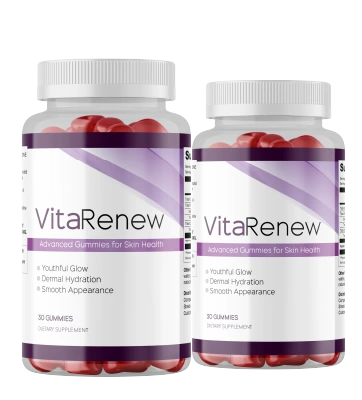
VitaRenew
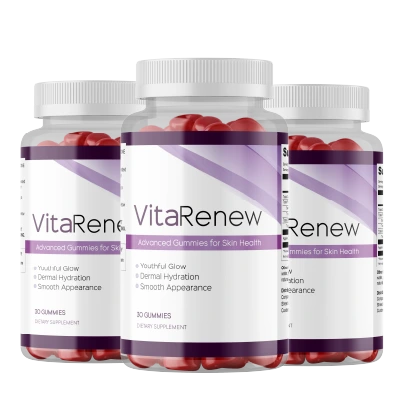
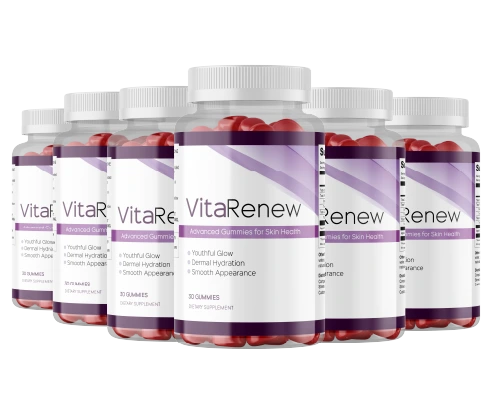
A daily gummy formulated with vitamin C, copper, zinc, vitamin E, and selenium — the cofactors that support collagen and elastin synthesis. Made in an FDA-registered, GMP-certified facility. Supports skin firmness, elasticity, hair, and nails. No subscription, one-time purchase. A two-bottle supply is a practical place to start.
The eye area shows age first. It makes sense to give your collagen process support from within.
60-day money-back guarantee · One-time purchase, no subscriptionWhat women report
“My upper eyelids started looking different — that thin, crinkled look when I blinked — somewhere around 44. After about ten weeks, a colleague asked if I’d slept better. The eyelid area just looked a little less worn.”
“I bought two bottles to try. The skin around my eyes — especially that papery texture on the upper lid — feels different now. Not dramatic, but my makeup artist asked what I was doing. That was around twelve weeks in.”
These statements reflect individual experiences. Results are not typical and will vary from person to person.
A note on timelines
Collagen remodelling is measured in weeks and months, not days. Most published studies on skin-directed nutritional support run for twelve to sixteen weeks before measuring visible outcomes. If you start, photograph the upper eyelid in consistent lighting on day one, and check at eight and twelve weeks rather than day three.
What you’re supporting is an ongoing biological process — not a cosmetic quick fix. The fibroblasts in your eyelid skin are still working. Providing the cofactors that process depends on is a reasonable, low-risk first step.
Product referenced above
VitaRenew
Vitamin C, copper, zinc, vitamin E, and selenium. Supports skin, hair, and nails. One-time purchase — no subscription. Two bottles (60-day supply) to start.
Your skin’s collagen process is still running. Give it what it needs to run well.
60-day money-back guarantee · Supports skin, hair and nails