Skin & Aging · Explainer
Why Your Décolletage Gets Crepey After 40 — The Double Hit Nobody Mentions
Most women protect their face religiously and forget their chest entirely. The décolletage quietly absorbs decades of sun while collagen quietly fades — and by the time the crinkled, papery texture appears, it turns out two separate processes have been running simultaneously for years.

She was getting dressed for dinner — a restaurant she'd been looking forward to all week. The dress she picked had a modest V at the neck, nothing dramatic. She pulled it on, turned toward the full-length mirror, and stopped.
The skin across her chest and upper breastbone looked different than she remembered. Not dramatically so — nothing anyone at dinner would probably notice. But she noticed. A thin, crinkled texture had settled into the V between her collarbones, loose in a way she associated with older women, not with her own reflection.
She put the dress back and chose something with a higher neckline. Then she sat down and, for the first time, started looking up what was actually causing it.
If that moment sounds familiar, here is what the search results rarely put together in one place: crepey chest skin doesn't have a single cause. It has two — and they usually arrive at the same time.
The décolletage: the most neglected zone on your body
Skincare routines are built around the face. The neck gets occasional attention. The chest — the décolletage — almost never makes the list until it becomes impossible to ignore.
This isn't vanity — it's a structural reality. The skin across the chest is intrinsically thinner than facial skin. It sits over bone and a minimal layer of subcutaneous fat, with less vascular support and less underlying muscle than the face. There's no equivalent of the constant facial-muscle movement that helps sustain blood flow and tissue tone in that area.
Dermatologists observe that the décolletage often ages faster than the face precisely because it starts from a thinner baseline and receives far less protective care. When you see crepey texture — the fine, paper-like folds that don't bounce back when pressed — that texture is the visible result of the structural layer beneath the skin (the dermis) becoming thinner and less organized.
The first hit: collagen loss after 40
The body's collagen production runs at a consistent pace through the twenties and into the early thirties. After forty, it begins to measurably decline. Estimates vary, but roughly 1% of skin collagen is lost per year after this point — and the pace accelerates in the years immediately following menopause.
Collagen is the primary structural protein in the dermis. It provides thickness, tensile strength, and the scaffolding that keeps the surface smooth and firm. As it thins, the skin above it loses its support — and begins to fold.
But here's what often goes unappreciated: collagen production doesn't stop. The fibroblast cells responsible for producing it remain active throughout life. What changes is the quality and efficiency of that production — and that efficiency depends heavily on cofactors. These are micronutrients — vitamin C, copper, zinc — that the collagen synthesis process requires in adequate amounts to function at its best.
Collagen doesn't stop being made. The question is how well the machinery assembles what it does make — and that depends on nutrients most people aren't thinking about.
Vitamin C is required by the enzymes that form collagen's distinctive triple-helix structure — the geometry that gives it mechanical strength. Without sufficient vitamin C, the resulting collagen is structurally weaker and less stable. Copper enables cross-linking, the process that binds individual collagen fibres into a resilient, load-bearing network. Zinc supports ongoing skin cell turnover and the repair signalling that runs continuously in healthy dermis tissue.
When these cofactors are below optimal levels, collagen production continues — but the output is less durable. The dermis thins not just because less collagen is made, but because what is made doesn't hold as well.
The second hit: decades of unprotected sun
Here is where the décolletage is especially vulnerable — and where most women have a longer exposure history than they realize.
Think about where the chest sits throughout a day outdoors. It faces upward on a lounge chair. It's exposed by every scoop-neck top, V-neck dress, and open-collar shirt worn across thirty or forty years of summers. The face, during that same period, got at least some sunscreen — if not regularly, then increasingly so as the conversation around photoaging became impossible to ignore. The chest almost never did.
UV radiation is a direct, documented driver of dermal degradation. It activates enzymes called matrix metalloproteinases that break down collagen and elastin in the dermis. It also disrupts the fibroblast signalling that would normally direct repair. This process — photoaging — accumulates across years and decades, and unlike surface pigmentation change, it reflects actual structural damage to the dermis.
By the time the hormonal changes of perimenopause begin, the décolletage has typically accumulated substantially more UV damage than the face. Estrogen plays a meaningful supporting role in skin thickness and collagen density — when estrogen levels fall, skin structure is affected, and it affects areas that were already compromised first. The face has a head start. The chest doesn't.
Two separate processes — internal collagen decline and external UV-driven degradation — arrive on the same timeline and in the same zone. That is the double hit. And it explains why the texture change appears there so conspicuously, even in women who look significantly younger than their age everywhere else.
Referenced in this article
VitaRenew
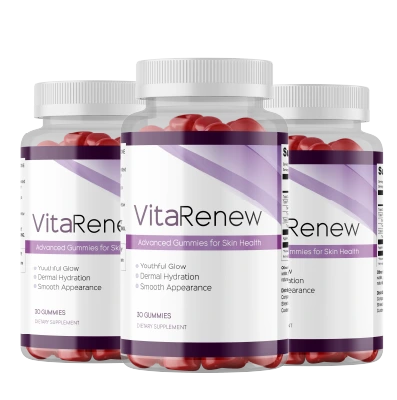
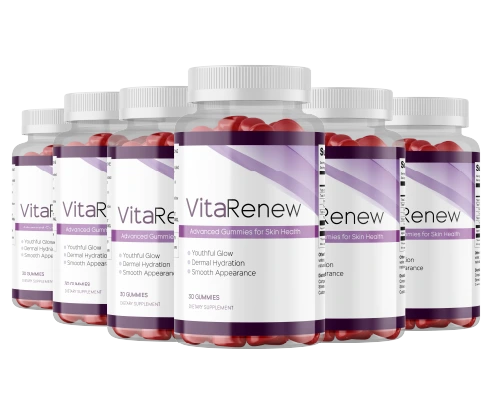
A daily gummy formulated around vitamin C, copper, and zinc — the cofactors that support how the body builds and maintains structural collagen. Made in an FDA-registered, GMP-certified facility. Designed for women who want to address skin firmness from within.
For the evening you reach for the dress without a second thought.
60-day money-back guarantee · One-time purchase, no subscriptionWhat "working from the inside" actually means
The most common response to crepey chest skin is topical — a new cream, a firming lotion, a retinol formulation. These products are not without merit, particularly for the surface of the skin (the epidermis). But the crepey texture is not an epidermal problem. It originates in the dermis, which sits below what most topical products reliably penetrate.
The skin's barrier function is, by design, nearly impermeable. That's its primary job. The same quality that protects the body from environmental harm prevents consistent dermal penetration by most topical molecules. This isn't a product failure — it's a physics reality.
A nutritional approach bypasses the barrier entirely. Micronutrients absorbed through the digestive system travel through the bloodstream and reach fibroblasts directly, through the vascular supply that serves the dermis from below. This is the logic behind supporting collagen production from within rather than from the surface down.
It doesn't replace topical care. Hydrating the surface still matters for appearance, and adding sunscreen to the décolletage going forward genuinely helps protect what you're working to rebuild. But for the structural issue — the thinning of the dermis itself — internal support addresses the mechanism in a way surface products cannot.
What women who have tried this report
"I'd been applying creams to my chest for two years and never saw anything meaningful change. I started this after a friend recommended it and honestly expected nothing. At week twelve I put on a dress I'd avoided for two summers and felt fine about it. Still can't fully explain it but I'm not stopping."
"It took about eight weeks before I noticed anything. The texture on my chest didn't change overnight but gradually felt less papery — less like I was pressing on something hollow. I keep a photo from day one to remind myself how far it's come."
These statements reflect individual experiences. Results are not typical and will vary from person to person.
One note on what to expect and when
Dermal remodelling happens on a slower clock than surface changes. The epidermis turns over roughly every four to six weeks — so early texture changes can sometimes be felt in that window. Meaningful structural improvement in the dermis takes longer; most clinical studies measuring this kind of outcome use twelve-week endpoints for a reason.
Photograph the area in consistent lighting on day one. Don't judge results at three weeks. Add broad-spectrum sunscreen to the décolletage daily — it won't undo past UV accumulation, but it will protect the structural progress you're building. Give the approach at least ninety days before drawing conclusions.
Product referenced above
VitaRenew
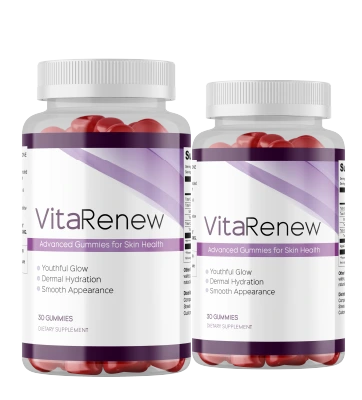
Vitamin C, copper, and zinc — the cofactors that support skin structure from within — in a daily gummy with a 60-day money-back guarantee.
Start with the 2-bottle pack. Same formula, same commission — and the lowest entry price.
60-day money-back guarantee · Supports skin, hair and nails