Skin & Body · Personal Story
Why Your Arms Look Crepey After Losing Weight
You worked hard to lose the weight — but your arms are showing something you didn't expect. The fat is gone. The skin didn't bounce back.

I lost thirty-eight pounds over fourteen months. I was proud of it — still am. I changed what I ate, I walked every morning before the neighborhood woke up, and I hit every number I'd set for myself. And when I reached the end of it, I looked at my arms and felt a quiet, specific disappointment I hadn't budgeted for.
The inner surface of my arms — from just below the shoulder down toward the elbow — had a papery, crinkled quality. When I raised my arm to wave or reach overhead, the skin moved with it in a way I could only describe as loose. I'd read about this before. I'd just assumed it was something that happened to other people, or to people who'd lost a lot more weight, or more quickly, than I had.
I know now that it's more common than any of us admit — partly because it feels like a strange thing to complain about after losing weight, and partly because most articles about it offer the same unhelpful suggestion: drink more water and be patient.
But after spending several months actually understanding what was going on under the surface, the explanation is more specific than that. And it changed what I did next.
The thing that weight loss actually removes
Here's the part nobody explains clearly. When you lose weight, what you're mostly losing from the arm is subcutaneous fat — the layer of fat that sits directly beneath the skin and above the muscle. That fat layer wasn't just sitting there. It was doing something structural: it was physically filling the space beneath your skin, giving the dermis a surface to conform to.
Think of it like a fitted sheet over a mattress. The sheet doesn't drape beautifully because it's a great sheet. It drapes well because the mattress underneath it provides volume and shape. If you removed the mattress but kept the sheet, you'd end up with fabric that piles on itself, folds where it doesn't have anything to hold it taut, and bunches in all the places where it has extra give.
That's what's happening on the inner arm after significant fat loss. The skin itself hasn't changed dramatically. What changed is what was underneath it — the volumetric support that the skin was relying on to look smooth and sit flat.
The skin didn't fail. It lost what it was resting on. That's a different problem — and it points toward a different kind of solution.
And then there's what was already happening in the dermis
This is where it gets more nuanced. The fat padding was doing two things: providing volume and masking something that was changing slowly underneath.
After the mid-thirties, the dermis — the structural layer just below the surface — begins producing collagen and elastin less efficiently than it did in youth. Collagen fibres are what give skin its thickness and rigidity. Elastin fibres are what allow it to spring back when stretched. As those fibres thin and lose organization, the dermis becomes less dense, and skin starts to behave like a fabric with less thread count.
This happens to everyone. But when fat was filling the space beneath the dermis, the visual effect was partially compensated for. The skin still looked smooth and reasonably taut because it had volume holding it in place.
Weight loss doesn't cause this collagen decline. But it removes the compensation. Once the fat is gone, the skin has to rely entirely on its own structural integrity — and for many women in their forties and fifties, that structural integrity has been quietly thinning for years. The crepey texture was already there. The fat loss just made it visible.
Why this feels unfair — and why it's not your fault
The reason this lands hard is that you did something genuinely good for your health. And the visible result on your arms feels like a punishment for it.
It's worth saying plainly: this isn't a failure of effort, diet, or skin care. It's a structural issue that develops under the surface over years, accelerated into visibility by the change in volume beneath it. The skin itself isn't damaged. The support network underneath it has changed.
Which means that the solutions that address the surface of the arm — firming creams, body scrubs, massage oils — are working on the wrong layer. They can improve how the skin feels to the touch and reduce surface dryness. They can't reach the dermis to change the structural density that determines texture and snap-back.
What I started paying attention to instead
What genuinely changed my approach was understanding how collagen production actually works — not as a vague wellness concept, but as a biochemical process that depends on specific inputs.
The body doesn't stop making collagen in the forties. The cells that manufacture it — fibroblasts — are still working. What changes is the quality and efficiency of what they produce. And that efficiency depends on a short list of cofactors that are essential to the assembly process:
- Vitamin C is necessary for two enzymes that stabilize each collagen molecule into its characteristic tight helix. Without adequate vitamin C, the collagen fibres produced are structurally weaker. This isn't a supplement talking point — it's been established biochemistry since the mid-20th century, which is why vitamin C deficiency causes connective tissue to deteriorate.
- Copper is required for an enzyme called lysyl oxidase, which cross-links collagen and elastin fibres after they're produced — binding loose threads into an organized, resilient network. Fibres can be made without adequate copper, but they can't be properly organized. The dermis ends up with components that aren't fully assembled.
- Zinc supports normal skin cell turnover and the everyday repair processes running continuously in the dermis. It's less dramatic than the other two, but it keeps the background maintenance happening at the pace it needs to.
When I looked at what I'd been trying — collagen powders, protein supplements — I realized I'd been supplying raw material to a process that was limited by something else entirely. Adding more bricks to a building site where the mortar is running low doesn't do much. The bricks just pile up.
What I switched to
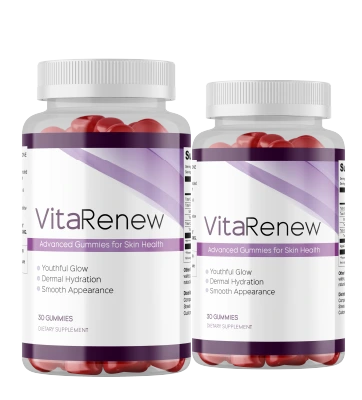
VitaRenew
A daily gummy built around the cofactors — vitamin C, copper, and zinc — that the skin's collagen assembly process actually depends on. FDA-registered, GMP-certified facility.
Try the 2-bottle starter. Same 60-day guarantee, same support.
60-day money-back guarantee · One-time purchase, no subscriptionWhat a realistic timeline looks like
I want to be honest about this part, because I went in with expectations that made the first six weeks feel like nothing was happening.
The outer surface of the skin turns over every four to six weeks. That's why you see changes in tan lines, surface texture, and overall tone fairly quickly when you change something. The dermis is slower. Collagen remodelling in the structural layer runs on months, which is why most controlled studies of skin-directed supplements run their measurements at eight to twelve weeks minimum.
Month one: I felt nothing I could confidently attribute to anything. Month two: the skin on the inner arm felt subtly different — slightly more resistance when I pinched it, less loose. I wasn't sure whether I was noticing it or inventing it. Month three: a photograph at an outdoor birthday party, arms visible, not posed or angled deliberately. When I looked at it afterward, the arms didn't look the way they had a year earlier.
That wasn't a dramatic transformation. It was a meaningful shift in something I'd been self-conscious about since losing the weight. The texture is still there. It's less pronounced. And I stopped choosing tops based on arm coverage in the spring of this year — which, for someone who'd done that habitually for two years, is the number that matters most.
"I lost forty-two pounds and my arms were the one thing I couldn't make peace with. A friend mentioned she'd been taking something for her skin and I looked into it. Around month two something shifted — the inner arm felt less papery when I touched it. By month four I'd stopped wearing long sleeves to hide them."
"I was skeptical because I'd tried creams and powders and nothing moved the needle. What I hadn't considered was whether the problem was in the layer those things actually reach. This felt different because the approach was different — working from the inside instead of the surface."
These statements reflect individual experiences. Results are not typical and will vary from person to person.
Starting without overcomplicating it
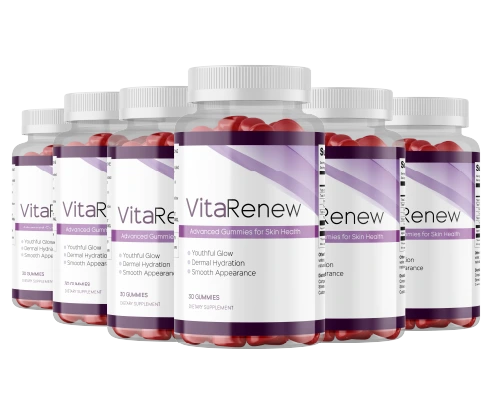
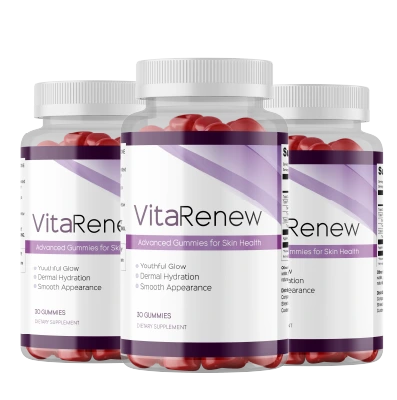
The formulation I found that matched this logic is called VitaRenew — a daily gummy with vitamin C, copper, zinc, plus vitamin E, selenium, and beta-carotene for antioxidant support. It's made in an FDA-registered, GMP-certified facility in the United States. It supports skin, hair, and nails — and it makes no claims about treating or reversing anything, because that would be dishonest and I wouldn't trust it if it did.
The 2-bottle option gave me two months to observe whether the approach was doing anything, with a 60-day money-back guarantee if it wasn't. That's how I started. It's the lowest-risk way to run the experiment.
If you're at the place I was — weight lost, arms not cooperating, tired of being told to moisturize and wait — this is where the conversation shifts from surface to structure. And that shift is what made the difference.
Where to start
VitaRenew
Vitamin C, copper, and zinc in a daily gummy. Supports the structural side of skin health. No autoship, 60-day guarantee.
The 2-bottle starter. A reasonable experiment with nothing to lose.
60-day money-back guarantee · One-time purchase, no subscription