Skin Health · Q&A
Can Low Vitamin D Cause Thin, Crepey Skin? Here's the Full, Honest Answer
It's a reasonable question — and a direct one. The short answer is: vitamin D has a real role in skin biology, but low levels alone don't explain the thin, papery texture that develops in the forties. The longer answer is more useful.

The question is direct and deserves a direct answer — so let's start there before we go deeper.
Can low vitamin D cause thin, crepey skin? The honest answer is: it can contribute, but it is not the primary driver, and correcting a deficiency alone rarely changes the texture significantly. Most women who've corrected a measured vitamin D deficiency and then checked their skin three months later already know this firsthand.
Understanding why that gap exists — between "vitamin D affects skin" and "fixing vitamin D fixes crepey skin" — turns out to be the most practically useful thing you can know about the subject.
What vitamin D actually does in skin biology
Vitamin D is not unimportant for the skin. The skin contains vitamin D receptors, and the research literature connects adequate D status to several aspects of skin function: the barrier's ability to hold moisture, the regulation of keratinocyte behaviour (the cells that form the outer layer), and immune activity in the skin.
Fibroblasts — the cells in the deeper dermis that manufacture collagen — also have vitamin D receptors. This is the connection that leads to the crepey skin question: if D receptors influence fibroblast activity, and fibroblasts make the structural proteins that keep skin firm, maybe vitamin D deficiency is driving the texture change.
It's a reasonable inference. The problem is that the evidence for a strong, direct causal link between low vitamin D and crepey texture is thin, while the evidence for other mechanisms — especially age-related and hormonal — is robust and well-established.
Vitamin D participates in skin biology as one of many regulators. The structural loss that produces crepey skin is driven by deeper, more dominant forces — and understanding those forces leads to more targeted choices.
The actual mechanism behind crepey skin after 40
Crepey skin is a change in the dermis — not the surface layer you moisturize, but the structural layer beneath it. The dermis is built from collagen fibres (giving skin thickness and tensile strength), elastin fibres (giving it springback), and molecules that attract and hold water between them.
Two processes converge in the forties to thin and loosen this scaffold.
The first is gradual: collagen production falls slowly from the mid-twenties onward, roughly one to two percent per year, accumulating quietly. By the mid-forties, the cumulative loss has become noticeable.
The second is more abrupt: estrogen actively supports collagen density and dermal thickness. As estrogen falls through perimenopause, collagen loss accelerates — research has documented a meaningful drop in dermal collagen content in the years immediately surrounding menopause. When the slow background decline and the estrogen-driven acceleration overlap, women experience the familiar "it happened so fast" sensation. It didn't happen fast — two loss curves intersected.
Vitamin D deficiency can sit alongside this process, but it is not the engine driving it. The engine is the structural and hormonal one above.
So why doesn't fixing vitamin D change the texture?
Because the bottleneck in the collagen assembly line — for most women over 40 — isn't vitamin D. It's the enzymatic machinery that converts amino acids into stable, properly cross-linked collagen fibres.
This machinery has two critical components, both of which are consistently underrepresented in skin supplement formulas and almost never discussed in articles about vitamin D and skin.
Vitamin C — the stabilizer the assembly line can't run without
Collagen's structural strength comes from its shape: three protein strands wound into a tight triple helix. That winding is performed by two enzymes — prolyl hydroxylase and lysyl hydroxylase — both of which are strictly dependent on vitamin C. Without sufficient vitamin C, these enzymes cannot form the helix correctly, and the collagen produced is unstable.
This isn't a supplement claim — it's the biochemical reason why scurvy causes connective tissue breakdown. You don't need severe deficiency for it to matter: marginal vitamin C status produces marginally weaker collagen output, and that compounds over years in a thinning dermis.
Copper — the element that binds the fibres together
Newly synthesized collagen and elastin fibres start as separate, unconnected threads. On their own they cannot form a resilient network. Cross-linking — the chemical bonding that ties fibre to fibre and creates a springy, interwoven mat — is performed by an enzyme called lysyl oxidase. Lysyl oxidase requires copper.
Without copper, the body can produce the collagen threads but cannot bind them. Imagine building a net where the strings are all made but never knotted together: you have the material, but not the function.
The gap here is striking: check the label of nearly any skin supplement and you'll find vitamin C — it's expected. Copper is almost never there. That omission is the most frequent single reason women supplement faithfully and see limited results.
Referenced in this article
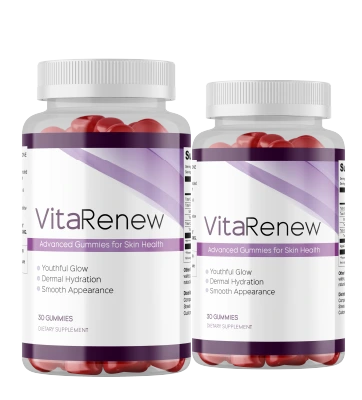
VitaRenew
Vitamin C, zinc and copper — the enzymatic cofactors the collagen scaffold depends on — in one daily gummy.
For women who've done the research and want a formula built around how the dermis actually works.
60-day money-back guarantee · One-time purchase, no subscriptionWhat to look for in a skin formula — the practical version
Given the above, the question shifts from "which vitamin am I missing?" to "does this formula address what the collagen process actually needs?" The answers are not the same question.
- Vitamin C at a meaningful dose. Token amounts added for label appeal don't support prolyl and lysyl hydroxylase at the level the dermis needs.
- Copper — specifically. This is the single most common omission in skin supplements, and the one with the most direct impact on whether synthesized fibres get properly bound.
- Zinc. Supports normal skin integrity and the continuous repair processes running in the dermis at all times.
- Antioxidant support (vitamin E, selenium, beta-carotene). Oxidative stress breaks down existing fibres while the body tries to build new ones — both need to be managed simultaneously.
- Verifiable manufacturing standards. FDA-registered facility, GMP certification, third-party testing.
- Honest timing claims. Dermal collagen remodels on months, not weeks. Any formula promising visible results in days is describing moisturizer effects, not structural change.
No. 1: VitaRenew
Of the formulas reviewed for this piece, VitaRenew is the one that most completely addresses the enzymatic side of collagen synthesis: vitamin C, zinc, and copper as its core, with vitamin E, selenium, and beta-carotene for antioxidant support. It's a daily gummy with no subscription — one-time purchase — made in an FDA-registered, GMP-certified facility and backed by a sixty-day money-back guarantee.
It supports skin, hair, and nails. It is not a treatment for any condition, and no responsible company would describe it as one.
What women who've tried it say
These are personal accounts, not clinical data. Outcomes vary with genetics, dietary baseline, sun history, and how far dermal changes have progressed.
"I'd been taking 5,000 IU of vitamin D for over a year, partly for the skin. Nothing changed. I read something about copper and collagen cross-linking and thought I'd never heard that before. Found VitaRenew, committed to three months. The skin on my chest looks better — not dramatically, but genuinely different. The texture isn't as papery. I'm staying with it."
"I wasn't expecting much — I'd been burned by other supplements. But the explanation about why copper matters specifically made sense to me, so I tried it. By two months my nails were stronger and the skin on my arms felt more resilient. By three months my husband noticed something was different without me saying anything."
These statements reflect individual experiences. Results are not typical and may vary based on age, diet, lifestyle, and other factors.
Quick-answer FAQ
Can low vitamin D deficiency directly cause crepey skin?
It can contribute at the margins — vitamin D receptors are present in the cells that produce collagen, and a serious deficiency may impair their function. But the primary drivers of crepey skin after 40 are age-related collagen decline and the hormonal changes of perimenopause, neither of which vitamin D primarily governs.
I fixed my vitamin D levels. Why hasn't my skin texture improved?
Because vitamin D was probably not the main bottleneck. The collagen assembly line also requires vitamin C to stabilize new collagen fibres, and copper to cross-link them into a resilient network. If those are missing, correcting vitamin D alone leaves the most rate-limiting steps unaddressed.
How long does it take to see a change from the right skin supplement?
The epidermis turns over in four to six weeks, so surface texture can shift first. Dermal remodelling is slower — most controlled studies measure outcomes at eight to twelve weeks. Give any formula a full three months before making a judgment, with a consistent photograph in neutral light as your benchmark.
A note on when to see a doctor. If a patch of skin changes suddenly, a spot changes shape or develops irregular edges, or any change is asymmetrical, that warrants evaluation by a dermatologist — it is not a supplement question. Crepey skin from normal aging is gradual and bilaterally symmetrical. If you are pregnant, nursing, on medication, or managing a health condition, speak with your healthcare provider before starting any supplement.
Product referenced above
VitaRenew
Vitamin C, zinc and copper in a daily gummy. Made in an FDA-registered, GMP-certified facility. 60-day guarantee.
The formula built around what the collagen assembly line is actually missing after 40.
60-day money-back guarantee · Supports skin, hair and nailsBackground reading
- Bikle DD. "Vitamin D and the skin: Physiology and pathophysiology." Reviews in Endocrine and Metabolic Disorders, 2012.
- Pullar JM, Carr AC, Vissers MCM. "The Roles of Vitamin C in Skin Health." Nutrients, 2017.
- Rucker RB et al. "Copper, lysyl oxidase, and extracellular matrix protein cross-linking." American Journal of Clinical Nutrition, 1998.
- Thornton MJ. "Estrogens and aging skin." Dermato-Endocrinology, 2013.
- Shuster S, Black MM, McVitie E. "The influence of age and sex on skin thickness, skin collagen and density." British Journal of Dermatology, 1975.